
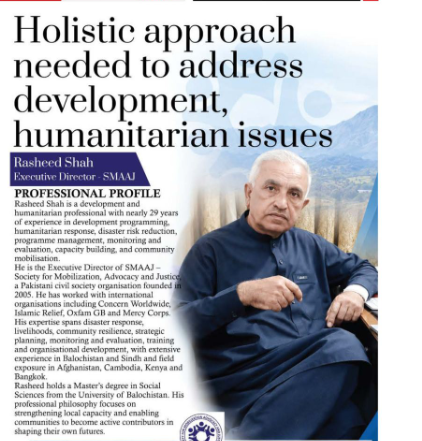

PROFESSIONAL PROFILE
Rasheed Shah is a development and humanitarian professional with nearly 29 years of experience in development programming, humanitarian response, disaster risk reduction, programme management, monitoring and evaluation, capacity building, and community mobilisation.
He is the Executive Director of SMAAJ – Society for Mobilization, Advocacy and Justice, a Pakistani civil society organisation founded in 2005. He has worked with international organisations including Concern Worldwide, Islamic Relief, Oxfam GB and Mercy Corps. His expertise spans disaster response, livelihoods, community resilience, strategic planning, monitoring and evaluation, training and organisational development, with extensive experience in Balochistan and Sindh and field exposure in Afghanistan, Cambodia, Kenya and Bangkok.
Rasheed holds a Master’s degree in Social Sciences from the University of Balochistan. His professional philosophy focuses on strengthening local capacity and enabling communities to become active contributors in shaping their own futures.
Q&A Section (Question & Answer)
Here is what he shared with Flare in an interview.
Flare: Kindly briefly introduce SMAAJ, its mission, and the communities it primarily serves.
Rasheed Shah: SMAAJ – Society for Mobilization, Advocacy and Justice is a Pakistani civil society organisation established in 2005. For more than two decades, it has worked with vulnerable and under-served communities, particularly in Balochistan and Sindh. Our mission is to strengthen communities to identify their priorities, build resilience and lead sustainable solutions. We believe development should be carried out with communities and led by them.
Flare: What are the organisation’s main areas of work and current programme priorities?
Rasheed Shah: SMAAJ works across humanitarian response, disaster risk reduction, climate resilience, livelihoods, WASH, health, gender, social protection, community mobilisation, advocacy and capacity development. Current priorities include locally led humanitarian action, climate and disaster resilience, sustainable livelihoods, women and youth empowerment, and stronger community and civil society institutions. We aim to connect emergency response with long-term development and resilience.
Flare: Which projects or interventions have created the strongest measurable impact in recent years?
Rasheed Shah: Our livelihoods programmes have produced tangible results by helping families move from short-term assistance towards income generation and greater economic independence.
Disaster risk reduction and anticipatory action programmes have also helped communities prepare before hazards become crises. Through more than 40 projects, SMAAJ has directly reached over 130,000 people while strengthening hundreds of community-based organisations.
Flare: What are the biggest social and development challenges currently facing the communities where SMAAJ works?
Rasheed Shah: Communities face interconnected challenges including poverty, unemployment, climate change, droughts and floods, limited livelihoods, inadequate health and education, gender inequality and weak infrastructure.
Climate change is intensifying these problems. Droughts, floods and other disasters can quickly destroy livelihoods. Communities therefore need not only emergency assistance but also resilience, preparedness and sustainable economic opportunities. Access can also be difficult due to security issues.
Flare: How does SMAAJ identify local needs and involve communities in programme planning and implementation?
Rasheed Shah: We start by listening. SMAAJ uses community consultations, assessments, focus groups, participatory approaches, surveys and direct field engagement to understand local realities. Communities help identify priorities, design interventions, implement, monitor and provide feedback.
Our experience shows that communities often understand their problems and solutions best. SMAAJ’s role is to facilitate, connect, strengthen and support that local capacity.
Flare: What role do women, youth and other vulnerable groups play in your programmes and decision-making processes?
Rasheed Shah: Women and young people are not simply beneficiaries; they are important partners and agents of change.
We promote their participation in consultations, community structures, training, livelihoods and leadership opportunities, while creating inclusive and safe spaces for women, youth and marginalised groups to influence decisions.
Flare: How do you measure the effectiveness, sustainability and long-term impact of your projects?
Rasheed Shah: We combine quantitative and qualitative approaches, using clear indicators, results frameworks, field verification, beneficiary feedback, assessments and lessons learned.
Sustainability requires more than achieving targets. We assess whether local institutions are strengthened, communities gain new skills, livelihoods continue, and local ownership remains after external support ends.
Flare: What are the main challenges faced by grassroots organisations in Pakistan today?
Rasheed Shah: A major challenge is that many grassroots organisations have strong community relationships but limited access to flexible, predictable and long-term funding.
Funding is often short-term and project-based, while community problems are long-term. Compliance, reporting and operational requirements are also increasingly demanding.
Flare: How important are partnerships with government, donors, civil society and the private sector to SMAAJ’s work?
Rasheed Shah: Partnerships are fundamental. No single organisation can address Pakistan’s complex development and humanitarian challenges alone. SMAAJ works with government institutions, development partners, international organisations, civil society networks and community organisations, while seeing strong potential for private-sector and philanthropic engagement.
Flare: What use does SMAAJ make of technology, digital communication and data in programme delivery and outreach?
Rasheed Shah: Technology is an important part of our systems. We use digital communication, electronic data collection, monitoring and reporting tools, financial management systems and online coordination. These tools improve accuracy, transparency and speed, particularly across geographically dispersed communities.
However, technology should support—not replace—human engagement. Data show what is happening, while listening to people helps us understand.
Flare: What are your key priorities and expansion plans for the next three to five years?
Rasheed Shah: Over the next three to five years, SMAAJ plans to strengthen and expand work in climate resilience, disaster risk reduction, anticipatory action, sustainable livelihoods, women and youth empowerment and locally led humanitarian response. We also aim to strengthen institutional systems, invest in organisational capacity and build strategic partnerships for more sustainable and flexible support. Our ambition is not simply to become larger, but stronger, more effective and more influential while remaining accountable to communities.
Flare: Finally, what message would you like to share with Flare readers about community development and social responsibility in Pakistan?
Rasheed Shah: Pakistan’s greatest resource is its people. Communities across the country have knowledge, skills, leadership and a strong willingness to improve their lives. What they often need is opportunity, investment, trust and partnership.
We should move from dependency towards empowerment, local leadership and shared responsibility. Government, civil society, businesses, donors and citizens all have a role to play. By investing in local communities and trusting them to lead solutions, we can build a Pakistan that is better prepared for crises and more inclusive, resilient and prosperous.


