

Introduction Paragraph
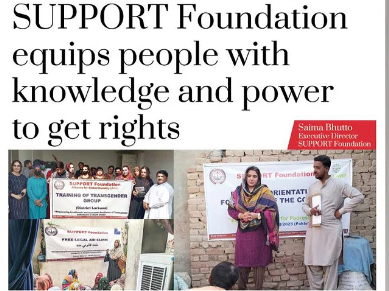
Saima Bhutto, the Executive Director of SUPPORT Foundation, provided insights about the organisation during an interview with Flare. She said that the mission of the SUPPORT Foundation is to protect human rights, gender equality, legal information, social and economic inclusion, community resilience, women’s empowerment, legal aid, protection, advocacy, and the inclusion of transgender individuals. The foundation envisions a peaceful, developed, and inclusive society in which all individuals can exercise their rights with dignity and equality.
Q&A Section (Question & Answer)
Flare: Kindly briefly introduce SUPPORT Foundation and its core mission.
Saima Bhutto: SUPPORT Foundation is a women-led, non-profit, non-political and non-religious organisation working in Sindh since 2010. Based in Shikarpur, it supports vulnerable and marginalised communities across the province.
Its mission focuses on human rights, gender equality, legal information, social and economic inclusion, community resilience, women’s empowerment, legal aid, protection, advocacy and transgender inclusion. Its vision is a peaceful, developed and inclusive society where everyone can exercise their rights with dignity and equality.
Flare: What inspired you to establish SUPPORT Foundation, and how has it evolved?
Saima Bhutto: SUPPORT Foundation was established in 2010 in Shikarpur amid poverty, tribal conflict, displacement and devastating floods. Its founders believed communities needed more than assistance—they needed the knowledge and power to get their rights. It has evolved into a broader rights-based organisation serving women, girls, transgender people and other marginalised communities through legal and economic empowerment, protection, documentation, advocacy, climate resilience and emergency response.
Flare: What are the major challenges facing women, girls, transgender communities and other vulnerable groups in Pakistan?
Saima Bhutto: Major challenges include poverty, gender inequality, social exclusion, GBV, limited access to justice, child marriage, girls’ education, economic exclusion, lack of identity documents and climate-related displacement. Transgender people also face discrimination, violence, family rejection and barriers to employment, healthcare and social protection. These challenges require community-led solutions combining legal empowerment, protection, economic opportunities, documentation and climate resilience.
Flare: Which key programmes and grassroots initiatives is SUPPORT Foundation implementing?
Saima Bhutto: SUPPORT Foundation follows a community-led, rights-based approach focused on vulnerable and excluded groups.
Key programmes include women’s legal empowerment and GBV prevention; vocational training and livelihoods for women and girls; transgender people inclusion and CNIC support; documentation and social protection; community advocacy; and humanitarian and climate-resilience assistance, including food, water, healthcare, livelihoods and WASH.
Flare: Could you share some of SUPPORT Foundation’s key achievements and impact?
Saima Bhutto: Since 2010, SUPPORT Foundation has:
Provided legal awareness to more than 1,300 women and legal advice to more than 400.
Supported vocational initiatives for 400 rural women and adolescent girls.
Helped transgender people obtain CNICs, access social protection and pursue livelihoods.
Provided educational materials to 200 newly enrolled girls in four rural Shikarpur schools.
Supported flood- and climate-affected households through humanitarian assistance, livelihoods, housing, water and sanitation.
Helping transgender people obtain CNICs is particularly significant, as legal identity can unlock welfare, banking, employment and public services.
Flare: How does SUPPORT Foundation identify communities most in need and ensure interventions are relevant and sustainable?
Saima Bhutto: We use participatory, evidence-based assessments, prioritising communities facing poverty, exclusion, gender inequality, displacement, disaster vulnerability and limited access to services. Through consultations, focus groups, household assessments and field visits, communities help shape programmes, implementation and monitoring. Sustainability comes through local capacity-building, community partnerships and links to government services and social protection.
Flare: What role do advocacy, awareness, education and community participation play in your work?
Saima Bhutto: They are central to our approach. Sustainable change requires knowledge, confidence and a collective voice. We conduct advocacy and awareness on GBV, legal rights, social protection, health, education and discrimination, while education and skills development help communities make informed decisions and advocate for themselves.
Our goal is to move communities from awareness to action, exclusion to participation and dependency to empowerment.
Flare: How important are partnerships with government, donors, civil society, media and the private sector?
Saima Bhutto: Partnerships are essential. Government enables access to identity documents, social protection, justice, health and other services. Donors provide resources and technical support, while civil society strengthens outreach and advocacy.
Media can amplify marginalised voices, while the private sector can support skills, employment, technology and livelihoods. Together, these partnerships strengthen local ownership and sustainability.
Flare: What are the main funding and operational challenges faced by grassroots organisations in Pakistan?
Saima Bhutto: Grassroots organisations face limited and unpredictable funding, complex compliance requirements and difficult operating environments.
Short-term funding makes staff retention, community engagement and long-term planning difficult, while foreign-funded projects can involve EAD procedures, approvals and extensive documentation. Other challenges include limited institutional resources, donor access, social resistance, security concerns and growing climate pressures.
Flare: What are SUPPORT Foundation’s priorities and expansion plans?
Saima Bhutto: Our priorities include:
Women’s protection and justice: Legal aid, rights awareness and referrals.
Transgender people inclusion: CNICs, social protection, livelihoods and leadership.
Women’s economic empowerment: Skills, entrepreneurship and market access.
Civic participation: Greater involvement of women and marginalised groups in governance.
Climate resilience: Disaster preparedness, WASH, resilient housing and livelihoods.
Geographic expansion: Reaching under-served communities in North Sindh.
Institutional sustainability: Strengthening fundraising, monitoring, safeguarding, finance and staff capacity.
Flare: As Executive Director, what has been your personal experience leading work with vulnerable communities?
Saima Bhutto: Since 2010, I have worked with women, girls, transgender people, poor families and other excluded communities in underserved areas of Sindh. The key lesson is that people need more than charity—they need dignity, information, opportunities and the ability to claim their rights. We listen first and develop solutions with communities.
Flare: What message would you like to share with Flare readers, policymakers, donors and potential partners?
Saima Bhutto: If we want a more peaceful, inclusive and developed Pakistan, no one should be left behind. Women, girls, transgender people and other marginalised communities are rights-holders, contributors and potential leaders. Policymakers should strengthen inclusive laws and services, while donors should invest in grassroots organisations through flexible, multi-year funding and capacity building. I also encourage civil society, media and the private sector to create opportunities for marginalised communities. At SUPPORT Foundation, we remain committed to working alongside communities—not speaking for them, but listening to them and creating space for them to lead.


