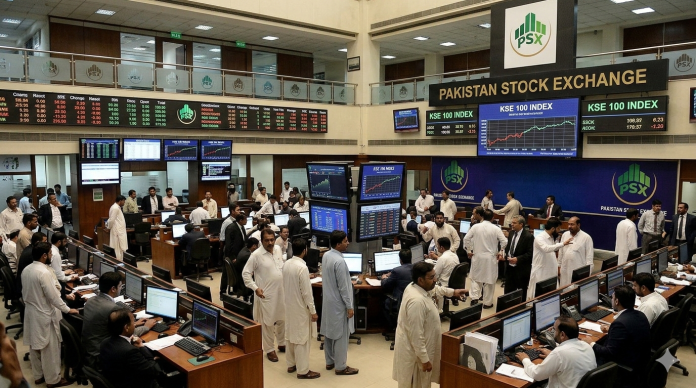

Trading at the Pakistan Stock Exchange (PSX) was suspended minutes after the market opened on Monday, following a dramatic plunge in the benchmark index. Panic selling gripped investors as escalating geopolitical tensions and rising global risk aversion sparked one of the sharpest intraday declines in the exchange’s history.
The benchmark KSE-100 Index tumbled 15,345 points, or 9.13%, dropping to 152,717 within minutes of the 9:16 a.m. opening. The steep fall triggered an automatic trading halt under exchange regulations designed to curb extreme volatility and prevent disorderly market conditions.
By 9:22 a.m., the index had marginally recovered but was still down 15,071 points, or 8.97%, hovering around 152,991. The sudden collapse marked one of the most severe single-day intraday declines ever recorded by the index.
Broad-Based Selling Across Indices
The selloff was not confined to the KSE-100 alone. The KSE All Share Index fell 8.49%, reflecting widespread weakness across the broader market. The KSE-30 Index dropped 9.69%, mirroring heavy losses among leading blue-chip companies.
Shariah-compliant indices also faced significant pressure. The KMI-30 declined 9.67%, while the KMI All Share Index fell 8.99%. Meanwhile, the PSX Dividend 20 Index shed 9.10%, indicating that even traditionally stable, dividend-paying stocks were caught in the downturn.
The synchronized drop across multiple indices highlighted the broad-based nature of the market rout, with virtually all sectors and investor segments impacted.
Geopolitical Fears Rattle Investors
The sharp decline comes amid heightened geopolitical tensions in the Middle East, particularly involving Iran. The escalating conflict has unsettled global financial markets and prompted investors to shift capital toward safer assets such as gold and US government bonds.
Global risk aversion has intensified in recent sessions, and emerging markets like Pakistan have borne the brunt of investor caution. Persistent foreign capital outflows, weakening corporate earnings momentum, and already cautious investor positioning have further amplified the downward pressure on equities.
The combination of external shocks and domestic vulnerabilities created a perfect storm for a steep market correction.
Heavyweight Stocks Lead the Fall
The selloff was largely driven by heavyweight constituents of the index. Major companies such as Fauji Fertilizer Company (FFC), United Bank Ltd. (UBL), Engro Holdings (ENGROH), Oil & Gas Development Company (OGDC), and Meezan Bank (MEBL) accounted for a substantial portion of the index-point erosion.
Among individual stocks, YOUW recorded the steepest decline, plunging 17.66%. CNERGY followed with a drop of 10.14%, while UNITY fell 10.03%. Both DHPL and SSGC also lost just over 10%, reflecting widespread investor exits.
Only a handful of stocks showed marginal resilience. PGLC edged up 0.15%, while TPLRF1 and MEHT remained flat. SHFA slipped slightly by 0.03%, and PSEL declined 0.82%, underscoring the overwhelmingly negative market breadth.
Sector-Wise Impact
Sectoral performance reflected the depth of the downturn. Commercial Banks, Fertilizer, Oil & Gas Exploration Companies, Cement, and Investment Banks and Securities Companies contributed most significantly to the decline.
Defensive sectors offered little support. Leasing Companies, Close-End Mutual Funds, Synthetic & Rayon, Leather & Tanneries, and Textile Spinning posted limited gains, but these were insufficient to offset the broader market slide.
The widespread sectoral losses emphasized the systemic nature of the selloff rather than isolated weakness in specific industries.
Trading Suspension and Reopening Plan
Following the automatic suspension, the exchange announced that trading would resume in phases. A pre-open session was scheduled for 10:22 a.m., with the official reopening set for 10:27 a.m., allowing investors time to reassess positions amid heightened volatility.
Market participants will be closely monitoring global developments and investor sentiment in the coming sessions. The extent of recovery will largely depend on easing geopolitical tensions and stabilization in international markets.
For now, the historic plunge serves as a stark reminder of the sensitivity of emerging markets to global shocks and the speed with which investor sentiment can shift during times of uncertainty.
Read More
Pakistan Eyes Saudi Oil Supplies if Strait of Hormuz Remains Closed