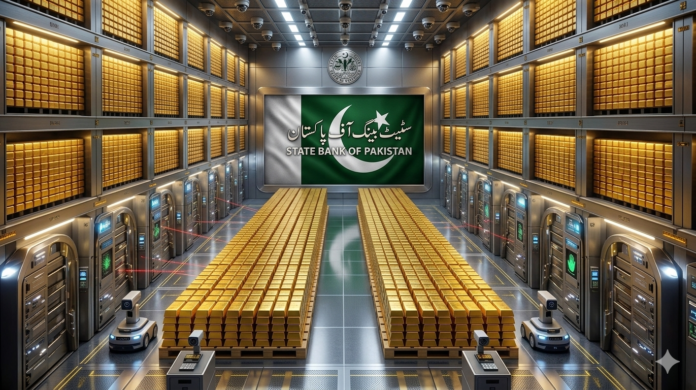

RISING GLOBAL TENSIONS SPARK DEBATE OVER RESERVE STRATEGY
Growing geopolitical tensions and uncertainty in global markets have reignited a critical debate over how countries should manage their foreign exchange reserves. For Pakistan, this discussion has become increasingly relevant as concerns mount over the long-term stability of the US dollar. Analysts and market observers are now questioning whether the country should gradually shift its reserve strategy toward gold as a safer and more stable asset.
The idea is not entirely new, but recent developments in global politics, particularly rising tensions in key regions, have added urgency to the conversation. As economic risks increase, the need for a more resilient and diversified reserve strategy is becoming harder to ignore.
WHY THE DOLLAR IS UNDER PRESSURE
The US dollar has long been the backbone of the global financial system, serving as the primary reserve currency for most countries. However, ongoing geopolitical conflicts and rising fiscal pressures are beginning to challenge its dominance.
Heavy government spending, particularly during times of conflict, can lead to increased debt and monetary expansion. Over time, this may weaken confidence in the currency, especially if inflation rises or economic growth slows. When global investors begin to question the stability of the dollar, countries that rely heavily on it for reserves may face increased vulnerability.
For Pakistan, which holds a significant portion of its reserves in dollars, this creates a strategic dilemma. Continuing to depend on a potentially volatile currency could expose the economy to external shocks.
GOLD AS A SAFE HAVEN IN UNCERTAIN TIMES
Gold has historically been viewed as a safe-haven asset, especially during periods of economic instability and geopolitical uncertainty. Unlike fiat currencies, gold is not tied to any single economy or government, making it a reliable store of value in turbulent times.
Central banks around the world have been increasing their gold holdings in recent years, reflecting a growing shift toward diversification. This trend highlights the importance of reducing reliance on a single currency and spreading risk across multiple assets.
For Pakistan, increasing gold reserves could provide a buffer against global financial instability. It offers protection against currency depreciation and helps maintain confidence in the country’s financial position.
LEGAL AND POLICY FRAMEWORK SUPPORTS GOLD PURCHASES
Pakistan has the legal authority to buy and hold gold as part of its reserve strategy. The central bank is empowered to deal in gold bullion and other precious metals, allowing it to adjust its asset composition based on economic conditions.
This means that increasing gold holdings would not violate any legal provisions or international obligations. However, reserve management involves more than just legality. It requires careful consideration of liquidity, trade requirements, and financial commitments.
While gold provides long-term stability, it is less liquid compared to foreign currencies. This makes it less suitable for meeting immediate financial needs, such as imports or debt repayments.
CURRENT GOLD RESERVES AND RECENT TRENDS
Pakistan already holds a notable amount of gold as part of its reserves. In recent years, there has been a gradual increase in gold accumulation, reflecting a cautious shift toward diversification.
This trend aligns with global patterns, where central banks have significantly increased their gold purchases. The sustained demand for gold at the institutional level indicates a broader reassessment of traditional reserve strategies.
Despite this progress, gold still represents a smaller portion of Pakistan’s overall reserves compared to foreign currencies. This highlights the need for a balanced approach that considers both stability and liquidity.
IMPACT OF GLOBAL CONFLICTS ON FINANCIAL MARKETS
Geopolitical tensions have far-reaching effects on financial markets, particularly when they involve key regions that influence energy supply and trade routes. Any disruption in these areas can lead to increased volatility in oil prices, currency markets, and global trade.
For countries like Pakistan, which are heavily dependent on energy imports, such disruptions can have significant economic consequences. Rising energy costs can increase inflation, strain foreign reserves, and weaken the national currency.
In this context, gold serves as a hedge against these risks. Its value often rises during periods of uncertainty, providing a counterbalance to losses in other assets.
THE CASE FOR DIVERSIFICATION RATHER THAN COMPLETE SHIFT
While the idea of moving entirely from dollar reserves to gold may seem appealing in times of uncertainty, it is not a practical solution. Reserve management requires a careful balance between risk, return, and liquidity.
A complete shift to gold would limit the central bank’s ability to conduct international transactions, as most global trade is still conducted in dollars. It would also reduce flexibility in responding to short-term financial needs.
Instead, a gradual diversification strategy may be more effective. By increasing the share of gold in its reserves while maintaining sufficient dollar holdings, Pakistan can achieve a balance between stability and usability.
CHALLENGES IN RESTRUCTURING RESERVE COMPOSITION
Adjusting a country’s reserve composition is a complex process that involves multiple economic considerations. Factors such as exchange rate stability, trade obligations, and external debt repayments must all be taken into account.
Additionally, sudden changes in reserve strategy can send signals to global markets, potentially affecting investor confidence. This makes it essential for policymakers to proceed cautiously and communicate their intentions clearly.
The transition toward a more diversified reserve portfolio must be gradual and well-planned to avoid unintended consequences.
THE FUTURE OF RESERVE MANAGEMENT IN A CHANGING WORLD
As the global economic landscape continues to evolve, traditional approaches to reserve management are being reexamined. The increasing role of gold, along with other alternative assets, reflects a shift toward more resilient financial strategies.
For Pakistan, this presents an opportunity to strengthen its economic foundations and reduce vulnerability to external shocks. By adopting a forward-looking approach, the country can better navigate the uncertainties of the global economy.
The key lies in balancing innovation with caution, ensuring that any changes to reserve strategy are both effective and sustainable.
CONCLUSION: STRIKING THE RIGHT BALANCE BETWEEN GOLD AND DOLLAR
The debate over whether Pakistan should abandon the dollar in favor of gold highlights the broader challenges of managing financial stability in an uncertain world. While gold offers undeniable advantages as a safe-haven asset, the dollar remains essential for global trade and liquidity.
Rather than choosing one over the other, a balanced approach that combines the strengths of both assets is likely to be the most effective strategy. By gradually increasing gold holdings while maintaining adequate dollar reserves, Pakistan can enhance its financial resilience without compromising its economic flexibility.
In a world shaped by rapid change and rising uncertainty, the ability to adapt and diversify will be key to long-term stability and success.
Read More
Why Corporate Credit Cards Remain Rare in Pakistan’s Banking Sector