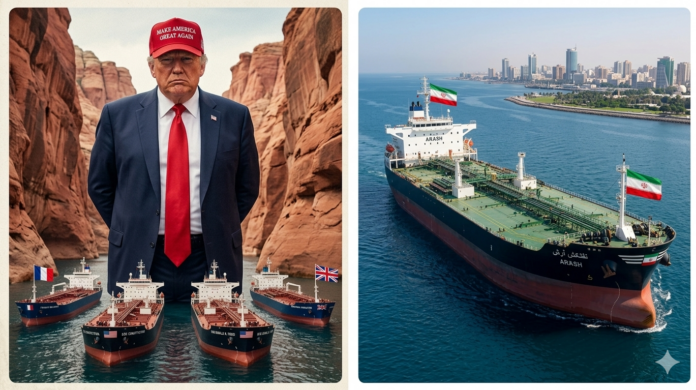

A DRAMATIC ESCALATION IN US-IRAN TENSIONS
The geopolitical landscape has shifted dramatically as the United States begins enforcing a full-scale naval blockade targeting Iran’s maritime activity. This move, ordered under a strict deadline, marks one of the most aggressive actions taken in recent years against Tehran and signals a sharp escalation in already strained relations between the two nations.
The blockade aims to control and restrict all maritime traffic entering and exiting Iranian ports. Military assets have been deployed across key shipping corridors, with operations focused on monitoring, intercepting, and potentially halting vessels linked to Iran. This development has instantly raised alarm across global markets and diplomatic circles, as the consequences extend far beyond the region.
The decision reflects a strategic attempt to pressure Iran into concessions, particularly regarding its nuclear ambitions and its influence across the Middle East. However, the move has also triggered immediate backlash, setting the stage for a potentially dangerous confrontation at sea.
MILITARY OPERATIONS BEGIN ACROSS STRATEGIC WATERS
Naval forces have already initiated active operations in critical maritime zones. These operations are designed to establish dominance over vital sea lanes that serve as Iran’s economic lifeline. The presence of warships, surveillance systems, and enforcement mechanisms has increased significantly, signaling that the blockade is not symbolic but operationally robust.
The objective is clear: restrict Iran’s ability to engage in international trade through maritime routes. By doing so, the United States seeks to exert maximum economic pressure without initiating a direct ground conflict. However, such measures carry inherent risks, especially in congested and strategically sensitive waterways.
The deployment has effectively turned major shipping routes into high-risk zones. Commercial vessels, oil tankers, and cargo ships operating near Iranian waters are now navigating under heightened uncertainty. Insurance costs for maritime transport are expected to surge, while shipping companies may reconsider routes altogether.
A STRATEGY FOCUSED ON MAXIMUM PRESSURE
The blockade is part of a broader strategy centered on applying intense economic and political pressure. By limiting Iran’s access to global markets via sea, the United States aims to weaken Tehran’s economic stability and force policy changes.
This approach echoes earlier sanctions-driven campaigns but goes a step further by physically enforcing restrictions. The expectation is that sustained pressure will compel Iran to return to negotiations under terms more favorable to Washington.
However, critics argue that such tactics may backfire. History has shown that aggressive measures can harden positions rather than soften them. Instead of yielding, Iran may respond by escalating its own actions, potentially targeting regional interests or disrupting global energy supplies.
IRAN RESPONDS WITH STRONG WARNINGS
Iran has reacted swiftly and forcefully to the blockade, condemning it as a violation of international law. Officials have described the move as an act of maritime aggression, warning that interference with Iranian vessels in international waters constitutes piracy.
The rhetoric coming from Tehran indicates that the situation could quickly spiral if enforcement actions lead to direct confrontations. Iranian authorities have made it clear that they will not accept restrictions on their maritime rights and are prepared to respond if necessary.
This stance raises concerns about potential clashes between naval forces. Even a minor incident at sea could escalate into a broader conflict, drawing in additional regional and global actors.
DIPLOMATIC EFFORTS COLLAPSE AMID RISING TENSIONS
Adding to the volatility is the collapse of recent diplomatic efforts between the two sides. Talks that had been underway in an attempt to ease tensions have now broken down completely.
Iranian officials have attributed the failure of negotiations to what they describe as unrealistic demands and shifting conditions imposed by the United States. The timing of the blockade, introduced during ongoing diplomatic engagement, has further deepened mistrust.
The breakdown of dialogue eliminates a crucial channel for de-escalation. Without active negotiations, the likelihood of misunderstandings and miscalculations increases significantly. Diplomatic isolation, combined with military pressure, creates an environment where conflict becomes more probable.
REGIONAL CONFLICT EXPANDS BEYOND THE GULF
The situation is not confined to maritime tensions alone. The broader region is witnessing a surge in military activity, further complicating an already fragile security environment.
In southern Lebanon, intensified clashes have been reported as military operations target armed groups in the area. Strategic locations and access routes have become focal points of control, indicating a widening scope of conflict beyond the immediate US-Iran standoff.
This expansion underscores the interconnected nature of regional tensions. Actions taken in one area can trigger reactions elsewhere, creating a chain effect that destabilizes multiple fronts simultaneously. The risk of a multi-theater conflict is becoming increasingly real.
GLOBAL ECONOMIC IMPLICATIONS INTENSIFY
The economic impact of the blockade is already beginning to surface. Energy markets are particularly sensitive to disruptions in the region, given its critical role in global oil supply.
Any restriction on Iranian exports, combined with increased risks to shipping routes, could lead to significant price volatility. Rising energy costs would have ripple effects across global economies, affecting industries, transportation, and consumer prices.
Trade routes passing near the affected zones may also experience delays or rerouting, increasing operational costs for international businesses. The uncertainty surrounding maritime security could further strain supply chains that are still recovering from previous global disruptions.
RISING RISK OF DIRECT CONFRONTATION
Perhaps the most concerning aspect of the situation is the growing risk of direct military confrontation. The presence of armed naval forces operating in close proximity increases the chances of incidents that could escalate rapidly.
Warnings issued regarding the treatment of approaching vessels highlight the seriousness of enforcement measures. Any miscalculation, whether intentional or accidental, could trigger a chain reaction leading to open conflict.
The absence of diplomatic engagement further amplifies this risk. Without communication channels, even minor encounters could be misinterpreted, resulting in disproportionate responses.
A CRITICAL MOMENT FOR GLOBAL STABILITY
The initiation of a full-scale naval blockade marks a defining moment in the evolving geopolitical landscape. It reflects a shift toward more aggressive tactics aimed at achieving strategic objectives but also introduces significant uncertainty and danger.
The coming days and weeks will be crucial in determining how the situation unfolds. Much will depend on how both sides manage their responses and whether any efforts are made to reopen diplomatic channels.
For now, the world watches closely as tensions rise, aware that the consequences of this confrontation could extend far beyond the immediate region. The balance between pressure and provocation remains delicate, and the margin for error continues to shrink.
Read More
FBR Approves Use of Seized Luxury Cars for Anti-Smuggling Operations