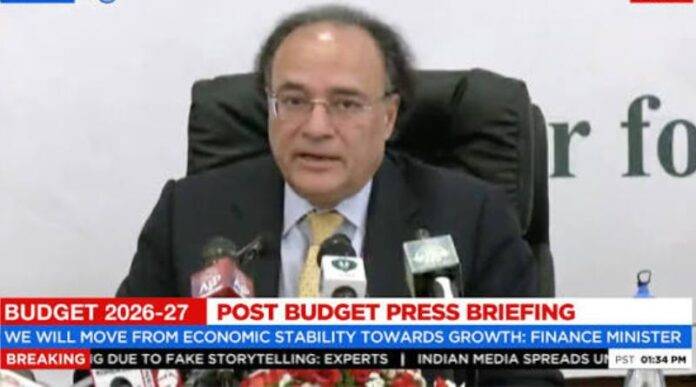

Pakistan has spent a long time trying to bring stability to its economy. For years, the government, businesses, and ordinary people have faced problems such as high inflation, rising costs, weak investment, pressure on foreign exchange reserves, and repeated concerns about the country’s financial position. Now, according to Finance Minister Muhammad Aurangzeb, the focus needs to change.
The country has worked hard to move away from economic uncertainty and create a more stable base. The next step, he says, should be growth.
Aurangzeb’s message is simple: Pakistan cannot remain focused on economic stability forever. Stability is important, but it should be used as a foundation for stronger economic activity, more investment, better exports, and new jobs.
The government now wants to move towards a stage where the economy can grow at a faster and more sustainable pace. This shift is important because economic growth is needed to improve living standards and create better opportunities for people across the country.
From Stability to Economic Growth
Pakistan has faced several difficult economic periods in recent years. Rising prices, a shortage of dollars, pressure on the rupee, high borrowing costs, and large government expenses have made it difficult for businesses and households to plan for the future.
In such a situation, controlling the economy becomes the first priority. Governments usually focus on reducing pressure on foreign exchange reserves, managing inflation, improving tax collection, and keeping government spending under control.
These steps can be painful, especially for ordinary people. When the government takes measures to reduce economic pressure, businesses may also face higher costs and consumers may have less money to spend.
However, stability provides an important base for the next stage.
Aurangzeb believes Pakistan has now reached a point where the country should look beyond simply avoiding another economic crisis. The government wants to create conditions in which businesses can expand, investors can make long-term plans, and industries can increase production.
The idea is not to ignore stability. Instead, stability should support growth.
Why Growth Matters for Pakistan
Economic growth is not just about increasing a number in government reports. For ordinary Pakistanis, stronger growth should mean more jobs, better salaries, greater business activity, and improved opportunities.
A growing economy can also increase government revenues. When companies sell more products, hire more workers, and earn higher profits, the government can collect more taxes. This can provide additional money for schools, hospitals, roads, energy projects, and other public services.
Growth can also help Pakistan reduce its dependence on borrowing.
For many years, the country has faced a gap between what it earns from exports and what it needs to pay for imports and other external obligations. Stronger exports can help reduce this pressure.
This is why the government is expected to give greater attention to sectors that can earn foreign exchange and create employment.
Exports Need a Bigger Role
One of the major challenges for Pakistan is its export performance. The country needs to sell more goods and services to international markets if it wants stronger and more reliable foreign exchange earnings.
Traditional exports such as textiles remain important, but Pakistan has opportunities in several other areas.
Information technology is one major example. Pakistani software companies, freelancers, and technology workers already provide services to customers around the world. With better internet access, training, payment systems, and support for technology businesses, this sector could grow further.
Agriculture and food processing also have large potential. Pakistan produces many crops and agricultural products, but a greater share of these products could be processed and sold as higher-value goods.
Manufacturing is another important area. If local industries become more productive and competitive, Pakistan can produce more goods for both local consumers and foreign buyers.
The shift towards growth will therefore require more than government spending. It will require businesses to become stronger and more competitive.
Investment Is Key
No economy can achieve strong growth without investment.
Pakistan needs investment in factories, technology, energy, transport, agriculture, housing, and other areas. Both local and foreign investors need confidence that they can operate their businesses without facing unnecessary delays or sudden changes.
Investors also want clear rules and a stable business environment.
If a company believes that policies can change without warning, it may hesitate before putting large amounts of money into a new project. This can slow economic activity and reduce job creation.
For this reason, policy consistency will be very important as Pakistan moves from stability towards growth.
The government will need to make it easier for businesses to start and expand. This includes reducing unnecessary paperwork, improving government services, speeding up approvals, and making regulations easier to understand.
The Private Sector Must Lead
The government alone cannot create sustainable economic growth.
The private sector has a major role to play in expanding production, creating jobs, increasing exports, and bringing new ideas into the market.
For this to happen, businesses need access to finance and a predictable economic environment. Small and medium-sized businesses especially need support because they employ a large number of people across Pakistan.
Banks and financial institutions can also play an important role by providing loans for productive business activity rather than focusing mainly on safer government lending.
A stronger private sector can help Pakistan build an economy that depends less on government spending and borrowing.
Reforms Cannot Be Ignored
Moving towards growth does not mean that economic reforms can be forgotten.
Pakistan still has several structural problems that need attention. The tax system needs improvement, government-owned companies require changes, energy sector problems must be addressed, and public spending needs to become more effective.
Tax collection is particularly important.
Pakistan has historically collected a relatively small amount of tax compared with the size of its economy. A wider tax base can help the government raise more revenue without placing an unfair burden on people who already pay taxes.
At the same time, tax reforms need to be fair and simple. Complicated rules can encourage businesses to remain outside the formal economy.
Bringing more businesses and individuals into the documented economy can help increase government revenue and improve economic planning.
Energy Costs Remain a Major Challenge
Energy is another important issue for Pakistan’s growth plans.
Industries need reliable electricity and gas at reasonable prices. If energy costs are too high, Pakistani products become more expensive in international markets.
This makes it difficult for local companies to compete with businesses from other countries.
Pakistan therefore needs to improve the efficiency of its energy system. Reducing losses, improving distribution, increasing the use of suitable local energy sources, and dealing with payment problems across the energy chain can help.
Cheaper and more reliable energy can support industrial growth and make exports more competitive.
Inflation Still Matters
Although the government may now be more focused on growth, inflation remains a major concern for ordinary Pakistanis.
People cannot feel the benefits of economic progress if food, electricity, transport, housing, and other basic expenses continue to rise too quickly.
This is why the transition from stability to growth must be carefully managed.
Fast economic growth that creates fresh inflationary pressure would not provide a lasting solution. Pakistan needs growth that is steady and supported by higher production, stronger exports, and greater investment.
In other words, the goal should not simply be to spend more money. The goal should be to produce more goods and services and create real economic value.
Better Business Conditions
Pakistan also needs to make doing business easier.
Entrepreneurs often face delays in registration, taxation, licensing, land matters, imports, exports, and other government processes. Such problems can increase costs and discourage investment.
Digital government services can help reduce these difficulties.
If business owners can complete more processes online, receive clear information, and track applications without visiting different offices, it can save both time and money.
A simpler business environment can encourage more people to invest in formal businesses instead of keeping their activities small or informal.
Agriculture Can Support Growth
Agriculture remains a major part of Pakistan’s economy and provides income to millions of people.
However, the sector faces problems such as low productivity, water shortages, outdated farming methods, poor storage, and limited access to modern technology.
Improving agriculture can have a major impact on economic growth.
Farmers need better seeds, modern equipment, improved irrigation methods, training, storage facilities, and access to markets. Food processing can also create additional value.
Instead of exporting only raw agricultural products, Pakistan can increase earnings by processing them into finished or semi-finished goods.
This can create jobs in rural areas and improve farmers’ incomes.
Technology Offers New Opportunities
Technology can also help Pakistan move into a stronger growth phase.
The global digital economy provides opportunities that do not always require huge physical infrastructure. Pakistani freelancers and technology companies can sell services to customers in different countries while operating from Pakistan.
To take advantage of this opportunity, the country needs better digital infrastructure, reliable internet, technical education, and easy international payment systems.
Young people can become an important part of this growth story if they receive the right skills.
Pakistan has a large young population, which can become an economic advantage if young people have access to quality education, vocational training, and employment opportunities.
Growth Must Reach Ordinary People
One of the biggest questions surrounding the shift towards growth is whether ordinary Pakistanis will actually benefit.
Economic growth is meaningful when its benefits reach households.
If the economy grows but job opportunities remain limited, wages stay weak, and the cost of living remains high, people may not feel that the country is moving forward.
Therefore, growth needs to be broad-based.
Small businesses, farmers, workers, young people, and middle-income families should all have opportunities to benefit from improving economic conditions.
Job creation should remain one of the main goals of economic policy.
A Long-Term Approach Is Needed
Pakistan has often faced a cycle in which economic pressure becomes serious, emergency steps are taken, stability improves for a period, and then new problems appear.
Breaking this cycle will require a long-term approach.
The country needs policies that remain in place even when political conditions change. Investors and businesses need confidence that economic rules will not be changed repeatedly.
Long-term planning is especially important for infrastructure, energy, education, exports, and industrial development.
A country cannot build a strong economy in a few months. Progress requires consistent work over several years.
What Aurangzeb’s Message Means
Aurangzeb’s statement that Pakistan is now ready to move from stability towards growth reflects a change in the government’s economic focus.
The message is that the country has spent enough time dealing with immediate financial risks and now needs to build a stronger economy.
But the transition will not be easy.
Pakistan still faces serious challenges, including high debt, energy sector problems, a narrow tax base, low exports, weak productivity, and pressure on household budgets.
The real test will be whether the government can turn economic stability into practical improvements for businesses and citizens.
If investment increases, exports improve, industries expand, and jobs are created, the shift could mark an important stage for Pakistan’s economy.
The Road Ahead
Pakistan now has an opportunity to build on the stability it has worked to achieve.
The next phase should focus on production, investment, exports, jobs, technology, and private-sector growth. Government reforms will also need to continue so that the economy becomes stronger and less vulnerable to repeated crises.
For ordinary Pakistanis, the hope is simple: a stronger economy should eventually mean better jobs, more stable incomes, lower financial pressure, and improved living standards.
The country cannot afford to remain trapped between repeated economic crises and short-term solutions.
Stability was necessary, but it is not the final destination.
As Finance Minister Muhammad Aurangzeb has indicated, Pakistan now needs to use that stability as a starting point for growth. The challenge is to make that growth steady, productive, and broad enough to benefit people across the country.
If Pakistan can successfully make this transition, the coming years could bring a more balanced economy with stronger businesses, higher exports, greater investment, and more opportunities for its people.
Read Also: check