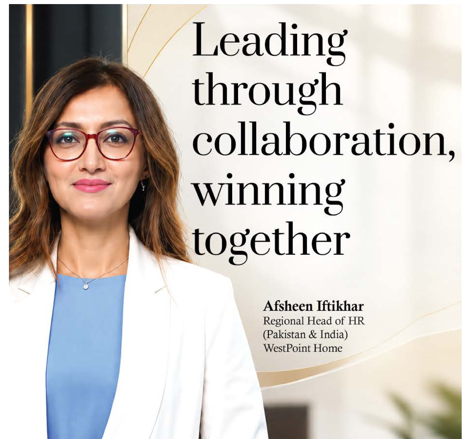

Afsheen Iftikhar
Regional Head of HR (Pakistan & India)
WestPoint Home
Pull Quote:
“The Flare panel conversed with Afsheen Iftikhar, who serves as the Regional Head of HR for Pakistan and India at WestPoint Home. She explains that she completed an MBA in HR, during which she received a gold medal, and has since applied her knowledge in her professional role. This unique blend of expertise has enabled her to identify her strongest contributions: merging insights about technology and integrated systems with the human aspects of business”
Interview Transcript
Flare: What drew you to HR, and which experiences shaped your leadership journey?
Afsheen Iftikhar: I began as an IT engineer after completing my BCS Hons. from Pak-AIMS. While working full-time, I pursued an MBA in HR, earning a gold medal and applying my learning at work. This combination helped me recognise where I could contribute most: bringing technology and integrated systems together with the human side of business. Developing people has always mattered to me, helping them find direction, solve problems and become independent. I moved into HR deliberately to build on that strength. My technical foundation still shapes my approach: understand the system, understand the person and develop solutions that help both perform better.
Flare: How did your experience across operations and regional HR shape your leadership?
Afsheen Iftikhar: A defining lesson is that no function works effectively in isolation from the business. Operations taught me to connect recommendations with delivery, cost and customer needs. As Regional Head of HR for Pakistan and India at WestPoint Home (a 22-year old global home textiles business), I bring that perspective to people decisions. A recruitment request, for example, should clarify the work, missing capability and whether hiring, development or a process change would address it best. Understanding the business helps HR offer relevant choices and anticipate how decisions affect other teams.
Flare: What does strategic HR leadership mean to you, and how do you balance business goals with people’s needs?
Afsheen Iftikhar: It means bringing evidence, options and an understanding of consequences into decisions while strengthening leaders’ ability to make them. I believe in equipping people to solve problems themselves. When a manager brings an issue, I help clarify the concern, assess options and agree on responsibilities. This builds judgment and ownership. Business priorities also require attention to capacity: transferring work between teams needs clear ownership, training and realistic workloads. Responsibility towards people means communicating honestly, applying consistent standards and treating individuals respectfully. My test is whether a recommendation supports delivery, works for the team and can be explained with integrity.
Flare: What have you learned about building trust across cultures and leadership teams?
Afsheen Iftikhar: Working across WestPoint Home’s international business, with global leaders from the US, UK and Bahrain, has reinforced my belief in adaptable leadership. A practice that works in one organisation or culture may need a different approach elsewhere. I first understand the environment, listen to local perspectives and clarify the outcome. Then I adapt my communication, practices or strategy while keeping principles such as fairness and accountability consistent. I believe in collaborating and winning together as a team. That requires checking understanding, agreeing on ownership and keeping commitments. Influence grows when colleagues see that you respect their context, understand their pressures and work with them towards a shared result.
Flare: How can HR use AI to solve business problems, and what is a practical way to begin?
Afsheen Iftikhar: Start with a business problem, such as slow onboarding or repeated customer handover errors. My technology background reinforces the importance of understanding the process before selecting a tool. AI could turn approved procedures into role-specific learning materials, practice scenarios and searchable guidance. Experienced employees should validate the content before a small team tests it. Compare preparation time, errors and time to independent performance with the existing approach. Use authorised tools, protect sensitive information and keep people accountable for decisions. The opportunity is to make expertise easier to access and apply. Scale what works: success means measurable improvement in business performance.
Flare: What must leaders do to build a culture where people can contribute, grow and perform?
Afsheen Iftikhar: Make expectations clear, welcome questions and give people opportunities to exercise judgment. When an employee asks for a solution, I believe in helping them analyse the issue and propose a response, with appropriate support. Over time, this develops independence. Regular conversations about objectives, obstacles and feedback make learning part of work. Leaders must also respond to suggestions and explain what happens next; otherwise, invitations to contribute lose credibility. Recognition should identify the behaviour and contribution being valued. The legacy I want to leave is people who can solve problems, take responsibility and develop others. That is how capability continues beyond one leader.
Flare: What helps women advance into leadership, and how do diverse perspectives improve decisions?
Afsheen Iftikhar: Women’s advancement requires fair access to responsibility, development and decision-making. The Women’s Empowerment Principles, established by UN Women and the UN Global Compact, offer a framework for leadership commitment, fair treatment and accountability. Representation matters; people must also have meaningful influence. A colleague with frontline experience, for example, may identify a risk others have missed. Gender, culture and professional background can bring different perspectives, without any individual representing an entire group. Review who receives challenging assignments, whose ideas are credited and whether promotion criteria are consistent. My advice to women is to build expertise, communicate their impact and seek sponsors who advocate for their progression. WestPoint Vision is strong at developing successful businesswomen.
Flare: How has Toastmasters shaped your leadership, and what value can it bring to organisations?
Afsheen Iftikhar: Toastmasters International, founded in 1924, is a global communication and leadership development organisation. It has taught me to manage nerves, respond spontaneously and recover when things do not go as planned. As an Area Director, I value that combination of practice, feedback and resilience. Through our Pakistan and international Toastmasters activities with colleagues from Pakistan and China, I have seen competent professionals who hesitated to express themselves in English gain confidence in sharing their expertise. Communication is a continuing practice: improve each day and contribute before everything feels perfect. Corporate clubs offer organisations opportunities to develop clearer presentations, better listening and confident communication across cultures.