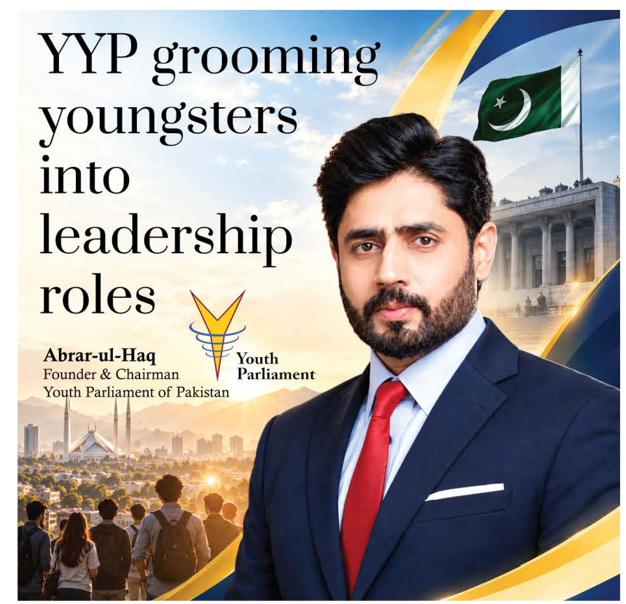

Abrar-ul-Haq
Founder & Chairman
Youth Parliament of Pakistan
Pull Quote:
“Abrar ul Haq is known for his humanitarian efforts, advocacy for education, and leadership in youth development. He is also the Founder and Chairman of the Youth Parliament of Pakistan (YPP). Throughout the years, YPP has aimed to offer young people in Pakistan chances to engage in leadership, participate in civic duties, serve their communities, learn about democracy, respond to humanitarian needs, and connect on an international level.”
Interview Transcript
Here is a Q&A session Flare held with Abrar ul Haq, Founder and Chairman of the Youth Parliament of Pakistan (YPP).
Flare: What inspired you to establish YPP?
Abrar-ul-Haq: When we established the Youth Parliament of Pakistan (YPP), our vision was to empower young people to contribute to the betterment of present-day Pakistan and not only to think about its future. YPP was created as a non-profit, non-political and non-religious platform to develop leadership, civic responsibility, community service and democratic understanding. Its philosophy rests on four pillars: Inform, Inspire, Invigorate and Involve. We seek to inform youth about their rights, responsibilities and national challenges; inspire them to recognise their potential; invigorate their confidence to transform ideas into action; and involve them in leadership, community service, policy discussions, humanitarian activities and civic engagement. Lead-ership means character, responsibility and service.
Flare: What was your vision for young Pakistanis when YPP was established?
Abrar-ul-Haq: Our vision was to develop young people into active, responsible citizens with strong leadership skills and an understanding of governance, democracy, human rights and social responsibility. True leadership is expressed through practical service to communities.
Flare: How did you seek to make YPP different from conventional youth organisations?
Abrar-ul-Haq: We wanted to combine learning with action, turning leadership training into practical community initiatives and Social Action Projects. Our programmes cover democratic participation, human rights, leadership development, policy dialogue, voter education, youth-led development, humanitarian assistance and international engagement, linking knowledge with service.
Flare: What did YPP’s Active Citizens of Pakistan programme with the British Council achieve?
Abrar-ul-Haq: The programme promoted leadership, advocacy, community engagement and social responsibility through workshops on project management, communication, conflict resolution and community mobilisation. Its key feature was the Social Action Project model, which encouraged young people to identify community problems and develop practical solutions.
Flare: What was the concept behind the initiation of “Kon Ho Ga Nojawano Ka Wazir-e-Azam”?
Abrar-ul-Haq: “Kon Ho Ga Nojawano Ka Wazir-e-Azam,” broadcast on ATV, promoted youth leadership and political awareness. It provided a platform for young people to debate national issues, present ideas and develop leadership and communication skills. The programme encouraged critical thinking about governance and responsible leadership while promoting constructive civic dialogue through mainstream media.
Flare: You also worked on youth skills and economic empowerment through “Umeed-e-Jawan”. What did the programme aim to achieve?
Abrar-ul-Haq: Umeed-e-Jawan aimed to equip vulnerable youth and women with practical livelihood skills. Supported by USAID, it operated through Youth Resource Centres in Bahawalpur, Lodhran, Multan and Muzaffargarh, offering embroidery, stitching and income-generation training. In April 2015, beneficiaries from 11 centres showcased their work at the Southern Punjab Youth Festival in Multan. The programme promoted economic opportunity, dignity and self-reliance.
Flare: How significant was your recognition by the OIC?
Abrar-ul-Haq: I was honoured by the OIC as its first Humanitarian Ambassador. I consider this recognition a responsibility, reflecting the importance of humanitarian service and young Pakistanis’ contributions during national crises. It also reinforced my belief that humanitarian work can build bridges between countries and communities.
Flare: Why is YPP’s participation in UN youth forums important?
Abrar-ul-Haq: Platforms such as the UN ECOSOC Youth Forum and High-Level Political Forum enable young Pakistanis to contribute to global discussions on sustainable development, climate change, gender equality and governance. Representation must be meaningful, equipping youth to share informed ideas, engage policymakers and build partnerships.
Flare: What does YPP’s growing presence at the UN represent for Pakistan?
Abrar-ul-Haq: YPP demonstrates that Pakistani youth can contribute meaningfully to international policy discussions, not merely benefit from development programmes. In 2025, YPP hosted a side event during the UN ECOSOC Youth Forum on youth governance, climate action, digital inclusion and partnerships. In 2026, it again engaged alongside the Forum, focusing on climate, water, peace, resilience, inclusive governance and youth and women’s participation. These engagements help bring Pakistan’s perspectives to global platforms while connecting young Pakistanis with international knowledge and opportunities.
Flare: What is your view of youth participation in policymaking?
Abrar-ul-Haq: Youth participation should move beyond consultation.
Young people should be given opportunities to understand how policies are developed, how institutions function and how evidence can be used to influence policy.
At YPP, we have always believed that leadership development must include policy education. A young person should be able to understand an issue, study evidence, debate respectfully, propose a solution and communicate that solution to decision-makers. That is how youth participation becomes meaningful.
Flare: After nearly two decades of YPP’s journey, what did you personally learn from it?
Abrar-ul-Haq: It has taught me that leadership is ultimately about service.
I have met thousands of young people across Pakistan, and I have seen extraordinary talent in places where opportunities were limited.
The lesson is very simple: talent exists everywhere, but opportunity does not.
Our responsibility is to create those opportunities. I have also learned that institutions survive when their mission is bigger than any individual.
YPP must continue beyond personalities and individual terms. Its values, systems, programmes and culture of service must be passed from one generation of young leaders to another.
Flare: Finally, what is your message to the youth of Pakistan?
Abrar-ul-Haq: Do not wait for someone else to change Pakistan.
Start with your own community.
Learn. Question. Participate. Serve. Respect differences. Understand your rights and responsibilities. Do not be afraid of failure. And remember that leadership is not a title. You can be a leader in your classroom, your university, your workplace, your village, your neighbourhood or your profession.