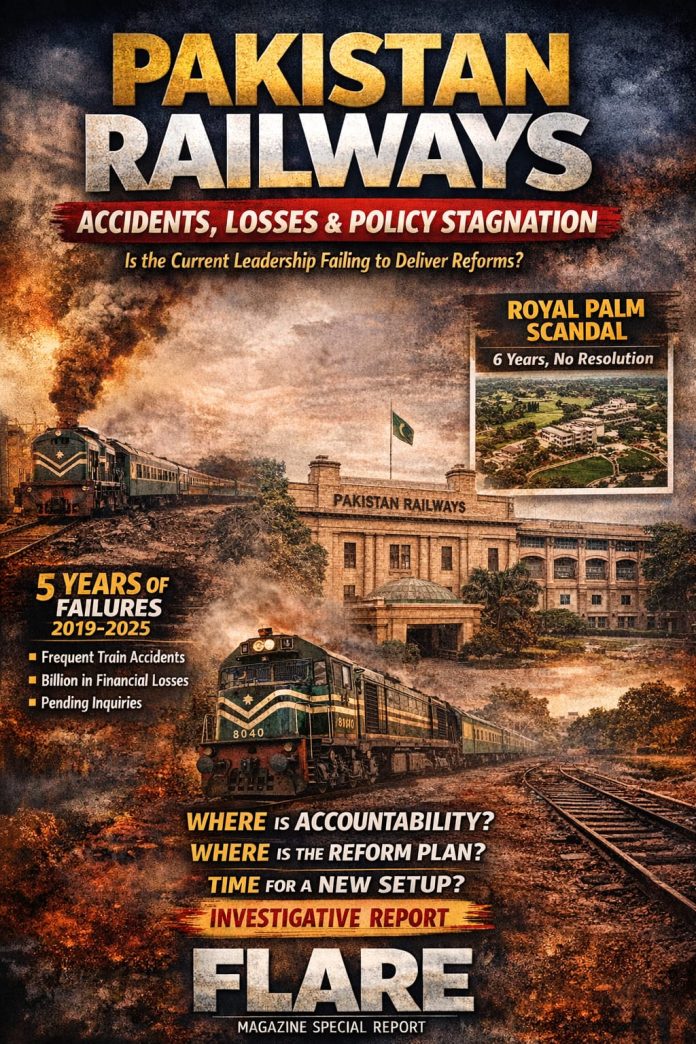
Pakistan Railways remains the backbone of the country’s transportation economy. Every
day, thousands of passengers and significant cargo volumes depend on its network.
However, official presentations submitted to the Senate Standing Committee on Railways
on 25 February 2026 have raised critical questions regarding safety, financial discipline,
and structural reforms within the institution.
The Senate briefing included accident data from 2019 to 2025, financial losses in rupees
(million), disciplinary actions against responsible employees, and causes of derailments
and operational failures. A separate review covering 1 January to 25 February 2026 was
also presented.
Five-Year Accident Trend: A Structural Concern?
The official presentation highlighted annual accident positions (2019–2025), accident
trends, and financial losses. It also claimed that the overall accident rate remained below
0.3% compared to total trains operated.
However, the same report identified recurring causes: aging infrastructure, funding
mismatches under PSDP allocations, SOP violations, human error, unmanned level
crossing breaches, operational failures, and track-side population expansion. The
persistence of these causes over multiple years raises a critical policy question: Have
structural reforms kept pace with identified risks?
2026 Early Data: Improvement or Temporary Dip?
For January–February 2026 (up to 25 February), accidents averaged 4.5 per month,
compared to 8.08 per month in 2025. While this decline appears positive, experts caution
that short-term reductions do not automatically indicate sustainable systemic
improvement.
The presentation included division-wise breakdowns, type-wise classification, and inquiry
aging summaries. Delays in accident investigations may hinder timely accountability and
corrective action.
Financial Losses: The Missing Transparency
Accident-related financial losses were reported in rupees (million). Yet questions remain
regarding recovery, insurance claims, and whether permanent losses have been
transparently disclosed. Revenue growth announcements often receive prominence, but a
comprehensive public picture of losses and recoveries is rarely presented.
Leadership Continuity and Policy Outcomes
With senior administrative continuity since 2019, and a CEO appointed in October 2023,
the expectation of measurable structural reform is reasonable. If infrastructure deficiencies
and operational weaknesses persist year after year, policymakers may need to evaluate
whether the current administrative model is delivering optimal results.
Royal Palm Case: A Test of Asset Governance
Following the Supreme Court’s 28 June 2019 decision declaring the Royal Palm
agreement void, the expectation was transparent commercialization of the approximately
140-acre asset in Lahore. Nearly six years later, a final and stable bidding outcome
remains pending.
The delay is not merely a property matter; it reflects broader questions of asset
management strategy, financial discipline, and policy execution.
Conclusion: Reform or Reassessment?
The Senate-submitted documents do not assign individual blame. However, they
undeniably highlight recurring operational risks, financial exposure, and delayed
institutional responses.
For Pakistan Railways to strengthen its credibility, long-term infrastructure planning,
transparent financial disclosure, timely inquiry completion, and accountable asset
management must become central pillars of reform. The question now is not whether
challenges exist — but whether the pace of reform matches the scale of those challenges.