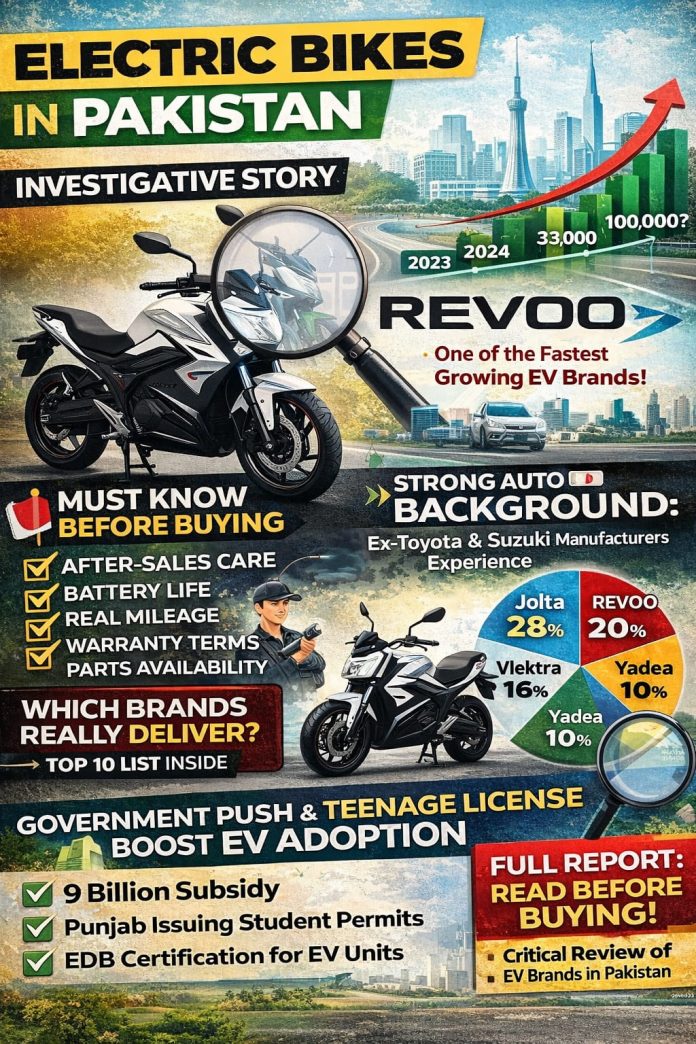

Islamabad: Pakistan’s electric motorcycle market is entering a new phase of accelerated growth as rising fuel prices, government incentives, and environmental awareness push consumers toward electric mobility. What was once a niche segment has now transformed into a fast-growing industry, with tens of thousands of annual sales recorded across the country.
However, an investigative review of the sector reveals that while the market is expanding rapidly, major differences exist among brands in terms of battery performance, after-sales services, spare parts availability, and overall reliability.
Industry analysts believe the demand surge is being driven by students, delivery riders, and daily commuters who are searching for a more economical and low-maintenance alternative to petrol-powered motorcycles.
Role of Engineering Development Board Praised
Stakeholders across the automotive sector have appreciated the proactive role of the Engineering Development Board (EDB) Pakistan. Under the government’s broader Electric Vehicle (EV) policy framework, the EDB has initiated regulatory measures to evaluate and certify companies involved in electric bike manufacturing and assembly.
The objective is to ensure:
- Compliance with quality standards
- Safety certifications
- Proper industrial development
- Encouragement of local manufacturing
This oversight is considered crucial in preventing substandard imports and protecting consumers from unreliable products.
Punjab Government’s Youth Driving Permit Policy Welcomed
Another major development supporting electric mobility is the Punjab Government’s decision to allow controlled driving permits for riders aged between 16 and 18 years.
Transport experts believe this move is practical, as thousands of college students depend on motorcycles for daily commuting. With regulated permits and legal licensing, young riders can operate vehicles responsibly under proper supervision.
Social Media Investigation Reveals Mixed Customer Experience
A detailed review of customer feedback across social media platforms highlights several recurring concerns:
- Actual mileage sometimes differs from the advertised range
- After-sales service quality varies significantly between cities
- Spare parts availability remains inconsistent for certain brands
- Battery replacement cost is a major financial concern
- Warranty terms are often unclear or poorly explained
While some brands maintain structured service networks, others struggle to provide consistent customer support, especially outside major urban centers.
REVOO Emerges as a Structured Industrial Player
Among the emerging players, REVOO has gained attention due to its industrial background. The group behind the brand reportedly has experience working as an automotive vendor with major manufacturers such as Toyota and Pak Suzuki Motor Company.
This prior exposure to automotive manufacturing standards and supply chain systems may provide REVOO with a technical edge in producing more reliable electric mobility products. Industry observers note that companies with structured engineering expertise are better positioned to maintain quality control and long-term sustainability.
Price Comparison Across Electric Bike Segments
The electric bike market currently falls into three major pricing categories:
- Entry-Level Segment: Rs 140,000 – Rs 200,000
- Mid-Range Segment: Rs 200,000 – Rs 300,000
- Premium Segment: Rs 350,000 – Rs 600,000
While entry-level models attract students and delivery riders, premium models focus on higher battery capacity, longer range, and advanced digital features.
Battery Technology Remains the Deciding Factor
Experts emphasize that the battery is the most critical component of any electric motorcycle. Buyers are advised to carefully examine:
- Battery type (Lithium-ion vs. Lead-acid)
- Charging cycles and lifespan
- Replacement cost
- Warranty coverage duration
- Availability of replacement units locally
Since battery replacement can represent a significant portion of the bike’s total cost, transparency in warranty and service terms is essential.
Future Outlook
The long-term prospects of Pakistan’s electric bike industry appear promising due to:
- Continued rise in petrol prices
- Government EV incentives
- Increasing urban traffic congestion
- Growing environmental awareness
- Expansion of local assembly facilities
If regulatory oversight remains strong and companies improve service networks, electric motorcycles could capture a significant share of Pakistan’s two-wheeler market in the coming years Advice for Buyers
Before purchasing an electric motorcycle, experts recommend:
- Checking availability of authorized service centers in your city
- Understanding battery warranty policy in detail
- Asking clearly about battery replacement cost
- Verifying spare parts availability
- Reviewing genuine customer feedback online
With informed decision-making and stronger policy support, Pakistan’s electric bike market has the potential to become a major contributor to sustainable transportation in the country.