

PAKISTANI RUPEE EXTENDS STRONG RUN AGAINST US DOLLAR
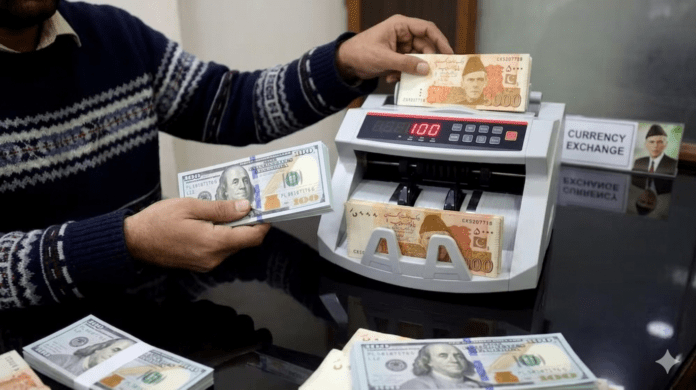
The Pakistani rupee continued its remarkable upward momentum on Tuesday, closing stronger against the US dollar for the 139th consecutive trading session. This consistent performance highlights a rare period of stability and gradual appreciation in the local currency after years of volatility in the foreign exchange market.
The currency closed at 278.97 per US dollar, gaining a marginal three paisas during the day’s trading session. While the gain may appear small on a daily basis, the broader trend reflects sustained strength that has been building over several months.
Most notably, the rupee has now returned to the 278 level against the US dollar for the first time in nearly two years. This milestone marks a significant psychological and economic benchmark for the currency market.
RUPEE RETURNS TO MID-2024 STABILITY ZONE
Market data indicates that the last time the Pakistani rupee consistently traded around the 278 level was between March and June 2024. During that period, exchange rates remained relatively stable, supported by improved external inflows and policy-linked economic adjustments.
That phase was seen as a temporary stabilization window, where currency pressure eased due to external financing support and fiscal measures. However, following that period, the rupee experienced renewed pressure, largely influenced by import demands and external payment obligations.
Throughout 2025, the currency frequently traded above the 278 mark, reflecting ongoing structural challenges in the external account. The recent return to this level in April 2026 suggests that the rupee has regained a significant portion of its earlier stability.
Economically, this shift represents a return to a previously observed equilibrium range, which market participants are closely watching for signs of longer-term sustainability.
139 CONSECUTIVE DAYS OF POSITIVE CLOSING
One of the most striking features of the current currency trend is the rupee’s 139-day streak of closing in positive territory against the US dollar. Such a prolonged period of gains or stability is uncommon in Pakistan’s foreign exchange history, where volatility has often been a recurring theme.
This extended streak suggests improved market confidence and better alignment between demand and supply in the foreign exchange market. It also indicates that short-term speculative pressure has been relatively contained compared to previous cycles.
While daily movements remain small, the consistency of positive closes signals a broader shift in sentiment. Traders and analysts often view such streaks as an indicator of underlying macroeconomic stabilization.
MIXED PERFORMANCE AGAINST OTHER GLOBAL CURRENCIES
Despite strengthening against the US dollar, the Pakistani rupee showed mixed performance against other major global currencies during the same trading session.
The currency remained largely stable against the United Arab Emirates dirham and the Saudi riyal, reflecting the traditional peg-like behavior due to close regional financial linkages. However, it weakened against several other major currencies.
The rupee lost significant ground against the British pound and the euro, reflecting broader global currency fluctuations and relative strength in those economies. It also declined against the Australian dollar and Canadian dollar, showing pressure in diversified international trade-linked valuations.
Specifically, the rupee weakened by more than two rupees against both the British pound and the euro, highlighting notable movement in European currency pairs. Against the Australian dollar, it recorded a loss of over one rupee, while it also declined similarly against the Canadian dollar.
In contrast, the rupee’s performance against Asian and Gulf currencies remained relatively stable, showing minimal day-to-day variation.
DETAILED CURRENCY MOVEMENT AND MARKET TRENDS
Recent trading data reflects fluctuating movements across multiple currencies, highlighting the complex dynamics of Pakistan’s foreign exchange market. The US dollar showed a slight decline against the rupee, continuing the downward trend that has supported local currency gains.
The euro, however, recorded a notable increase against the rupee, indicating stronger global positioning and exchange rate volatility in international markets. The British pound also strengthened, contributing to the rupee’s losses in that segment.
Other currencies such as the Australian dollar, Malaysian ringgit, Chinese yuan, and Canadian dollar showed mixed movement patterns, with most gaining strength against the rupee. These fluctuations are influenced by both global economic conditions and domestic market adjustments.
Meanwhile, Gulf currencies including the UAE dirham and Saudi riyal remained largely stable, reflecting their traditional alignment with the US dollar and steady bilateral financial relationships.
FACTORS BEHIND RECENT RUPEE STRENGTH
The recent strengthening of the Pakistani rupee can be attributed to a combination of improved external inflows, tighter market regulation, and better alignment between demand and supply in the currency market.
Reduced pressure on imports and improved management of foreign exchange reserves have also played a role in stabilizing the currency. Additionally, regulatory oversight in the currency market has helped curb speculative activity, contributing to smoother trading patterns.
Market confidence appears to have improved gradually, with traders responding to signs of macroeconomic stability and policy continuity. These factors collectively support the rupee’s recent performance against the US dollar.
However, analysts caution that currency stability remains sensitive to external shocks, global commodity prices, and trade imbalances, which can quickly influence exchange rate dynamics.
IMPACT ON TRADE AND ECONOMIC OUTLOOK
A stronger or stable rupee has mixed implications for the broader economy. On one hand, it helps reduce the cost of imported goods, including fuel, machinery, and essential commodities. This can ease inflationary pressures and improve purchasing power for consumers.
On the other hand, currency strength can affect export competitiveness, as Pakistani goods become relatively more expensive in international markets. This can place pressure on export-oriented industries, particularly in textiles and manufacturing.
For businesses operating in international trade, currency stability is generally seen as a positive development, as it reduces uncertainty and improves planning efficiency.
Overall, the current trend reflects a transitional phase where the economy is attempting to balance external pressures with internal stability.
OUTLOOK FOR THE RUPEE IN COMING MONTHS
The future direction of the Pakistani rupee will depend on several key factors, including foreign exchange reserves, import demand, global oil prices, and external financing inflows.
If current stability continues and external conditions remain favorable, the rupee may maintain its position within the current range. However, any sudden changes in global markets or domestic demand could introduce renewed volatility.
Market participants will continue to closely monitor policy developments, trade balances, and international financial conditions to assess the sustainability of the current trend.
FINAL THOUGHTS ON CURRENCY PERFORMANCE
The rupee’s return to the 278 level against the US dollar after nearly two years marks an important moment in Pakistan’s currency trajectory. The 139-day streak of positive closes reflects improved short-term stability, even as challenges remain in the broader economic environment.
While the currency has shown resilience against the US dollar, its mixed performance against other global currencies highlights ongoing volatility in international exchange markets.
Overall, the current trend signals cautious optimism, with stability improving but long-term sustainability still dependent on structural economic factors and external conditions.
Read More