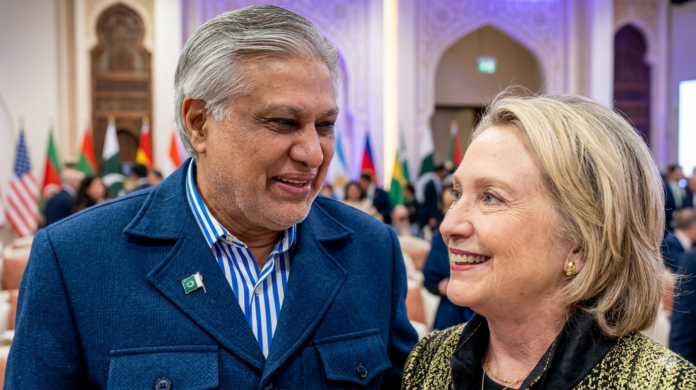

HILLARY CLINTON RAISES CONCERNS OVER US POSITION IN IRAN TALKS
Former United States Secretary of State Hillary Clinton has expressed serious concerns over the state of diplomatic relations between the United States and Iran following the failure of high-level negotiations held in Islamabad. According to her remarks, the breakdown of talks has significantly weakened Washington’s ability to influence outcomes in ongoing geopolitical discussions with Tehran.
Clinton’s comments come at a time of heightened tension in international diplomacy, where efforts to stabilize relations between the two nations have faced repeated setbacks. The failed Islamabad talks were seen as a critical opportunity to reset engagement, but the absence of a breakthrough has instead intensified uncertainty.
Her assessment suggests that the United States is now operating from a weaker diplomatic position than before, with reduced leverage in shaping future negotiations.
FAILED ISLAMABAD TALKS TRIGGER DIPLOMATIC CONCERNS
The recent negotiations held in Islamabad were widely viewed as an important attempt to revive stalled dialogue between Washington and Tehran. However, the discussions reportedly ended without any meaningful agreement, raising concerns among international observers.
The failure of these talks has been interpreted as a setback for diplomatic efforts aimed at easing long-standing tensions. Instead of building momentum toward cooperation, the outcome has reinforced divisions between the two sides.
Hillary Clinton highlighted this failure as a turning point, suggesting that missed opportunities during the discussions have contributed to a decline in US influence over the negotiation process.
The breakdown has also fueled debate about the effectiveness of current diplomatic strategies and whether alternative approaches are needed to achieve progress.
CLINTON SAYS US HAS LOST DIPLOMATIC LEVERAGE
During a recent television interview, Hillary Clinton stated that the United States should have maintained stronger strategic pressure on Iran throughout the negotiation process. According to her, the lack of consistent diplomatic leverage has weakened Washington’s position at a critical moment.
She argued that the US no longer holds the upper hand in discussions with Tehran, marking a significant shift in the balance of diplomatic influence. This perceived loss of leverage, she suggested, has limited America’s ability to guide negotiations toward favorable outcomes.
Clinton’s remarks reflect broader concerns within foreign policy circles about the effectiveness of current engagement strategies. The inability to secure progress in Islamabad has intensified scrutiny of the overall diplomatic approach.
CRITICISM OF US FOREIGN POLICY STRATEGY
A central theme of Clinton’s comments was criticism of the broader US foreign policy approach toward Iran. She questioned whether recent decisions have strengthened or weakened America’s negotiating position in the region.
According to her analysis, the current strategy has failed to maintain consistent pressure on Iran while also not achieving meaningful diplomatic gains. This imbalance, she argued, has created a situation where the United States is reacting rather than leading in negotiations.
Clinton suggested that diplomatic momentum has shifted away from Washington, allowing Iran to maintain a stronger position in ongoing discussions.
Her remarks highlight growing debate over whether US foreign policy has adapted effectively to changing geopolitical realities.
QUESTIONING KEY ROLES IN DIPLOMATIC ENGAGEMENTS
In addition to her broader critique, Hillary Clinton also raised concerns about the involvement of certain individuals in recent diplomatic discussions. She specifically questioned the role of President Donald Trump’s son-in-law Jared Kushner and Middle East envoy Steve Witkoff in the Islamabad negotiations.
Clinton suggested that the structure of the negotiating team and the decision-making process may have influenced the outcome of the talks. While she did not provide detailed accusations, her comments implied concerns about the effectiveness and strategic alignment of those involved.
These remarks have added a political dimension to the already complex diplomatic situation, further fueling debate over how negotiations are being managed at the highest level.
SHIFT IN BALANCE BETWEEN UNITED STATES AND IRAN
One of the key points raised in Clinton’s analysis is the perceived shift in diplomatic balance between the United States and Iran. She argued that recent developments suggest Iran may now hold a stronger negotiating position than it did previously.
This shift, according to her, is the result of stalled negotiations, inconsistent pressure strategies, and the inability to achieve breakthroughs in key diplomatic engagements such as the Islamabad talks.
The loss of perceived leverage can have long-term implications for future negotiations, as it may influence how both sides approach the bargaining table in upcoming discussions.
International relations experts often emphasize that perception plays a critical role in diplomacy, and Clinton’s comments reflect concern that the United States may now be seen as operating from a weaker position.
IMPACT OF STALLED NEGOTIATIONS ON GLOBAL DIPLOMACY
The failure of the Islamabad talks is not only significant for bilateral relations between the United States and Iran but also has broader implications for global diplomacy.
When major negotiations fail, it often creates uncertainty in international markets, security frameworks, and regional alliances. The inability to reach consensus can slow down other diplomatic initiatives and reduce confidence in conflict resolution mechanisms.
Clinton’s remarks underscore the importance of maintaining consistent engagement strategies in high-stakes negotiations. Without clear progress, diplomatic relationships can become more fragile and difficult to manage over time.
INCREASING TENSIONS AND STRATEGIC UNCERTAINTY
Tensions between the United States and Iran have been a long-standing feature of international politics, but recent developments have added new layers of complexity. The failure of recent talks has increased uncertainty about the future direction of these relations.
Strategic uncertainty can affect not only diplomatic channels but also broader geopolitical stability. Countries involved in or affected by these negotiations often adjust their policies based on perceived shifts in power dynamics.
Clinton’s comments highlight concerns that the current trajectory may not be favorable for sustained diplomatic progress, especially if negotiations continue to stall.
ROLE OF DIPLOMACY IN LONG-TERM STABILITY
Diplomacy remains a critical tool for managing international conflicts and preventing escalation. Effective negotiation strategies require consistency, clarity, and the ability to maintain leverage while also encouraging cooperation.
According to Clinton’s perspective, the recent approach has not fully achieved these objectives, leading to weakened outcomes in key discussions such as those held in Islamabad.
The effectiveness of diplomatic engagement often depends on timing, strategy, and execution. When any of these elements are lacking, negotiations can fail to produce meaningful results.
BROADER POLITICAL IMPLICATIONS OF THE REMARKS
Clinton’s comments are likely to contribute to ongoing political debate regarding US foreign policy direction. Her assessment adds to existing discussions about how the United States should engage with Iran and other regional powers.
The criticism of negotiation strategies and personnel involvement may also influence public perception of the effectiveness of current diplomatic leadership.
As geopolitical challenges continue to evolve, such statements contribute to a broader dialogue about the future of international relations and strategic decision-making.
OUTLOOK FOR FUTURE US IRAN RELATIONS
The future of US Iran relations remains uncertain following the failed Islamabad talks. While diplomatic channels remain open, the lack of progress suggests that significant challenges remain ahead.
Restoring momentum in negotiations will likely require renewed strategy, improved coordination, and a clearer framework for engagement. Both sides may need to reassess their positions to create space for future dialogue.
For now, the situation remains delicate, with diplomatic outcomes heavily dependent on future decisions and international developments.
FINAL ANALYSIS ON CLINTON’S WARNING
Hillary Clinton’s remarks highlight growing concerns about the direction of US foreign policy in relation to Iran. Her statement that the United States is in a weaker position following the failed Islamabad talks reflects broader uncertainty within diplomatic circles.
While opinions differ on strategy and execution, the failure to achieve progress in recent negotiations underscores the complexity of managing long-standing international tensions.
The coming months will likely be critical in determining whether diplomatic efforts can regain momentum or continue to face setbacks in an increasingly complex geopolitical environment.
Read More
Govt Imposes 2+ Hour Daily Power Cuts Instead of Reducing Electricity Prices