
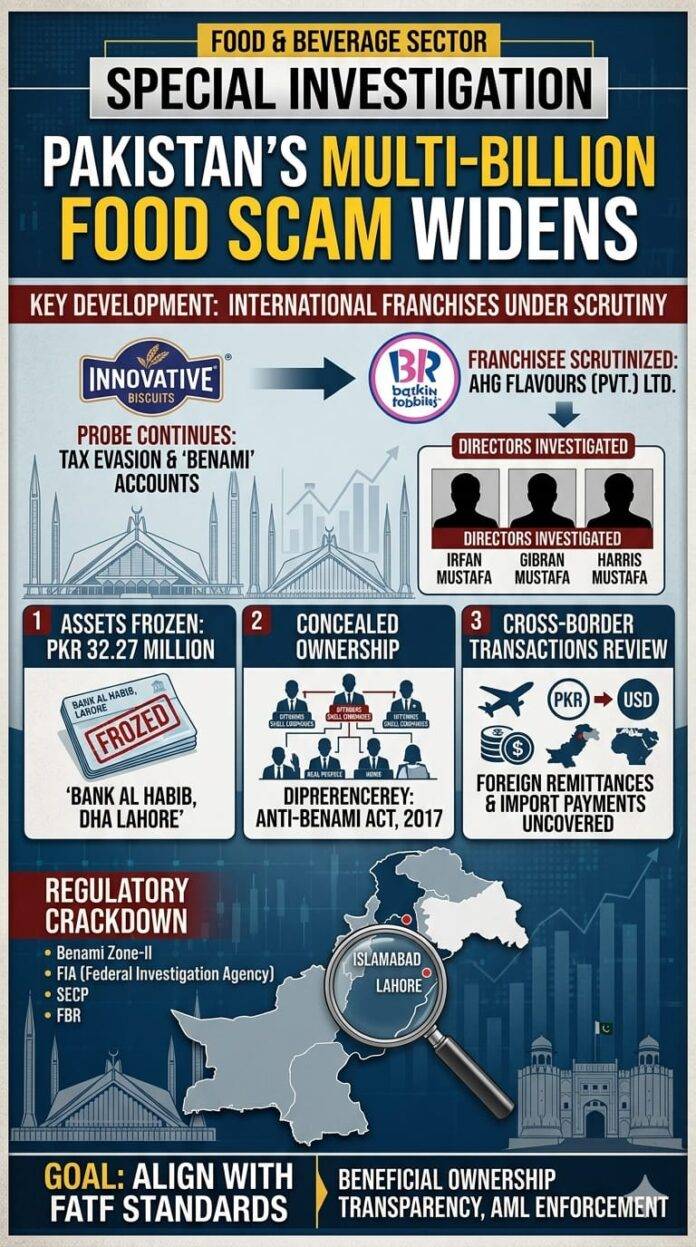

News Desk: Pakistan’s ongoing crackdown on undocumented financial activity in the food and beverage sector has deepened, with federal authorities expanding the scope of the high-profile Innovative Biscuits investigation to include entities operating under international franchise arrangements.
Among those now under scrutiny is M/s AHG Flavours (Pvt.) Ltd, the master franchisee of Baskin-Robbins ice cream in Pakistan, linked to its directors, Irfan Mustafa, Gibran Mustafa, and Harris Mustafa. Investigators examined the company’s financial structure, banking patterns, and ownership disclosures amid concerns of concealed beneficial ownership and irregular fund flows.
Asset Freeze and Benami Concerns
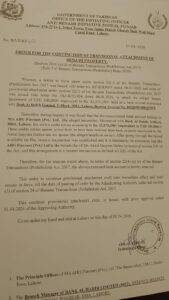
Under an attachment order issued by ABI Zone-II (No. BZ-II/IO/450), authorities have frozen a bank account maintained by AHG Flavours at Bank Al Habib, DHA Lahore, holding approximately PKR 32.27 million.
Preliminary findings, according to officials familiar with the matter, indicate that the account activity and asset positioning may not align with declared ownership structures per the SECP and FBR records. Investigators are assessing whether the funds were deliberately routed and maintained in a manner designed to obscure true beneficial ownership, raising potential violations under the Anti-Benami Transactions (Prohibition) Act, 2017.
Regulatory sources noted that patterns observed in the case are consistent with structured financial arrangements where corporate vehicles are used to mask underlying control and economic interest.
Emerging Cross-Border Dimensions
Authorities are also reviewing whether certain transactions associated with AHG Flavours, Ltd., involved cross-border elements, including foreign remittances, import payments, and related-party flows. These aspects are being examined in the context of compliance with foreign exchange regulations and potential anti-money laundering (AML) implications.
Officials have not ruled out the possibility that discrepancies between documented inflows and recorded utilization of funds could form part of a broader pattern of financial misrepresentation. Such patterns, if substantiated, may trigger scrutiny beyond domestic tax and benami laws, extending into AML compliance frameworks.
Innovative Biscuits Probe as Catalyst
The scrutiny of AHG Flavours follows investigative leads emerging from the Innovative Biscuits case, where authorities are probing alleged large-scale tax evasion and unreported sales involving key directors, including Sheikh Munir.
Investigators identified irregularities in production-to-sales reconciliation and banking footprints in that case, which provided a comparative baseline for detecting similar anomalies across other entities within the food supply chain. This led to a closer examination of companies operating within parallel distribution and import networks.
Sources indicate that authorities are particularly focused on identifying systemic practices involving under-reporting, off-book transactions, and the use of layered financial channels.
Regulatory Posture Hardens
Initiating Officer Bilal Qasim and other officials involved in the inquiry have signaled a more assertive enforcement posture, particularly where internationally recognized brands are linked to local entities with opaque financial structures.
Authorities emphasize that the investigation is being driven by financial records, statutory disclosures, and transaction-level analysis. Furthermore, the officials maintain that enforcement actions are based on independently verifiable documentation.
Wider Industry Implications
Regulators are now understood to be mapping similar financial patterns across other importers and distributors in the food and beverage sector. The current action is being viewed as part of a broader effort to enforce transparency in beneficial ownership, ensure proper documentation of capital flows, and address potential misuse of corporate structures.
The case underscores the current government’s intensified efforts to align Pakistan’s financial and regulatory framework with Financial Action Task Force (FATF) requirements, particularly in relation to beneficial ownership transparency, anti-money laundering (AML) enforcement, and the monitoring of cross-border financial flows


