
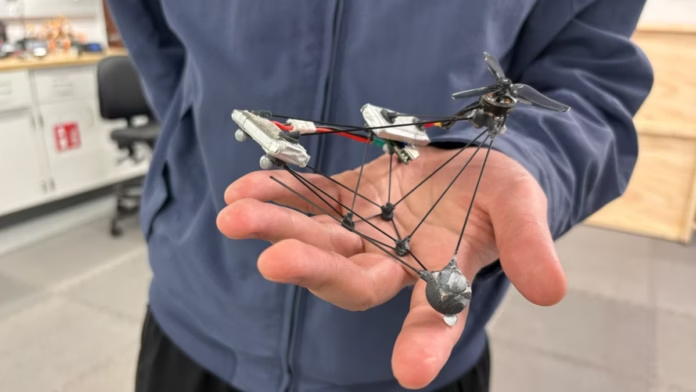

Engineers at Northwestern University have created a new experimental drone that is much harder for people to see while it is flying. Instead of using camouflage, transparent materials, or special light-bending technology, the drone hides itself by spinning very quickly.
The researchers call the drone “Phantom Twist.” Its unique design takes advantage of the way the human eye sees fast-moving objects. When something spins very fast, our eyes cannot clearly see its shape. This is the same reason why the blades of a fast-spinning fan or propeller appear almost invisible.
Drone Spins 25 Times Every Second
The Phantom Twist can spin 25 times per second while flying.
Because it rotates so quickly, people cannot clearly see the drone’s body. Instead of looking like a normal drone, it appears as a faint, blurry, semi-transparent shape that blends into the background.
The drone does not become completely invisible, but it becomes much more difficult to notice, especially from a distance.
Designed for Less Disturbance
The researchers believe this technology could be useful in situations where regular drones might disturb people or animals.
For example, the drone could be used for:
- Monitoring wildlife without scaring animals.
- Surveying forests, wetlands, and natural habitats.
- Inspecting bridges, power lines, and other infrastructure.
- Conducting environmental research with less visual distraction.
Because the drone is harder to notice, animals are less likely to run away, and people are less likely to change their behavior when it is flying nearby.
A Different Drone Design
Unlike most drones, which have four propellers attached to a fixed body, Phantom Twist has a completely different design.
It uses:
- One motor
- One propeller
The propeller spins in one direction, while the rest of the drone rotates in the opposite direction.
Since there are no large stationary parts, the entire drone becomes a moving blur during flight, making it much harder to see.
AI Helped Design the Drone
Artificial intelligence played a major role in creating Phantom Twist.
The research team first used computer software to generate around 20,000 possible drone designs that could fly safely.
AI and optimization algorithms then tested different positions for important parts such as:
- The motor
- The propeller
- The batteries
- The circuit board
- The counterweight
The goal was to find a design that was both stable in the air and difficult for humans to notice.
Tested Against Real Backgrounds
After generating thousands of designs, the researchers tested the most promising ones using computer simulations.
The drones were shown spinning in front of 100 different real-world backgrounds, including natural environments and urban scenes.
The researchers used a computer model that mimics human vision to measure how noticeable each drone looked.
They selected the 500 least visible designs and continued improving them until they found the best balance between stability and low visibility.
Once the final design met all requirements, they built a real working prototype and tested it in flight.
Around 10 Times Harder to Notice
According to the research team, the finished Phantom Twist is about 10 times less visible than a traditional quadcopter.
The drone’s components are placed at different heights and angles so that, while spinning, they visually blend together instead of standing out.
This creates a motion blur effect that makes the drone much less noticeable to the human eye.
Still a Prototype
Although the Phantom Twist performs well, it is still an experimental project.
The researchers say the drone still has a few limitations.
For example:
- Its propeller is still quite noisy.
- Some wires and support rods remain visible during flight.
Future versions are expected to use:
- More transparent materials.
- Quieter motors and propellers.
- Improved designs that make the drone even harder to notice.
Research Presented in Australia
The research was presented on July 16 at the Robotics: Science and Systems 2026 conference held in Sydney, Australia.
The study was titled “Computational Design of a Low-Visibility UAV Using a Human-Aligned Perceptual Metric.”
The project was led by Michael Rubenstein, an associate professor of computer science and mechanical engineering at Northwestern University’s McCormick School of Engineering and a member of the university’s Center for Robotics and Biosystems.
Other members of the research team included Emma Alexander, Sam Kriegman, David Matthews, Jingxian Wang, and Chen Yu.
The research was supported by the National Science Foundation.
If future improvements are successful, drones like Phantom Twist could become valuable tools for wildlife research, environmental monitoring, scientific studies, and infrastructure inspections by carrying out their work while attracting much less attention than traditional drones.


