
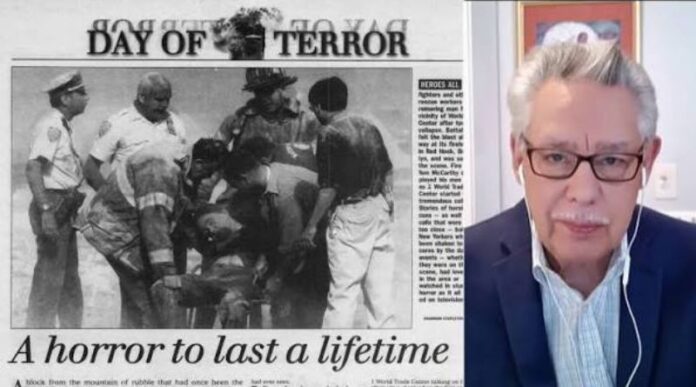

Twenty-five years after the September 11 attacks, the tragedy of 9/11 continues to affect thousands of people who survived the attacks and worked around Ground Zero. While nearly 3,000 people were killed on the day of the attacks, many more have died in the years since from illnesses linked to their exposure to the toxic dust and chemicals released after the World Trade Center buildings collapsed.
Journalist Juan González was among those who warned about the dangers soon after the attacks. At a time when government officials were telling New Yorkers that the air around Ground Zero was safe, González questioned those claims and continued reporting about the possible health risks.
His warnings became an important part of the long story surrounding the environmental impact of 9/11. Twenty-five years later, many of the concerns he raised have become even more serious as firefighters, rescue workers, emergency medical workers, residents, students and others continue to suffer from cancer, breathing problems and other diseases.
González recently revisited his reporting and his book Fallout: The Environmental Consequences of the World Trade Center Collapse. His comments have again brought attention to questions about what officials knew after the attacks, what information was made public and whether workers were properly protected.
A Disaster That Changed New York Forever
The attacks of September 11, 2001, destroyed the World Trade Center and changed New York City within minutes. Huge clouds of dust and smoke spread through Lower Manhattan after the towers collapsed.
The area around Ground Zero became a massive emergency and recovery site. Thousands of firefighters, police officers, construction workers, medical teams, volunteers and other workers entered the area to search for victims, remove debris and restore the city.
But the collapse also released a large amount of material into the air.
The buildings contained many different substances, including asbestos, lead, glass, metals and other chemicals. When the towers collapsed, much of this material was broken into tiny particles and spread through the surrounding area.
People who lived, worked or studied near Ground Zero were exposed to the dust. Rescue and recovery workers were exposed for long periods as they worked through the debris.
At the time, however, the full health impact of the disaster was not known.
González argued that this uncertainty itself should have been a reason for officials to be more careful.
González Questioned Official Assurances
In the weeks after 9/11, government officials repeatedly gave assurances about air quality around Lower Manhattan. These statements helped encourage workers and businesses to return to the area.
But González believed officials should not have described the environment as safe when there was not enough information to make such a conclusion.
In his reporting, he argued that nobody could guarantee that the air around Ground Zero was safe because the disaster was unlike anything the city had faced before.
His concern was not simply that officials lacked perfect information. His bigger concern was that they were giving people confidence at a time when important questions about toxic exposure remained unanswered.
According to González, government agencies should have released all available testing data and clearly explained what scientists knew and did not know.
Instead, he believed the early public message focused too heavily on returning New York to normal.
A Warning About Future Illness
One of González’s biggest concerns was that the health effects would not appear immediately.
People exposed to dangerous substances do not always become sick right away. Some illnesses can take years to develop.
That is why González warned that the environmental disaster could create a second wave of victims long after the attacks themselves.
He later said that his main prediction was sadly correct, although the timing was different from what he expected. He had feared that people would eventually die because of exposure to the toxic environment.
Instead of taking decades for serious deaths to begin, he said it took only about five years.
The number of people affected has continued to grow over the years.
Workers Paid a Heavy Price
The workers at Ground Zero faced some of the greatest risks.
Firefighters, police officers, paramedics, construction workers and volunteers worked in an environment filled with dust and debris. Many spent long hours at the site, often without the level of protection that would be expected at a dangerous industrial location.
For many workers, helping others came before thinking about their own health.
They were responding to one of the worst disasters in American history. Their main goal was to find survivors, recover victims and clear the site.
But the long-term consequences became clear later.
Many workers developed breathing problems, asthma, chronic coughs and other respiratory illnesses. Others were later diagnosed with different forms of cancer and other serious diseases.
The health crisis has therefore become a lasting part of the 9/11 story.
The Dangers Were Not Limited to Rescue Workers
The health effects of the disaster were not limited to people who worked directly at Ground Zero.
People who lived nearby were also exposed. Students attended schools in Lower Manhattan. Office workers returned to buildings near the World Trade Center. Residents remained in apartments and homes that had been affected by the dust.
This meant that the environmental impact spread beyond the immediate disaster site.
González and other journalists began reporting about illnesses among people who had been exposed.
At the time, however, many questions remained unanswered. How dangerous was the dust? How long did the contamination remain? Which chemicals were present? What levels of exposure could cause illness?
These questions were important because people needed accurate information to make decisions about their health and safety.
The Role of Government Information
One of the most important issues raised by González is the need for transparency during a disaster.
People cannot protect themselves if they do not know the risks.
If government agencies have test results showing dangerous substances, those results need to be made public. If scientists do not yet know whether an area is safe, officials should say so clearly.
González argued that giving people false confidence can be more dangerous than admitting uncertainty.
The recent release of previously unpublished records has renewed this debate.
In 2026, New York City officials began making public a large collection of documents related to air quality and contamination following the World Trade Center attacks. More than 170,000 pages of records had reportedly remained stored in city offices for years.
The records include air-quality reports, contamination information and internal communications.
Their release could provide a clearer picture of what city officials and health agencies knew during the months following 9/11.
Why the Newly Released Records Matter
The release of these documents is important because the debate over Ground Zero has never been only about what happened on September 11.
It is also about what happened afterward.
The attacks lasted only a few hours, but the cleanup and recovery continued for months. During that period, thousands of people continued to enter the area.
The decisions made during those months affected the health of many people for years to come.
The newly released documents may help answer questions about how officials assessed the risks and how information was shared with the public.
They may also help researchers better understand the long-term effects of exposure.
For families who lost loved ones to 9/11-related diseases, such information can provide another piece of a story that has remained incomplete for decades.
González’s Book Preserved an Early Record
González collected much of his reporting about the environmental impact of the attacks in his book Fallout.
The book focused on the dangers created by the collapse of the World Trade Center and the official response to those dangers.
His reporting was especially notable because it appeared when many people were focused almost entirely on the immediate tragedy.
The country was grieving. Rescue workers were searching through the ruins. New York was trying to recover.
In that environment, discussions about long-term environmental risks received less attention.
González continued to raise those questions.
He argued that the public deserved to know the truth, even if the information was uncomfortable.
The Message Was Not About a Secret Plot
González has also made an important distinction about his criticism of officials.
He has said that he was not arguing that there was a secret plan to deliberately hide the truth from the public.
Instead, he suggested that officials may have underestimated the danger, faced political pressure or simply wanted to believe that the situation was under control.
This distinction matters.
Disasters often create pressure on governments to restore normal life as quickly as possible. Businesses want to reopen. Workers want to return. Leaders want to reassure the public.
But public reassurance can become dangerous if it moves faster than the science.
The lesson from 9/11, according to González’s reporting, is that officials must be willing to admit when they do not have all the answers.
Twenty-Five Years Later, the Health Crisis Continues
The passage of time has not ended the 9/11 health crisis.
For many survivors and workers, September 11 is not simply an event from the past. It is connected to medical appointments, treatment, medication and memories of friends and colleagues who became sick.
The number of deaths linked to 9/11-related illnesses has continued to rise. According to current reporting, nearly 10,000 additional people have died from illnesses connected to the disaster in the years since the attacks.
That number shows why the environmental story of 9/11 remains important.
The attacks killed thousands immediately, but the wider human cost continued long after the smoke disappeared from Lower Manhattan.
A Lesson for Future Disasters
Perhaps the biggest lesson from González’s reporting is that public safety must come before the desire to return to normal.
After a major disaster, people need clear and honest information.
If the air may be dangerous, workers should be told. If testing is incomplete, the public should know. If scientists are still studying the risks, officials should not present uncertain information as a guarantee of safety.
Protective equipment, health monitoring and proper safety rules can help prevent long-term damage.
The experience of Ground Zero shows what can happen when people are exposed to a dangerous environment without fully understanding the risks.
It also shows why records and scientific information matter.
Remembering the People Behind the Numbers
Twenty-five years after 9/11, it can be easy to think about the tragedy only through statistics.
Nearly 3,000 people died on the day of the attacks.
Thousands more have died since.
But every number represents a person and a family.
There are firefighters who never came home. There are workers who developed serious illnesses years after helping with the recovery. There are residents who continue to deal with health problems. There are families who have spent years trying to understand why their loved ones became sick.
Their experiences show that the impact of 9/11 cannot be measured only by what happened that morning.
The disaster created a long-term health crisis that continues to affect people a quarter of a century later.
González’s Warning Still Matters
Juan González’s early reporting stands out because he raised questions that many others were not asking at the time.
He warned that the toxic material released after the World Trade Center collapse could create serious health problems in the future.
Twenty-five years later, the growing number of 9/11-related illnesses and deaths has made those warnings difficult to ignore.
The release of thousands of pages of previously unavailable records could now help the public understand more about what officials knew and when they knew it.
For González, the issue is not simply about proving whether someone was right or wrong in 2001.
It is about learning from the past.
Future disasters will happen. New York, the United States and other countries will face emergencies that may involve dangerous chemicals, damaged buildings or contaminated environments.
When that happens, officials will have to make difficult decisions with incomplete information.
The lesson from Ground Zero is clear: when public health is at risk, honesty and caution should come first.
People deserve to know what is known, what is unknown and what steps they can take to protect themselves.
Read Also: check