
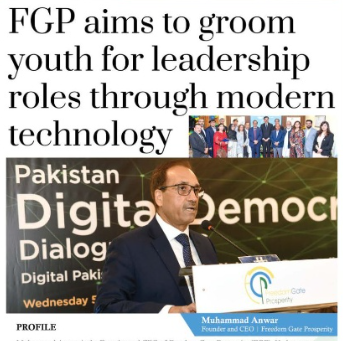

Muhammad Anwar
Founder and CEO | Freedom Gate Prosperity
Muhammad Anwar is the Founder and CEO of Freedom Gate Prosperity (FGP). He has more than three decades of experience in project management, administration, institutional development, networking and skills development, including 33 years of service with the Friedrich Naumann Foundation for Freedom. A Political Science graduate from the University of the Punjab, he remains actively engaged in democratic discourse, civic education and leadership development. He is also a co-founder and senior office-bearer of The Learning School in Kot Radha Kishan, which has expanded educational opportunities for students from underserved communities. His wider engagement includes university advisory work, lectures, policy discussions, motivational speaking, and media commentary. Through FGP, he now focuses on civic empowerment, digital inclusion, economic opportunity, institutional strengthening, peace, and climate action.
Muhammad Anwar serves as the Founder and CEO of Freedom Gate Prosperity (FGP), a not-for-profit organisation based in Pakistan that operates at the intersection of civic empowerment, democratic participation, digital inclusion, economic opportunity, and climate resilience.
Flare: What motivated you to create Freedom Gate Prosperity?
Muhammad Anwar: Freedom Gate Prosperity grew out of the belief that turning experiences into institutions increases their value to individuals. After 33 years with the Friedrich Naumann Foundation for Freedom, I aimed to build on key lessons: valuing individual freedom, promoting democratic engagement, encouraging economic opportunities, ensuring effective management, and investing in people.
Thus, Freedom Gate Prosperity was established in Pakistan to unite citizens, experts, academic institutions, civil society, businesses, and government around practical solutions. Our goal is not just to discuss challenges, but to create environments, tools, and collaborations that empower individuals to engage in society and expand their opportunities.
Flare: What key focus areas does FGP address?
Muhammad Anwar: Our initiatives are structured around interconnected priorities, rather than separate projects. These priorities encompass civic and democratic participation, digital rights and accountability of technology, empowerment of youth and women, economic reform and entrepreneurship, climate resilience, governance, media literacy, and building institutional capabilities.
Flare: Why has the concept of digital democracy become integral to your organisation?
Muhammad Anwar: Technology now plays a pivotal role in almost every aspect of democratic engagement. Citizens access information through digital means, public discourse is mostly influenced by online platforms, and artificial intelligence is reshaping the production and consumption of knowledge.
Flare: What is the concept behind the Rights & Voices initiative?
Muhammad Anwar: Rights & Voices embodies our conviction that rights gain significance when individuals can comprehend and utilise them. Central to this initiative is the Rights & Voices mobile App, created by Freedom Gate Prosperity to enhance the accessibility, practicality, and clarity of rights-related information.
The App is designed to empower citizens, especially youth, to become more informed about their rights, duties, and avenues for civic participation. Additionally, it aims to promote responsible interactions with public institutions and to foster stronger relationships between citizens and pertinent organisations.
Flare: FGP has also developed FGP Connect. What problem does it resolve?
Muhammad Anwar: FGP Connect is an Institutional Management System created to address our specific operational requirements. Civil society organisations frequently maintain important information across various spreadsheets, email folders, and personal computers. This fragmentation undermines institutional memory and complicates reporting, handoff, and accountability processes.
FGP Connect consolidates essential information within a cohesive system that encompasses contacts, organisations, events, participants, partners, donors, publications, media coverage, operations, approvals, assets, and financial management.
Flare: How significant are young people and universities in FGP’s strategy?
Muhammad Anwar: They are fundamentally important. Pakistan has a large youth demographic, but simply labelling young people as the future does not create opportunities. They require skills, exposure, networks, confidence, and authentic involvement in decision-making processes.
I maintain a strong connection with universities through lectures, advisory roles, and institutional collaborations. FGP aims to bridge university communities with practitioners, public institutions, entrepreneurs, and civil society to ensure that learning addresses real-world challenges.
My long-standing relationship with The Learning School, Kot Radha Kishan (Kasur), has reinforced the lesson that education is most effective when it fosters both competence and character.
Flare: What do you think Pakistan’s most pressing institutional challenges are?
Muhammad Anwar: One of the most profound challenges is the decline of trust. Citizens may lack confidence in institutions, and institutions may fail to communicate effectively with the public, while public discourse often becomes polarised prior to a thorough examination of evidence.
My experiences have revealed that strong institutions are established through reliable processes, which include well-defined responsibilities, documented decisions, respect for individuals, financial discipline, and an openness to learn from mistakes.
Flare: FGP collaborates with various types of partners. What is its significance?
Muhammad Anwar: The intricate challenges facing Pakistan cannot be addressed by any single sector in isolation. Civil society offers insights from the community and public-interest viewpoints. Universities provide research and cultivate young talent. Businesses introduce innovation and drive economic vitality. Public institutions are equipped with the authority and capacity to translate concepts into policy. Moreover, international partners can offer valuable comparative experience and technical assistance.
FGP aims to act as a connector between these different communities. We prioritise partnerships built on common goals, transparency, and mutual respect rather than superficial engagements.
Flare: How do you define your approach to leadership?
Muhammad Anwar: In my opinion leadership should foster systems and build confidence, rather than create dependency. Individuals perform optimally when they feel respected, trusted, and entrusted with clear responsibilities. Concurrently, institutions require discipline, documentation, and accountability.
As such, I seek to blend an open team culture with robust systems. A leader should attentively listen, make necessary decisions, mentor team members, maintain the organisation’s institutional knowledge, and ensure operational continuity beyond any individual.
Flare: What is your vision for FGP in the coming years?
Muhammad Anwar: Our focus will be on deepening our impact rather than merely increasing the volume of activities. We aim to enhance Rights & Voices, broaden meaningful digital democracy involvement, create actionable economic and climate initiatives, and forge enduring partnerships throughout Pakistan. We also plan to continue developing FGP Connect as a professional institutional management tool.


