

PROFILE
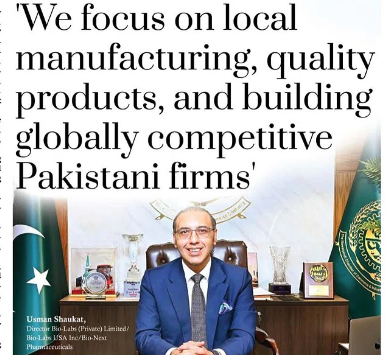
Usman Shaukat graduated with honours from the University of Virginia’s McIntire School of Commerce in Finance, International Business, and Economics, with executive education at Harvard University and London Business School.
He began his career on Wall Street with J.P. Morgan after internships at leading financial institutions. Returning to Pakistan in 2005, he joined Bio-Labs and helped drive its growth into a leading pharmaceutical manufacturer, exporting to more than 18 countries across pharmaceuticals, consumer health, personal care, and international distribution.
Usman Shaukat has held key leadership roles at PPMA, RCCI, the Islamabad Industrial Association, and Entrepreneurs’ Organization (EO). He is currently serving as President of RCCI (2024-26), Chairman North of PPMA (2025-26), and Business Coordinator at the Federal Tax Ombudsman’s Office.
Q&A Section (Question & Answer)
Questions & answers with Usman Shaukat
Flare: How has your professional journey shaped your leadership across Bio-Labs, Bio-Next, Bio-Labs Consumer Health, and ZH Therapeutics?
Usman Shaukat: My journey combines international exposure, financial discipline, entrepreneurship, and experience building businesses in Pakistan.
After graduating with honours from the University of Virginia’s McIntire School of Commerce, I began my career on Wall Street, including at J.P. Morgan, gaining expertise in finance, strategy, risk management, and decision-making.
In 2005, I returned to Pakistan and entered the pharmaceutical and healthcare sector. Over time, Bio-Labs expanded into Bio-Next Pharmaceuticals, Bio-Labs Consumer Health, and ZH Therapeutics.
Together, these businesses focus on strengthening local manufacturing, delivering quality products, and building Pakistani companies capable of competing internationally.
Flare: What are your immediate strategic priorities as the owner and founder of these organisations?
Usman Shaukat: My priority is sustainable, long-term growth through stronger manufacturing, product expansion, operational efficiency, technology, talent, and international expansion.
Bio-Labs already reaches more than 18 countries, while Bio-Next, Bio-Labs Consumer Health, and ZH Therapeutics have expanded into injectables, nutritional health, consumer healthcare, personal care, and hygiene.
I also want our businesses to become more data-driven and professionally managed, supported by strong systems and capable leadership teams.
Flare: How does Bio-Labs ensure manufacturing quality, patient safety, and regulatory compliance?
Usman Shaukat: In healthcare, quality is non-negotiable. Our approach relies on strong quality assurance and control systems, trained personnel, controlled manufacturing processes, testing of raw materials and finished products, and compliance with regulatory and Good Manufacturing Practice (GMP) requirements. Compliance is part of our organisational culture, not simply an inspection requirement. Commercial objectives must never compromise quality or patient safety. Trust and consistency are fundamental to sustainable growth.
Flare: What role do research, innovation, local manufacturing, and import substitution play in the group’s growth strategy?
Usman Shaukat: They are central to our long-term strategy. Pakistan has strong talent but remains dependent on imports in critical healthcare areas. Building local capabilities can reduce import dependence, conserve foreign exchange, and create higher-value economic activity. Our investments in Bio-Next, consumer health, personal care, and manufacturing support this vision. We aim to move beyond traditional import substitution towards innovation and export-led growth.
Research can improve formulations, manufacturing, product quality, and solutions for unmet healthcare needs, while stronger university-industry collaboration can turn local talent into viable products and exports.
Flare: How can Pakistan’s pharmaceutical industry improve access to safe, effective, and affordable medicines?
Usman Shaukat: Improving access requires a sustainable balance of quality, affordability, and availability. Manufacturers need policies that support investment in technology, quality systems, research, and production. Imported raw materials, energy, financing, and compliance costs all affect prices, so affordability cannot rely on price controls alone.
We need stronger local manufacturing, healthy competition, efficient regulation, and domestic production of APIs and critical inputs. Ultimately, medicines must be both affordable and consistently available.
Flare: How are digital transformation, data, automation, and emerging technologies changing the group’s operations?
Usman Shaukat: Technology is transforming our operations, with a focus on improving quality, productivity, visibility, and decision-making. Data supports forecasting, inventory, production planning, procurement, and commercial performance, while automation, AI, and analytics improve efficiency and optimisation.
Flare: What initiatives are being taken to develop scientific, technical, and managerial talent?
Usman Shaukat: People are our most important asset. We emphasise continuous learning, professional development, modern management and manufacturing practices, and opportunities for talented employees to take responsibility. Stronger university-industry links are also needed to prepare graduates for modern business and manufacturing.
Flare: From your perspective as President of RCCI, what are the key opportunities and obstacles facing Pakistani businesses today?
Usman Shaukat: Pakistan has strong entrepreneurial potential, supported by its young population, large domestic market, strategic location, and talent.
Opportunities exist in pharmaceuticals, healthcare, technology, IT, agriculture, manufacturing, food processing, regional trade, and exports. However, businesses face high operating and energy costs, taxation, financing constraints, regulatory complexity, and policy uncertainty.
Predictability is essential. Businesses can adapt to difficult conditions, but uncertainty makes long-term investment harder.
The private sector needs a level playing field, transparent policies, efficient regulation, and consistency to compete internationally.
Flare: As Chairman of PPMA North Zone, which policy reforms would most strengthen Pakistan’s pharmaceutical sector?
Usman Shaukat: The sector needs regulation that protects patients while remaining efficient and predictable enough to encourage investment and innovation.
Registration, licensing, and approvals should have clear requirements, timelines, and effective digital systems. Policies should also support local API production, advanced manufacturing, research and development, and pharmaceutical exports.
Pakistan can build greater capabilities in complex formulations, specialised products, biotechnology, and other higher-value areas. Stronger coordination among regulators, government, and industry is essential.
Flare: What are your priorities for the next five years, and what message do you have for Flare readers, entrepreneurs, and policymakers?
Usman Shaukat: My priorities are sustainable growth, international expansion, innovation, manufacturing, technology, and people. I want to expand manufacturing, strengthen our product portfolio, enter new international markets, and develop the next generation of leadership.
Pakistan’s pharmaceutical and healthcare sector can become a stronger contributor to exports and economic development. My message to entrepreneurs is simple: think long term, build with integrity, and create real value.
To policymakers, I would emphasise predictable policies, a level playing field, and an environment that rewards investment, exports, innovation, and employment.
Ultimately, “Made in Pakistan” should represent quality, reliability, innovation, and global competitiveness.


