
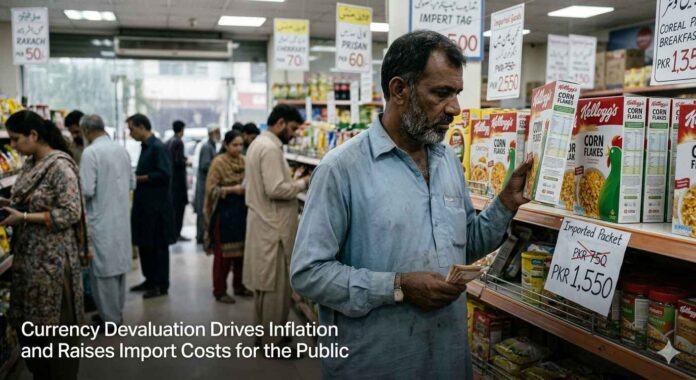

Understanding Currency Devaluation and Its Economic Impact
Currency devaluation is often presented as a tool to improve a country’s economic competitiveness, particularly by making exports cheaper in global markets. However, in practice, the effects are far more complex and, in many cases, disproportionately burden the general public. In Pakistan, repeated episodes of currency depreciation have highlighted both the intended and unintended consequences of such policies.
A weaker currency increases the cost of imports, which directly impacts domestic prices. Since Pakistan relies heavily on imported goods, including fuel, machinery, and raw materials, any depreciation in the currency quickly translates into inflation. This creates a chain reaction that affects businesses, households, and the broader economy.
The Reality Behind a Weaker Rupee
Recent economic signals suggest that the national currency may weaken further in the near term. Projections indicate that it could decline significantly against the dollar, reflecting underlying pressures in the economy. While this adjustment is often justified as necessary for economic reform, the immediate impact is felt by consumers through rising prices and reduced purchasing power.
The technical argument for devaluation is that an overvalued currency distorts trade dynamics. By allowing the currency to find its market level, policymakers aim to correct imbalances. However, the real-world outcomes depend heavily on the structure of the economy, and in Pakistan’s case, several constraints limit the effectiveness of this approach.
Why Devaluation Does Not Always Boost Exports
In theory, a weaker currency should make exports more competitive by lowering their prices in international markets. However, Pakistan’s experience shows that this relationship is not straightforward.
One major challenge is the country’s reliance on imported inputs for manufacturing. Many export-oriented industries depend on raw materials and machinery sourced from abroad. When the currency weakens, the cost of these inputs rises, offsetting any gains from increased export competitiveness.
Additionally, high energy costs further erode the advantage of a weaker currency. Businesses face rising operational expenses, which limit their ability to expand production or reduce prices. As a result, the expected boost to exports often fails to materialize.
Structural Constraints Limiting Export Growth
Another key factor is the lack of diversification in the export sector. Pakistan’s exports are heavily concentrated in a few industries, which restricts the potential for broad-based growth. Without expanding into new sectors and improving value addition, the benefits of currency adjustments remain limited.
Moreover, access to financing remains a challenge. High interest rates increase the cost of borrowing, making it difficult for businesses to invest in technology, infrastructure, and capacity expansion. This further weakens the ability of exporters to compete globally.
Structural reforms, rather than currency adjustments alone, are essential for sustainable export growth. Improving productivity, enhancing efficiency, and investing in innovation are critical steps that must accompany any exchange rate policy.
Rising Import Costs and Inflationary Pressures
The most immediate and visible impact of currency devaluation is the increase in import costs. Essential goods such as fuel, food items, and industrial inputs become more expensive, leading to a rise in overall price levels.
Inflation affects every segment of society, but its impact is particularly severe for low- and middle-income households. As the cost of living increases, families are forced to cut back on essential expenses, affecting their quality of life.
The rise in energy prices is especially significant, as it has a cascading effect on the entire economy. Higher fuel costs increase transportation expenses, which in turn raise the prices of goods and services across the board.
Trade Deficit and Economic Imbalance
Despite efforts to manage imports and boost exports, the trade deficit remains a persistent challenge. The gap between imports and exports continues to widen, reflecting structural weaknesses in the economy.
An increasing trade deficit puts additional pressure on the currency, creating a cycle of depreciation and rising costs. Addressing this imbalance requires a comprehensive approach that goes beyond short-term measures.
Reducing dependence on imports, promoting local production, and enhancing export competitiveness are essential for achieving long-term stability.
Monetary Policy and Interest Rate Adjustments
In response to economic pressures, authorities often adopt tighter monetary policies. This includes raising interest rates to control inflation and stabilize the currency. While such measures can help manage short-term challenges, they also have side effects.
Higher interest rates increase the cost of borrowing for businesses and consumers. This can slow down economic activity, reduce investment, and limit job creation. Balancing the need for stability with the goal of growth is a complex task that requires careful planning.
Monetary policy must be complemented by structural reforms to achieve sustainable results. Without addressing underlying issues, short-term measures may provide only temporary relief.
Global Factors and External Pressures
The domestic economy does not operate in isolation. Global developments, such as fluctuations in oil prices and geopolitical tensions, have a significant impact on Pakistan’s economic stability.
Rising global oil prices increase the import bill, putting additional pressure on the currency and contributing to inflation. Supply chain disruptions further exacerbate the situation, affecting the availability and cost of essential goods.
These external factors highlight the importance of building resilience within the economy. Diversifying energy sources, improving efficiency, and reducing dependence on imports are critical steps in this direction.
Exchange Rate Flexibility and Policy Direction
A flexible exchange rate regime allows the currency to adjust in response to market conditions. This approach is often recommended as it helps absorb external shocks and maintain economic balance.
However, managing such a system requires strong institutional capacity and effective oversight. Sudden fluctuations can create uncertainty and disrupt economic planning.
Authorities must strike a balance between allowing market forces to operate and intervening when necessary to prevent excessive volatility. Clear communication and consistent policies are essential for maintaining confidence in the system.
The Role of Remittances and External Financing
Remittances play a crucial role in supporting the economy by providing a steady flow of foreign exchange. They help offset the trade deficit and reduce reliance on external borrowing.
However, managing remittance flows and associated policies requires careful coordination. Ensuring that incentives are aligned with fiscal constraints is essential for maintaining sustainability.
External financing, including loans and support programs, also plays a significant role. While such assistance can provide temporary relief, it must be accompanied by reforms that address underlying economic challenges.
Impact on Businesses and Industry
Businesses across various sectors are affected by currency devaluation. Import-dependent industries face rising costs, while exporters struggle with structural constraints.
Small and medium enterprises are particularly vulnerable, as they often lack the resources to absorb cost increases or adapt to changing conditions. Supporting these businesses is essential for maintaining economic stability and employment.
Encouraging innovation, improving access to finance, and reducing regulatory barriers can help businesses navigate these challenges more effectively.
The Burden on the General Public
Ultimately, the impact of currency devaluation is felt most acutely by the general public. Rising prices, reduced purchasing power, and economic uncertainty create significant challenges for households.
For many families, managing daily expenses becomes increasingly difficult. Essential items such as food, fuel, and utilities consume a larger share of income, leaving little room for savings or investment.
Addressing these challenges requires targeted policies that protect vulnerable groups and ensure equitable distribution of economic opportunities.
The Need for Comprehensive Economic Reforms
Currency devaluation alone cannot resolve the complex challenges facing the economy. A comprehensive approach is needed, focusing on structural reforms, diversification, and long-term planning.
Investing in key sectors, improving infrastructure, and enhancing productivity are essential for achieving sustainable growth. Strengthening institutions and ensuring policy consistency can also contribute to greater economic stability.
Reforms must be designed to address both immediate challenges and long-term goals, creating a balanced and resilient economic framework.
Conclusion: Balancing Stability and Growth
Currency devaluation is a powerful tool, but its effectiveness depends on the broader economic context. In Pakistan, the challenges associated with inflation, rising import costs, and limited export growth highlight the need for a more holistic approach.
By focusing on structural reforms, improving competitiveness, and supporting businesses and households, it is possible to mitigate the negative effects of devaluation while promoting sustainable growth.
The path forward requires careful coordination, strategic planning, and a commitment to addressing underlying issues. Only then can the economy achieve a balance between stability and progress, ensuring a better future for all.
Read More
Future of Ride-Hailing Linked to Merchant Identification for Transparent Financial Flows