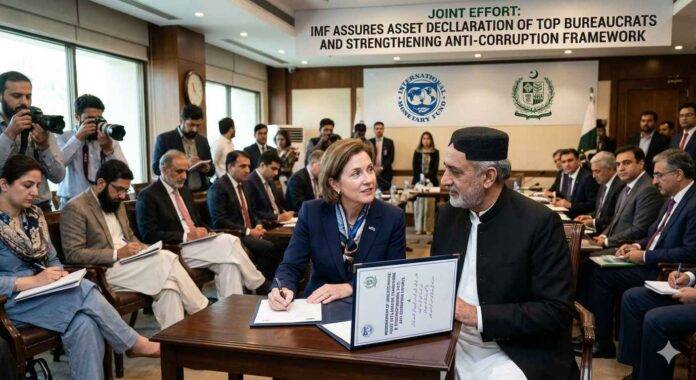

Major Governance Reform Linked to IMF Programme in Pakistan
Pakistan has formally committed to the International Monetary Fund under its ongoing financial programme to introduce sweeping governance reforms aimed at increasing transparency, accountability, and institutional discipline.
At the core of these reforms is a major decision to publicly disclose the assets of senior federal civil servants ranging from BPS-17 to BPS-22. The move is designed to address long-standing concerns over corruption, misuse of authority, and lack of financial transparency within the public sector.
The government has assured the IMF that this asset declaration system will be fully implemented by December 2026, marking one of the most significant administrative transparency initiatives in recent years.
Public Disclosure of Bureaucratic Assets to Strengthen Transparency
The decision to make asset declarations public represents a structural shift in governance practices. For decades, citizens have demanded transparency regarding the financial holdings, benefits, and income sources of senior bureaucrats.
However, these demands were largely ignored until international financial institutions linked governance reforms to economic assistance.
Under the new framework, federal civil servants will be required to disclose their financial assets, which will then be subject to digital verification and structured monitoring systems.
The goal is to reduce corruption risks at higher levels of administration and improve public trust in government institutions.
Autonomy of Anti-Corruption Institutions Under Reform Agenda
Another major component of the reform plan is the institutional strengthening of anti-corruption bodies.
The government has committed to making the National Accountability Bureau autonomous by January 2027. This step is intended to reduce political influence in accountability processes and ensure independent investigations.
The reforms also include the identification of ten high-risk government departments where corruption vulnerabilities are considered significantly higher.
These departments will be reviewed under a structured risk assessment system focusing on financial exposure, administrative weaknesses, and historical corruption patterns.
Digital Transformation of Asset Declaration System
A major part of the reform involves the digitisation of the entire asset declaration process.
A centralised digital platform will be developed to allow civil servants to submit their financial disclosures electronically. This system is expected to be fully operational by mid-2026.
The Federal Board of Revenue will play a key role in designing and managing this digital infrastructure, ensuring data integration and secure submission processes.
The Establishment Division has also revised civil service conduct rules to incorporate risk-based verification and controlled public access to non-sensitive financial data.
Strengthening Financial Monitoring and Inter-Agency Coordination
To further improve oversight, the reform programme includes enhanced coordination between financial and regulatory institutions.
The Financial Monitoring Unit and central banking authorities will be granted expanded access to asset declaration data. This integration will support anti-money laundering efforts and counter-terror financing controls.
Banks and financial institutions will also be able to access selected data sets for compliance and verification purposes, strengthening the overall financial governance ecosystem.
Risk-Based Identification of High-Corruption Departments
Authorities will conduct a comprehensive review of ten federal departments identified as high risk for corruption.
The evaluation framework will examine multiple factors, including financial transactions, administrative gaps, procurement processes, and historical misconduct cases.
This assessment will be conducted in consultation with oversight bodies such as accountability agencies, audit institutions, financial regulators, and investigation authorities.
The objective is to design targeted reforms that address structural weaknesses instead of applying uniform policies across all departments.
Expanded Role of Accountability Institutions
The reform agenda also enhances the role of provincial anti-corruption bodies.
These agencies will be strengthened to conduct financial investigations at the provincial level, especially in cases involving public funds and administrative corruption.
A formal notification process under anti-money laundering regulations will also allow provincial bodies to access financial intelligence, improving investigative capacity.
This step is aimed at creating a more coordinated national anti-corruption framework across federal and provincial levels.
Governance Challenges and Institutional Weaknesses
Pakistan’s governance system has faced long-standing challenges related to inefficiency, political interference, and declining institutional performance.
Over the past two decades, governance indicators have shown deterioration due to weak accountability, lack of merit-based decision-making, and inconsistent policy implementation.
Despite multiple reform commissions and administrative restructuring efforts, systemic issues continue to persist.
Experts argue that without institutional independence and transparent accountability mechanisms, governance reforms remain incomplete.
IMF-Backed Reform Programme and Financial Conditions
The governance reforms are part of a broader economic stabilisation programme supported by a multi-billion-dollar IMF arrangement.
The programme emphasises structural reforms, fiscal discipline, and institutional transparency as conditions for financial assistance.
Pakistan has already agreed to key review benchmarks, including improved governance frameworks and enhanced fiscal oversight mechanisms.
The IMF has consistently stressed that long-term economic stability depends on institutional reforms alongside financial adjustments.
Rising Public Debt and Fiscal Pressures
Alongside governance reforms, Pakistan continues to face significant fiscal challenges.
Total public debt has reached unprecedented levels, driven by persistent budget deficits, rising import costs, and heavy reliance on borrowing.
A large portion of government expenditure is directed toward debt servicing, leaving limited fiscal space for development spending.
Officials have acknowledged that continued borrowing to repay existing debt remains a major concern for long-term financial sustainability.
Calls for Fiscal Discipline and Structural Reform
Policy discussions have increasingly focused on improving fiscal discipline and reducing non-essential expenditures.
Concerns have been raised over rising government spending patterns, limited revenue growth, and structural inefficiencies in tax collection systems.
There have also been proposals to rationalise public sector spending and improve financial accountability within government institutions.
Experts suggest that governance reforms, combined with fiscal restructuring, are essential to stabilise the economy.
Conclusion: Toward a More Transparent Governance Framework
The agreement to publicly disclose bureaucratic assets and strengthen anti-corruption institutions represents a major shift in Pakistan’s governance structure.
If implemented effectively, these reforms could significantly improve transparency, reduce corruption risks, and strengthen institutional accountability.
However, the success of these measures will depend on consistent enforcement, political commitment, and long-term institutional independence.
The reform agenda signals a broader transition toward a more transparent and digitally monitored governance system, aligned with international standards of accountability and financial discipline.
Read More
Cybercriminals Use Multiple Tactics to Steal WhatsApp Data for Fraudulent Activities