
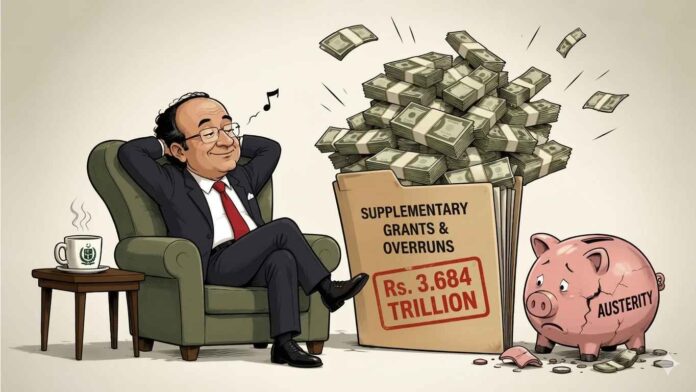

The federal government is facing renewed scrutiny after seeking parliamentary approval for supplementary expenditures totaling Rs. 3.684 trillion, a figure that has reignited debate over fiscal discipline, budget planning, expenditure management, and the effectiveness of austerity measures. The amount significantly exceeds the supplementary spending approved in previous years and has become a focal point in discussions surrounding public finances, governance, and economic management.
The request comes at a time when policymakers continue to emphasize fiscal consolidation, economic stabilization, and prudent spending practices. However, the sheer scale of the additional expenditures has prompted questions about whether budget estimates accurately reflect government spending requirements and whether existing expenditure controls are sufficient to prevent large overruns.
As lawmakers review the supplementary grant requests, economists, analysts, and taxpayers are closely examining the factors behind the overspending and its implications for Pakistan’s fiscal outlook.
Understanding Supplementary Grants and Excess Spending
Supplementary grants are additional funds sought by the government when spending exceeds the amounts originally approved in the annual budget. These grants are generally used to meet unforeseen expenditures, emergency requirements, or obligations that cannot be delayed.
Under constitutional procedures, governments may spend funds beyond approved allocations in exceptional circumstances, but such expenditures must eventually be presented before parliament for regularization and approval.
The current request involves post-facto approval, meaning the expenditures have already occurred and lawmakers are being asked to formally authorize them after the fact.
While supplementary grants are a recognized component of public finance management, unusually large supplementary spending often raises concerns about budget forecasting, expenditure planning, and fiscal accountability.
The latest request is particularly notable because it exceeds previous years by a substantial margin, creating fresh debate regarding financial management practices.
A Significant Increase Compared to Previous Years
The scale of the current supplementary spending request stands out because it is more than four times larger than the amount regularized by parliament in the previous fiscal cycle.
This sharp increase has attracted widespread attention among policymakers and economic observers.
A significant rise in supplementary expenditures may indicate that initial budget projections failed to adequately account for emerging fiscal pressures or changing economic conditions.
It may also reflect structural challenges within government budgeting processes, where certain expenditures consistently exceed allocated amounts due to underestimation or evolving policy priorities.
Regardless of the underlying reasons, the increase has intensified calls for stronger fiscal oversight and improved expenditure forecasting mechanisms.
Many analysts argue that reducing the gap between budgeted and actual spending is essential for maintaining credibility in fiscal planning and strengthening public confidence in economic management.
Debt Servicing Emerges as the Largest Contributor
One of the most significant drivers of supplementary spending continues to be debt servicing.
A large portion of the additional expenditure request is linked directly to obligations associated with servicing public debt.
Debt servicing includes interest payments and related costs arising from domestic and external borrowing.
As public debt levels increase, debt servicing obligations consume a growing share of government resources, reducing fiscal space for development projects, social services, and economic initiatives.
The increasing burden of debt servicing has become one of the most important fiscal challenges facing Pakistan.
Rising interest rates, exchange rate fluctuations, and refinancing requirements have contributed to growing debt-related expenditures in recent years.
These costs are often difficult to postpone because governments must meet debt obligations to maintain financial stability and preserve credibility with lenders and investors.
Consequently, debt servicing frequently becomes a major contributor to supplementary spending requirements.
Power Sector Continues to Create Fiscal Pressures
Another major component of supplementary expenditures relates to the power sector.
Pakistan’s energy sector has long faced structural challenges, including transmission losses, recovery shortfalls, capacity payments, and circular debt accumulation.
These issues often require government intervention through subsidies, grants, and financial support measures.
The continued need for substantial allocations to the power sector highlights the financial pressures associated with maintaining electricity supply while attempting to protect consumers from excessive tariff increases.
Energy sector expenditures remain among the most significant recurring fiscal challenges confronting policymakers.
Without comprehensive structural reforms, power sector support requirements are likely to continue exerting pressure on public finances and contribute to future supplementary spending needs.
The repeated allocation of additional funds to the sector underscores the importance of long-term reforms aimed at improving efficiency, reducing losses, and strengthening financial sustainability.
Growing Demands for Grants and Subsidies
Government grants and subsidies also account for a considerable portion of supplementary expenditures.
These allocations are often used to support vulnerable populations, stabilize prices, assist strategic sectors, and address economic challenges.
Subsidies can play an important role in protecting low-income households and supporting economic activity during periods of uncertainty.
However, they also create fiscal obligations that can exceed original budget estimates.
As inflation, economic pressures, and social welfare requirements evolve throughout the year, governments frequently adjust subsidy programs to address emerging needs.
The growing reliance on supplementary grants for subsidies raises important questions about how such expenditures should be incorporated into annual budgeting processes.
Many analysts argue that improved forecasting and contingency planning could help reduce the need for large mid-year adjustments.
Education and Health Sector Allocations
Supplementary spending requests also include allocations for education and healthcare services.
Investments in these sectors are critical for long-term economic development and human capital formation.
Educational expenditures support schools, universities, skills development programs, and broader efforts to improve learning outcomes.
Similarly, healthcare funding helps maintain medical services, improve access to treatment, and strengthen public health infrastructure.
While additional funding for these sectors may be necessary to address emerging challenges, repeated reliance on supplementary grants can indicate that original budget allocations were insufficient to meet operational requirements.
Ensuring adequate funding for education and health remains a key policy objective for governments seeking sustainable economic growth and social development.
Social Protection and Poverty Alleviation Spending
Social protection programs continue to represent an important area of government expenditure.
Supplementary allocations for poverty alleviation and social safety initiatives reflect efforts to support vulnerable communities facing economic hardship.
Social protection measures can include direct cash transfers, food assistance programs, emergency relief initiatives, and targeted support for low-income households.
These programs become particularly important during periods of inflation, economic uncertainty, or external shocks.
The challenge for policymakers lies in balancing the need for social protection with broader fiscal sustainability objectives.
As economic conditions evolve, governments often face pressure to expand support programs beyond initial budget estimates, contributing to supplementary spending requirements.
Questions Surrounding Austerity Measures
The supplementary spending request has also fueled debate about the effectiveness of government austerity measures.
Austerity policies are typically designed to reduce expenditures, improve fiscal discipline, and strengthen public finances.
Governments frequently promote austerity initiatives as evidence of their commitment to responsible economic management.
However, critics argue that large supplementary expenditures may undermine the credibility of austerity claims.
The existence of significant spending overruns raises questions about whether expenditure controls are being implemented effectively.
Supporters of the government contend that many supplementary expenditures arise from unavoidable obligations and operational necessities rather than discretionary spending decisions.
Nevertheless, the scale of the current request has intensified scrutiny of fiscal management practices.
The Challenge of Budget Forecasting
Accurate budget forecasting remains one of the most important aspects of effective public finance management.
Governments must estimate revenues, expenditures, economic growth, inflation, debt servicing costs, and policy requirements months before a fiscal year begins.
Unexpected economic developments can significantly alter fiscal conditions after budgets have been approved.
Changes in global commodity prices, exchange rates, interest rates, energy costs, and economic growth patterns can all influence government spending needs.
While some degree of variance between projected and actual expenditures is inevitable, large deviations may indicate weaknesses in forecasting methodologies or planning processes.
Strengthening budget forecasting capabilities can help improve fiscal predictability and reduce reliance on supplementary grants.
Implications for Fiscal Consolidation Efforts
Pakistan’s fiscal consolidation strategy aims to reduce budget deficits, improve revenue collection, manage debt levels, and strengthen macroeconomic stability.
Large supplementary expenditures can complicate these objectives by increasing overall spending requirements.
Fiscal consolidation requires careful balancing of expenditure controls, revenue generation, economic growth, and social welfare priorities.
Managing this balance becomes more challenging when unexpected spending pressures emerge during the fiscal year.
Policymakers must therefore develop mechanisms that allow flexibility while maintaining overall fiscal discipline.
The current supplementary spending request illustrates the complexity of achieving fiscal consolidation in an environment characterized by multiple competing priorities and ongoing economic challenges.
The Role of Parliamentary Oversight
Parliamentary approval serves as an important accountability mechanism within the budgetary process.
Legislators are responsible for reviewing government expenditures, questioning spending decisions, and ensuring public funds are used appropriately.
The debate surrounding supplementary grants provides an opportunity for lawmakers to assess the reasons behind spending overruns and evaluate the effectiveness of fiscal management practices.
Strong parliamentary oversight helps promote transparency and accountability while reinforcing democratic governance principles.
As lawmakers examine the supplementary spending request, discussions are expected to focus on expenditure justification, fiscal sustainability, and future budget planning improvements.
Balancing Operational Needs and Fiscal Discipline
Government officials maintain that many of the supplementary expenditures were necessary to meet operational requirements that could not be postponed or accommodated within existing allocations.
Certain obligations, such as debt servicing, energy sector support, social welfare programs, and essential public services, require immediate funding regardless of budget constraints.
Balancing these operational needs with fiscal discipline remains one of the most difficult challenges in public finance management.
Governments must ensure continuity of essential services while simultaneously pursuing fiscal responsibility and economic stability.
Finding this balance requires effective planning, realistic budgeting, and responsive financial management systems.
Economic Implications of Rising Public Expenditures
The scale of supplementary spending has broader implications for economic policy and fiscal sustainability.
Higher public expenditures can influence borrowing requirements, debt levels, inflation expectations, and investor confidence.
Financial markets closely monitor government spending patterns because they affect perceptions of fiscal stability and economic management.
Sustained expenditure overruns may increase pressure on public finances and complicate efforts to reduce fiscal deficits.
Conversely, certain expenditures may support economic activity, social stability, and essential public services.
The overall impact depends on how effectively additional spending contributes to economic objectives and whether it is accompanied by measures to strengthen revenue generation and expenditure efficiency.
Looking Ahead: Strengthening Fiscal Management
The debate surrounding the Rs. 3.684 trillion supplementary spending request highlights the importance of strengthening fiscal management systems and improving budget planning processes.
Future reforms may focus on enhancing expenditure forecasting, strengthening monitoring mechanisms, improving transparency, and introducing more effective expenditure controls.
Better coordination between government departments, improved financial reporting systems, and stronger accountability frameworks can help reduce reliance on supplementary grants.
At the same time, policymakers must retain sufficient flexibility to respond to changing economic conditions and unforeseen challenges.
The discussion also underscores the need for long-term structural reforms aimed at addressing recurring fiscal pressures such as debt servicing costs, energy sector liabilities, and social protection requirements.
Conclusion
The government’s request for parliamentary approval of Rs. 3.684 trillion in supplementary expenditures has become a major focal point in discussions about fiscal policy, budget planning, and public finance management.
The substantial increase compared with previous years has raised legitimate questions regarding expenditure controls, forecasting accuracy, and the implementation of austerity measures.
While government officials argue that many of the expenditures were unavoidable and necessary for operational continuity, critics contend that the scale of the overruns highlights weaknesses in budgeting and financial management processes.
As parliament reviews the request, the debate is likely to shape broader discussions about fiscal discipline, economic governance, and the future direction of Pakistan’s public finance strategy.
The outcome will not only determine the regularization of past expenditures but may also influence future efforts to strengthen budget planning, improve accountability, and ensure long-term fiscal sustainability.
Read More
SECP Launches Strategy to Add 2.5 Million New Investors in Pakistan


