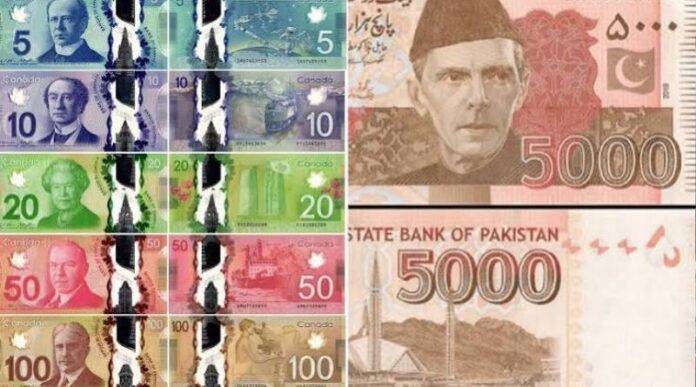

The Pakistani rupee (PKR) showed a positive performance against two major foreign currencies, the Canadian Dollar (CAD) and the Euro (EUR), gaining around Rs. 1 against each during the latest trading session. The improvement in the value of the local currency comes as Pakistan continues to closely watch developments in both local and international financial markets.
Currency movements remain important for businesses, investors, overseas Pakistanis, importers, exporters and ordinary people. Even a small change in the value of the rupee can affect the cost of imported goods, foreign travel, education expenses and international business payments.
The latest movement showed that the Pakistani rupee performed better against the Canadian Dollar and the Euro. A stronger rupee means that fewer Pakistani rupees are needed to buy one unit of a foreign currency. This can provide some relief to businesses and individuals who need foreign currencies for payments.
PKR Shows Improvement Against Major Currencies
The Pakistani rupee has experienced different levels of movement against major global currencies in recent months. While its value against the US Dollar remains the main focus of the currency market, changes against currencies such as the Euro, Canadian Dollar, British Pound and Australian Dollar are also important.
During the latest session, the PKR gained about Rs. 1 against both the Euro and the Canadian Dollar. This meant that the local currency became stronger compared with the previous trading session.
The Euro is widely used in European countries and is an important currency in international trade and finance. Similarly, the Canadian Dollar is important for people and businesses dealing with Canada. Changes in these exchange rates can directly affect Pakistani importers, students, travellers and families receiving money from abroad.
The improvement of around Rs. 1 may appear small, but exchange rate changes can have a wider effect when large amounts of money are involved. For example, a business making a large payment in Euros or Canadian Dollars may save a significant amount if the Pakistani rupee becomes stronger.
Why Exchange Rate Movements Matter
Exchange rates affect many parts of Pakistan’s economy. Pakistan imports a wide range of goods from different countries, including machinery, technology products, chemicals, vehicles and other important items. When the rupee becomes stronger against a foreign currency, the cost of buying products from countries using that currency may become lower.
On the other hand, exporters may face different conditions. A weaker rupee can sometimes help exporters because foreign buyers may be able to purchase Pakistani products at lower prices. However, exporters also use imported materials and machinery, which can become more expensive when the rupee loses value.
This is why currency movements are closely followed by businesses and economic experts.
For ordinary people, exchange rates can affect the prices of imported goods available in local markets. Products made using imported parts or raw materials can also become more expensive when foreign currencies rise against the rupee.
A stronger PKR against the Euro and Canadian Dollar may therefore be seen as a positive sign for people and businesses that need to make payments in these currencies.
Euro Remains an Important Global Currency
The Euro is one of the world’s major currencies and is used by several European countries. Pakistan has trade and business relations with European nations, making the Euro important for the country’s economy.
Pakistani businesses involved in trade with Europe closely watch changes in the EUR/PKR exchange rate. Importers buying goods from European suppliers may benefit when the rupee strengthens against the Euro.
Students planning to study in European countries can also be affected by exchange rate movements. Tuition fees, accommodation costs and daily expenses may become more expensive or cheaper depending on the value of the Pakistani rupee against the Euro.
Similarly, Pakistani travellers visiting Europe must exchange their rupees into Euros. A stronger rupee can reduce the number of rupees required for the same amount of foreign currency.
During the latest session, the gain of around Rs. 1 against the Euro offered a small improvement for those who need to buy the European currency.
Canadian Dollar Also Falls Against the Rupee
The Pakistani rupee also gained around Rs. 1 against the Canadian Dollar during the session. This was another positive development for the local currency.
Canada is home to a large Pakistani community, and many Pakistanis have family members, students and business connections in the country. The exchange rate between the PKR and CAD can therefore be important for many households.
Pakistani students studying in Canada often have to pay tuition fees and living expenses in Canadian Dollars. When the PKR becomes stronger against the CAD, the total cost of converting rupees into Canadian currency can become slightly lower.
Businesses involved in trade with Canada may also benefit from a stronger rupee, especially if they need to import goods or services and make payments in Canadian Dollars.
However, people receiving Canadian Dollars from abroad may get slightly fewer rupees when converting the same amount of foreign currency into PKR. This shows that exchange rate movements can create benefits for some people while having a different effect on others.
International Markets Play a Major Role
The value of the Pakistani rupee against currencies other than the US Dollar is not based only on local economic conditions. International currency markets also play a major role.
For example, the Euro may strengthen or weaken because of economic developments in Europe. Changes in interest rates, inflation, trade conditions and central bank decisions can affect the value of the Euro.
The Canadian Dollar is also influenced by global developments. Canada’s economy has close links with commodity markets, especially oil and other natural resources. Changes in global oil prices can therefore affect the Canadian currency.
As a result, the Pakistani rupee may gain against the Canadian Dollar even when there is no major change in Pakistan’s own economic conditions. The same is true for the Euro and other international currencies.
This is why daily exchange rate movements must be understood in the context of both local and global financial developments.
Effect on Importers and Businesses
Businesses that import products from Europe or Canada can benefit when the Pakistani rupee gains value against the Euro or Canadian Dollar.
A stronger PKR means importers may need fewer rupees to complete foreign payments. This can help reduce the overall cost of imported goods.
However, a single day’s gain does not always lead to lower prices in the local market. Businesses usually consider exchange rates over a longer period. Other costs, including taxes, shipping charges, fuel prices and international prices, also affect the final cost of imported products.
Still, regular improvement in the value of the rupee can help businesses manage their expenses better. It may also reduce pressure on companies that have payments due in foreign currencies.
For Pakistan, currency stability is also important because sudden and major changes can create uncertainty in the market. Businesses prefer stable conditions because they can plan future payments and costs more easily.
Impact on Overseas Pakistanis
Millions of Pakistanis live and work outside the country. Many of them send money home to support their families. Exchange rate movements can affect the number of rupees received for the same amount of foreign currency.
If a person sends Euros or Canadian Dollars to Pakistan, a stronger PKR may mean that the family receives fewer rupees after conversion. On the other hand, if the rupee becomes weaker, the same foreign amount can provide more rupees.
Despite this, exchange rates are only one factor affecting remittances. Overseas Pakistanis also consider income, family needs and the overall cost of sending money.
Pakistan receives significant remittances from overseas citizens, making the foreign exchange market an important part of the national economy.
Stability Remains Important for Pakistan
A stable currency is important for Pakistan’s economic planning. Large and sudden changes in the value of the rupee can create difficulties for businesses, investors and consumers.
The latest gain against the Euro and Canadian Dollar is a positive movement, but the overall direction of the currency depends on many factors. These include foreign exchange reserves, imports, exports, remittances, international oil prices and investor confidence.
Government economic policies and decisions by the State Bank of Pakistan can also influence the overall market environment. At the same time, global events can quickly change the value of major currencies.
The PKR’s movement against foreign currencies will therefore continue to be watched closely by market participants.
What Could Happen Next?
It is difficult to predict the exact direction of any currency because financial markets can change quickly. A currency may gain during one trading session and lose value during the next.
The future performance of the PKR against the Euro and Canadian Dollar will depend partly on developments in international markets. Changes in the value of the Euro and Canadian Dollar against the US Dollar can also affect their exchange rates with the Pakistani rupee.
Pakistan’s own economic situation will remain equally important. Strong foreign exchange reserves, stable inflation, controlled imports and healthy remittance inflows can support the local currency.
However, rising import payments, higher oil prices or increased demand for foreign currency can place pressure on the rupee.
For now, the latest session brought some positive news as the PKR gained around Rs. 1 against both the Canadian Dollar and the Euro.
Conclusion
The Pakistani rupee recorded a positive performance by gaining approximately Rs. 1 against the Canadian Dollar and the Euro in the latest trading session. The development showed an improvement in the local currency’s position against these two major international currencies.
Such movements are important for importers, businesses, students, travellers and overseas Pakistanis. A stronger rupee can reduce the cost of foreign payments, although it may also affect the amount received in rupees by people sending money from abroad.
The exchange rate market remains influenced by both Pakistan’s economic situation and changes in international financial markets. The value of the Euro and Canadian Dollar can move because of global economic conditions, making daily currency changes difficult to predict.
The latest gain is a positive development for the Pakistani rupee. However, long-term currency stability will remain more important than short-term daily changes. Businesses and consumers will continue to watch future movements closely as the PKR responds to local economic conditions and changes in the global market.
Read Also: check