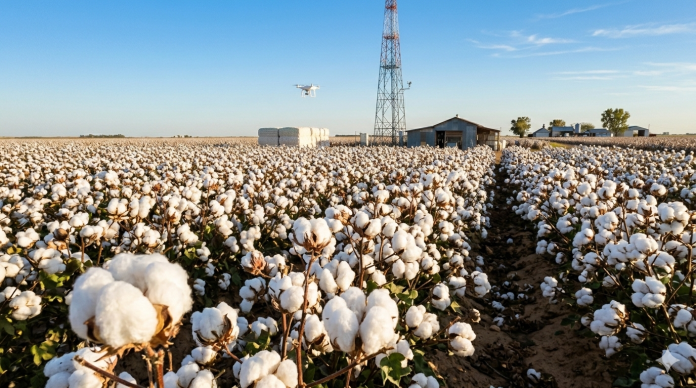

Pakistan’s cotton production for the 2025–26 season reached 5.607 million bales, reflecting a modest increase of 1.5 percent compared to the previous year. Despite the slight improvement, overall output remained significantly below the official target of 10.2 million bales set at the start of the season.
The shortfall underscores persistent structural challenges in the agriculture sector, including fluctuating weather conditions, pest attacks, water shortages, and shifting crop patterns. While the marginal growth offers some relief after previous declines, it has not been sufficient to narrow the substantial gap between actual production and policy expectations.
Provincial Performance Highlights Disparities
The production target allocated 5.553 million bales to Punjab and 4.627 million bales to Sindh and Balochistan combined. However, both regions fell considerably short of their assigned goals.
Punjab produced 2.693 million bales during the season, falling approximately 51.5 percent below its target. The underperformance in the country’s traditionally leading cotton-producing province reflects ongoing concerns about declining acreage, lower yields, and competition from alternative crops.
In contrast, Sindh and Balochistan together produced 2.915 million bales, about 37 percent below their combined target. Despite also missing their objective, these provinces collectively outperformed Punjab in actual output by roughly 7.6 percent. This shift marks a notable change in regional production dynamics, as Punjab has historically dominated national cotton output.
The differing performance levels may influence future agricultural planning and resource allocation decisions, particularly regarding irrigation management, seed quality improvement, and farmer support programs.
Domestic Consumption and Stock Position
During the season, textile mills purchased approximately 5.188 million bales from ginning factories to meet industrial demand. Exporters acquired an additional 100,078 bales, reflecting moderate international interest in Pakistani cotton.
Remaining stocks held by ginners, exporters, traders, and farmers are estimated at around 400,000 bales. However, only about 125,000 bales are considered to be high-quality cotton suitable for premium textile production.
The limited availability of quality cotton is emerging as a critical concern for the textile sector, which relies heavily on consistent fiber standards for value-added exports. As a result, domestic prices are expected to remain firm in the coming weeks, particularly if global supply chains face further disruptions.
Rising Imports to Bridge the Gap
To compensate for the production shortfall, Pakistani textile mills have reportedly signed agreements to import more than four million bales. These imports are intended to stabilize raw material supply and ensure uninterrupted operations in spinning and weaving units.
The growing reliance on imported cotton highlights the widening gap between domestic production and industrial demand. While imports help sustain export-oriented manufacturing, they also exert pressure on foreign exchange reserves and increase vulnerability to global price volatility.
Continued Cotton Arrivals
Cotton arrivals are still ongoing, with 62,300 bales reaching ginning factories in February alone. This represents a sharp 348 percent increase compared to February of the previous year, indicating a late-season pickup in supply.
At present, 67 ginning factories remain operational in Punjab, processing incoming cotton. Analysts suggest that final production figures should ideally be compiled in early April to account for late arrivals and ensure accurate reporting.
Target Calculation Debate
An additional factor complicating the production shortfall is the method used to calculate targets. Official production goals are based on a standard bale weight of 170 kilograms. However, actual bale weights average closer to 160 kilograms.
When recalculated using the lower average weight, the effective national target rises to approximately 10.837 million bales. Under this adjusted benchmark, the production shortfall increases to around 5.23 million bales, representing nearly 48 percent below target.
This discrepancy raises questions about the realism of target-setting mechanisms and whether revised methodologies are needed to better reflect ground realities.
Outlook for the Sector
The persistent gap between targets and actual output highlights the need for structural reforms in Pakistan’s cotton sector. Improving seed technology, enhancing pest management, modernizing irrigation systems, and ensuring better price incentives for farmers could be critical to reversing the long-term decline.
While the slight production increase provides a measure of stability, significant policy and operational changes will be required to restore cotton as a reliable pillar of the country’s agricultural economy and textile supply chain.
Read More
Jazz, Zong and Ufone Cleared to Participate in Pakistan’s 5G Spectrum Auction