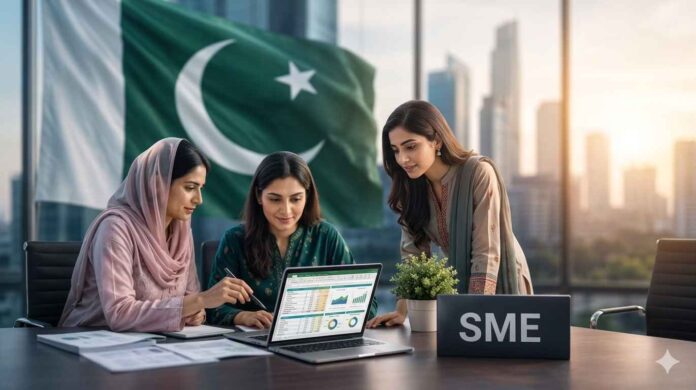

Pakistan is intensifying efforts to strengthen its small and medium enterprise sector by encouraging banks to increase financing for SMEs and women entrepreneurs. The latest push reflects growing recognition of the critical role small businesses play in economic growth, employment generation, industrial expansion, and export development.
The government has emphasized the need for commercial banks to simplify lending procedures, improve financial accessibility, and provide targeted support for women-led businesses and export-oriented enterprises. Authorities believe easier access to financing could unlock significant untapped economic potential across Pakistan’s business landscape.
The move comes as policymakers seek to address longstanding structural challenges facing the SME sector, including limited credit access, weak documentation systems, insufficient integration into formal supply chains, and barriers to international markets.
Officials have also highlighted the importance of expanding economic participation among women entrepreneurs, who remain significantly underrepresented within formal business and financial systems despite growing interest in entrepreneurship and digital commerce.
The renewed focus on SME financing is part of broader economic reform efforts aimed at increasing exports, improving industrial productivity, supporting innovation, and creating sustainable employment opportunities across Pakistan.
SMEs Considered the Backbone of Pakistan’s Economy
Small and medium enterprises represent one of the most important pillars of Pakistan’s economy.
The SME sector accounts for nearly 90 percent of businesses operating across the country and contributes significantly to employment, industrial production, domestic trade, and economic activity.
Thousands of SMEs operate in sectors such as manufacturing, agriculture, textiles, technology, retail, logistics, food processing, construction, handicrafts, and services.
These businesses play a crucial role in supporting local economies, creating jobs, and driving entrepreneurship at both urban and rural levels.
Despite their economic importance, many SMEs continue facing difficulties in accessing formal financing channels. Limited credit availability has often prevented businesses from expanding operations, investing in technology, increasing production capacity, or entering export markets.
Economic experts believe strengthening the SME sector could significantly improve Pakistan’s long-term economic resilience and reduce dependence on large industries concentrated in a few sectors.
A stronger SME ecosystem may also help diversify economic activity and encourage more inclusive growth across different regions of the country.
Government Pushes Banks to Improve SME Financing
One of the central goals of the latest policy push is improving access to financing for small businesses.
Commercial banks have been encouraged to simplify loan procedures, reduce financing barriers, and develop products tailored specifically for SMEs and women entrepreneurs.
Many small businesses struggle to obtain bank financing because they lack formal documentation, collateral, credit histories, or audited financial records.
Traditional lending models often favor large corporations and established borrowers, leaving smaller enterprises underserved.
Authorities believe banks must adopt more flexible and inclusive financing strategies to support economic growth and entrepreneurship.
Improved SME financing can help businesses expand production, purchase equipment, improve technology, hire workers, and strengthen competitiveness.
The government also aims to lower financing costs for small businesses to make borrowing more affordable and accessible.
Financial experts argue that increasing SME lending could stimulate broader economic activity and improve industrial productivity.
Women Entrepreneurs Receiving Greater Policy Attention
Women entrepreneurs have become a major focus of Pakistan’s economic development strategy.
Authorities are increasingly emphasizing the need to improve financial inclusion and create greater economic opportunities for women-led businesses.
Many women entrepreneurs in Pakistan face unique challenges, including limited access to financing, cultural barriers, restricted market access, lack of collateral, and lower representation within formal business sectors.
Despite these obstacles, women-owned businesses are steadily growing across sectors such as fashion, e-commerce, food services, handicrafts, education, digital services, beauty products, and home-based manufacturing.
The government believes supporting women entrepreneurs can significantly contribute to economic growth, household incomes, and social development.
Expanding financing access for women-led SMEs may also encourage more female participation in entrepreneurship and formal economic activity.
Digital banking, online marketplaces, and fintech platforms are creating new opportunities for women entrepreneurs to operate businesses with lower entry barriers.
Authorities now want financial institutions to actively support these emerging opportunities through easier credit access and targeted lending initiatives.
Export Expansion Seen as Key Economic Priority
The government’s focus on SMEs is closely tied to broader efforts aimed at increasing Pakistan’s export capacity.
Officials believe small and medium enterprises possess substantial untapped potential to contribute to export growth across various sectors.
Many SMEs produce competitive products in textiles, agriculture, sports goods, leather, information technology, handicrafts, engineering, and processed foods but struggle to access international markets.
Limited financing often prevents these businesses from scaling production, meeting international quality standards, investing in certifications, or participating in global trade exhibitions.
The government is encouraging banks and relevant institutions to support SMEs in expanding exports and connecting with foreign buyers.
Authorities also aim to improve international market exposure through roadshows, trade exhibitions, export promotion programs, and business networking initiatives.
Strengthening SME exports is considered important for improving Pakistan’s trade balance, increasing foreign exchange earnings, and reducing external economic pressures.
Roadmap Prepared for SME Sector Development
Officials have prepared a development roadmap focused on strengthening the SME sector over the coming years.
The strategy includes phased reforms, sector-specific initiatives, financing improvements, market expansion programs, and industrial development measures.
Authorities have also been instructed to finalize implementation plans with measurable targets and defined timelines to ensure progress remains trackable and accountable.
The roadmap reportedly includes dozens of initiatives across multiple strategic sectors aimed at improving SME competitiveness and growth potential.
The focus areas include financing access, industrial value chains, digital documentation, export promotion, market integration, and entrepreneurship development.
Economic analysts believe clearly defined implementation strategies are essential because Pakistan’s SME sector has historically suffered from fragmented policies and inconsistent support mechanisms.
Long-term policy continuity will likely be critical for achieving meaningful results.
Agriculture Processing Sector to Receive SME Status
One of the notable policy decisions involves granting SME status to processing sectors within agriculture.
This move is expected to provide agricultural processing businesses with greater access to financing, policy incentives, and institutional support.
Agriculture remains one of Pakistan’s largest economic sectors, but much of its output lacks value addition due to limited processing infrastructure.
Food processing, packaging, cold storage, and agricultural manufacturing businesses can help increase export value, reduce waste, and improve farmer incomes.
By classifying these businesses as SMEs, authorities aim to integrate agriculture more effectively into industrial and export development strategies.
The decision may encourage investment in agri-processing industries while creating opportunities for rural entrepreneurship and employment generation.
Agricultural SMEs could play a major role in modernizing Pakistan’s food supply chains and increasing export competitiveness in global markets.
Need for Easier and Lower-Cost Financing
One of the biggest obstacles facing SMEs in Pakistan is the high cost and complexity of borrowing.
Businesses often encounter strict collateral requirements, lengthy approval processes, high markup rates, and extensive documentation demands.
Many entrepreneurs, particularly startups and small enterprises, find formal financing inaccessible or unaffordable.
The government is encouraging financial institutions to simplify lending procedures and introduce lower-cost financing options tailored to SME needs.
Digital lending platforms, alternative credit assessment models, and fintech integration could help improve financial access for underserved businesses.
Experts believe reducing financing barriers may encourage business formalization, investment, innovation, and expansion across multiple sectors.
Improved access to affordable credit can also strengthen productivity and competitiveness among smaller enterprises.
Importance of Vendor Profiling and Supply Chain Integration
Authorities are also focusing on strengthening industrial value chains through vendor profiling and improved business integration.
Many SMEs operate outside formal supply chains and struggle to connect with large industries, exporters, or multinational companies.
Vendor profiling systems can help identify capable businesses and integrate them into broader industrial networks.
Improved supply chain integration may create new opportunities for SMEs to participate in manufacturing ecosystems, industrial partnerships, and export production.
Formal integration into supply chains can also improve business documentation, financial transparency, and access to institutional financing.
Industrial experts believe stronger SME linkages with larger corporations could significantly improve productivity and competitiveness within Pakistan’s manufacturing sector.
National SME Database to Improve Documentation
Documentation challenges remain a major issue for Pakistan’s SME sector.
Many small businesses operate informally without proper registration, financial records, tax documentation, or digital data systems.
This lack of formal documentation often prevents SMEs from accessing financing, government incentives, and export opportunities.
Authorities are now working on the creation of a national SME database aimed at improving documentation, transparency, and policy planning.
A centralized database may help policymakers better understand the sector’s size, structure, financing needs, and economic contribution.
Improved documentation can also help banks evaluate business performance more effectively and expand lending opportunities.
Digital records and formal registration systems are increasingly important for integrating SMEs into modern financial and commercial ecosystems.
Pakistan’s SME Financing Still Low Compared to Regional Economies
Despite repeated policy efforts, SME financing levels in Pakistan remain relatively low compared to many regional economies.
Small businesses often rely heavily on personal savings, family funding, informal borrowing, or trade credit instead of formal bank loans.
Limited credit penetration has constrained growth potential across multiple sectors.
Economic experts argue that expanding SME financing is essential for supporting entrepreneurship, industrial diversification, and economic resilience.
Regional competitors with stronger SME financing systems often demonstrate higher levels of innovation, exports, and employment growth.
Pakistan’s financial sector may need deeper structural reforms to significantly improve SME credit availability.
These reforms could include credit guarantee schemes, risk-sharing mechanisms, digital lending systems, and specialized SME banking products.
Women-Led Startups and Digital Businesses on the Rise
Women entrepreneurs are increasingly entering digital and technology-driven sectors due to expanding internet access and growing e-commerce adoption.
Online businesses allow women to operate enterprises with lower startup costs and greater flexibility compared to traditional brick-and-mortar operations.
Social commerce, freelance services, digital marketing, online education, fashion brands, beauty products, and home-based food businesses are among the fastest-growing segments for women entrepreneurs.
Access to financing can help these businesses scale operations, improve marketing, invest in technology, and expand into larger domestic and international markets.
Authorities believe supporting women-led digital businesses may also contribute to financial inclusion and economic modernization.
The rise of digital entrepreneurship could become an important driver of future SME growth in Pakistan.
SME Development Seen as Essential for Employment Generation
Pakistan’s growing population and expanding labor force continue increasing pressure on the economy to create sustainable employment opportunities.
SMEs are considered particularly important because they typically generate jobs more rapidly than large corporations.
Small businesses often provide employment opportunities for youth, women, skilled workers, and rural populations.
Expanding SME activity through improved financing and policy support could therefore play a major role in reducing unemployment and supporting income growth.
Employment generation through SMEs may also help reduce economic disparities between urban and rural areas.
Economic planners increasingly view entrepreneurship development as essential for long-term social and economic stability.
Future Outlook for SME Growth in Pakistan
Pakistan’s renewed focus on SME financing and women entrepreneurship reflects growing recognition of the sector’s importance for sustainable economic development.
If implemented effectively, improved financing access, policy support, and export facilitation could significantly strengthen the country’s small business ecosystem.
The long-term success of these initiatives will depend on cooperation between banks, regulators, government institutions, and private sector stakeholders.
Financial inclusion, digital transformation, improved documentation, and market integration are likely to remain key priorities in future SME development policies.
A stronger SME sector could help Pakistan diversify its economy, increase exports, create jobs, and improve resilience against economic shocks.
Women entrepreneurs are also expected to play an increasingly important role in shaping the future business landscape as digital platforms and financial technologies continue expanding opportunities across the country.
With targeted reforms and sustained institutional support, Pakistan’s SME sector may emerge as one of the most powerful engines of economic growth, innovation, and entrepreneurship in the years ahead.
Read More
Mohmand and Dasu Dam Project Costs Surge by Rs. 1.6 Trillion