
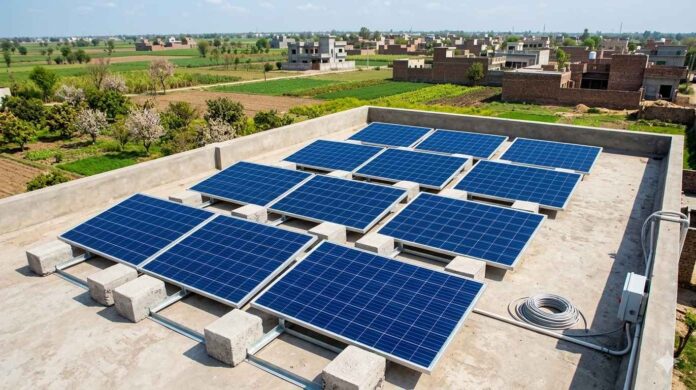

Pakistan is witnessing one of the most dramatic energy transformations in its history as solar power capacity rapidly expands across the country. Distributed solar installations have now reached levels nearly equal to the country’s entire utility-scale electricity generation capacity, signaling a major shift in how electricity is produced and consumed nationwide.
The latest energy sector data shows that Pakistan’s distributed solar power capacity climbed to approximately 38 gigawatts during FY2024-25. This figure is equivalent to nearly 93 percent of the country’s installed utility-scale power generation capacity, highlighting the extraordinary pace at which consumers are adopting solar energy solutions.
The rapid expansion of solar electricity is reshaping Pakistan’s energy landscape far beyond official grid infrastructure. Millions of households, businesses, farms, factories, and commercial users are increasingly generating electricity independently through rooftop and distributed solar systems.
This transformation is fundamentally changing the structure of Pakistan’s power sector, creating what experts describe as a parallel electricity system operating alongside the national grid.
The rise of distributed solar energy also reflects growing public frustration with expensive electricity tariffs, unreliable power supply, and the financial inefficiencies of the traditional centralized energy system.
Pakistan’s Energy Landscape Undergoing Historic Change
For decades, Pakistan’s electricity system was dominated by centralized power generation plants connected through the national grid. Electricity production depended heavily on thermal plants fueled by imported coal, RLNG, furnace oil, hydropower, and limited renewable energy sources.
Consumers relied almost entirely on electricity distributed through the national grid system operated by public and private sector entities.
However, rising electricity costs, recurring power shortages, inflationary pressures, and technological advancements in solar energy have dramatically altered consumer behavior in recent years.
Instead of depending solely on grid electricity, consumers across Pakistan are increasingly investing in private solar power systems capable of generating electricity independently.
The result is the rapid emergence of a decentralized electricity ecosystem that is reshaping national energy consumption patterns.
Energy experts believe Pakistan is now experiencing one of the fastest solar adoption transitions among emerging economies, driven largely by economic necessity and consumer demand rather than solely by government policy.
Distributed Solar Capacity Reaches Massive Scale
The expansion of distributed solar energy in Pakistan has reached unprecedented levels.
By FY2024-25, total distributed solar capacity reportedly climbed to approximately 38 gigawatts, placing it nearly on par with the country’s entire utility-scale installed generation capacity.
This level of solar deployment would have been considered unimaginable just a few years ago. The rapid acceleration reflects how quickly consumers have embraced solar technology as an alternative to expensive and unreliable conventional electricity supply.
Distributed solar systems include rooftop installations on homes, commercial buildings, industrial facilities, agricultural operations, educational institutions, and small businesses.
Unlike large utility-scale power plants connected directly to the national grid, distributed solar systems often operate behind the meter, meaning electricity is generated and consumed directly at the point of use.
Many of these installations are either partially connected to the grid through net-metering arrangements or completely independent from the centralized electricity network.
The scale of this transformation demonstrates how consumers themselves are increasingly driving Pakistan’s energy transition.
Solar Electricity Generation Rising Rapidly
Pakistan’s distributed solar systems are not only expanding in capacity but are also generating massive volumes of electricity.
Estimated distributed solar generation reached approximately 51 terawatt-hours during FY25. This amount represents nearly 46 percent of total grid electricity sales recorded during the same period.
The figure highlights how solar power has evolved from a niche alternative energy source into a major contributor to Pakistan’s overall electricity supply.
Solar energy now plays an increasingly central role in meeting national electricity demand, particularly during daylight hours when rooftop systems operate at maximum efficiency.
Experts believe actual solar electricity generation may be even higher than official estimates because many installations operate outside formal registration and accounting frameworks.
The rapid growth of behind-the-meter electricity production has created major challenges for accurately measuring Pakistan’s total energy consumption and generation patterns.
Traditional electricity statistics increasingly fail to capture the full scale of electricity being produced independently by consumers.
Grid Electricity Sales Continue Declining
One of the clearest indicators of Pakistan’s solar transition is the ongoing decline in grid electricity sales.
Electricity sales through the national grid reportedly fell from approximately 125 terawatt-hours in FY22 to around 111 terawatt-hours by FY25.
At first glance, the decline could appear to signal weakening electricity demand. However, energy experts emphasize that overall demand has not actually decreased.
Instead, a growing portion of electricity demand is now being met outside the centralized grid system through distributed solar generation.
This distinction is critically important because it reveals that Pakistan’s energy consumption patterns are changing rather than shrinking.
Consumers are not necessarily using less electricity overall. They are increasingly generating electricity independently rather than purchasing it from the national grid.
This trend represents one of the biggest structural changes ever experienced by Pakistan’s electricity sector.
Households Leading Pakistan’s Solar Revolution
Residential consumers have emerged as one of the biggest drivers behind Pakistan’s solar expansion.
Rising electricity tariffs, inflation, and concerns over power reliability have encouraged households across urban and rural areas to invest heavily in rooftop solar systems.
Many homeowners now view solar panels as a long-term financial investment capable of reducing monthly electricity costs and protecting against future tariff increases.
Falling global solar panel prices and improved battery storage technologies have further accelerated residential adoption.
In many cities, rooftop solar systems have become increasingly common across homes, apartment buildings, and residential communities.
Middle-income and upper-middle-income households in particular have rapidly embraced solar technology as electricity bills continue rising.
The residential solar boom is gradually reducing household dependence on the national grid while transforming consumers into independent electricity producers.
Businesses and Industries Rapidly Expanding Solar Adoption
Commercial and industrial sectors are also playing a major role in Pakistan’s solar energy expansion.
Factories, office buildings, shopping malls, warehouses, hotels, educational institutions, and commercial enterprises are increasingly adopting solar systems to lower operating costs and reduce dependence on expensive grid electricity.
For industries facing rising production expenses and competitive pressures, solar energy offers an opportunity to stabilize electricity costs over the long term.
Industrial users often consume large amounts of electricity during daylight hours, making solar systems particularly attractive for reducing operational expenses.
Many businesses are also investing in hybrid systems combining solar panels with battery storage and backup generators to improve energy reliability.
The growing use of solar power within the industrial sector may eventually help improve export competitiveness by reducing energy-related production costs.
Experts believe industrial solar adoption will likely continue accelerating as technology costs decline further and electricity tariffs remain elevated.
Agriculture Sector Increasingly Turning to Solar Energy
Pakistan’s agriculture sector is also becoming an important participant in the country’s solar transition.
Farmers are increasingly using solar-powered systems for irrigation pumps, water management, livestock operations, cold storage, and agricultural processing activities.
In rural areas where grid electricity may be unreliable or unavailable, solar systems provide a practical and cost-effective alternative energy solution.
Solar-powered irrigation systems are particularly gaining popularity because they reduce dependence on diesel fuel and lower long-term operating expenses.
The agriculture sector’s adoption of solar technology is expected to improve energy access in rural areas while supporting broader agricultural productivity and sustainability goals.
As solar technology becomes more affordable, rural adoption may continue expanding rapidly across farming communities nationwide.
Net-Metering Capacity Continues Expanding
Pakistan’s net-metering system has also experienced significant growth alongside broader solar adoption trends.
Net-metering capacity reportedly rose to approximately 6.8 gigawatts by FY2024-25, reflecting increasing integration between private solar systems and the national grid.
Under net-metering arrangements, consumers can export surplus solar electricity back into the grid in exchange for credits or compensation.
The system allows consumers to offset electricity bills while contributing excess generation to the broader electricity network.
Net-metering has played an important role in encouraging solar adoption by improving the financial attractiveness of rooftop installations.
However, the rapid expansion of net-metering has also created new challenges for electricity distribution companies and policymakers.
As more consumers generate their own electricity and reduce grid purchases, traditional utility revenue models face growing pressure.
This dynamic is forcing policymakers to reconsider how electricity pricing, grid management, and energy planning should function in a decentralized energy environment.
Official Energy Data No Longer Reflects Reality
One of the most important conclusions emerging from Pakistan’s solar transition is that traditional energy statistics may no longer fully represent actual electricity generation and consumption patterns.
Large volumes of solar electricity are generated behind the meter or outside formal accounting systems, making accurate measurement increasingly difficult.
Official grid sales data capture only electricity supplied through centralized distribution networks, not the rapidly growing volume of privately generated solar power consumed directly by users.
As a result, conventional energy data increasingly understates Pakistan’s true electricity production and demand levels.
Experts argue that energy planning frameworks must adapt quickly to account for decentralized generation and off-grid energy systems.
Without accurate visibility into total energy production and consumption patterns, policymakers may struggle to make informed infrastructure and investment decisions.
The rise of distributed solar is effectively creating a second electricity economy operating partially outside traditional utility structures.
Solar Growth Challenging Pakistan’s Traditional Power Sector
Pakistan’s solar boom is creating major challenges for the country’s traditional centralized electricity system.
Thermal power plants built under long-term contracts continue imposing fixed financial obligations on the system even as grid demand growth slows.
At the same time, more consumers are reducing reliance on grid electricity by generating their own power independently.
This creates a financial imbalance where fewer consumers are paying for the centralized grid system while expensive generation capacity remains fully contracted.
Electricity distribution companies may face growing financial pressure as higher-paying industrial and commercial users increasingly shift toward self-generation through solar systems.
Experts warn that without structural reforms, the traditional power sector could experience worsening financial instability in the coming years.
Pakistan’s energy transition therefore presents both opportunities and challenges for policymakers and utility operators.
Solar Energy Reshaping Pakistan’s Economic Future
The rapid expansion of solar energy could have major long-term economic implications for Pakistan.
Greater reliance on solar power may help reduce dependence on imported fuels such as coal, LNG, and furnace oil, improving the country’s external balance and reducing exposure to international energy price volatility.
Expanding renewable energy generation may also help lower carbon emissions and improve environmental sustainability.
The growth of solar-related industries, including installation services, equipment distribution, battery systems, and engineering support, could create new employment and business opportunities across the economy.
At the same time, transitioning toward a decentralized electricity model will require major investments in grid modernization, energy storage, smart infrastructure, and regulatory reform.
Experts believe Pakistan now has an opportunity to redesign its electricity system around more flexible, resilient, and consumer-driven energy models.
Future Outlook for Pakistan’s Solar Energy Sector
The outlook for Pakistan’s solar energy sector remains extremely strong as adoption continues accelerating across households, businesses, industries, and agriculture.
Falling technology costs, rising electricity tariffs, improving battery solutions, and growing public awareness are likely to support continued expansion over the coming years.
Solar energy may increasingly become one of the dominant sources of electricity generation within Pakistan’s broader energy mix.
However, the rapid pace of change will also require significant policy adaptation and infrastructure planning to ensure long-term grid stability and financial sustainability.
Energy experts believe Pakistan’s future electricity system will likely operate as a hybrid model combining centralized generation with large-scale distributed renewable energy networks.
The country’s ongoing solar revolution is already reshaping how electricity is generated, distributed, and consumed.
What was once considered an alternative energy source has now evolved into a parallel electricity system capable of rivaling the national grid itself.
Read More
Pakistan Raises Over Rs. 76 Billion Through 6th Hybrid Sukuk Auction


