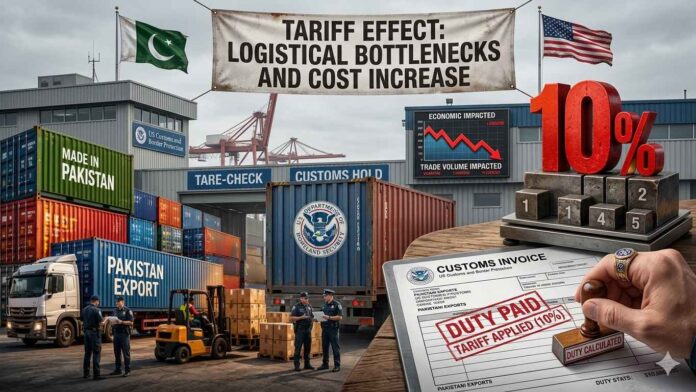

Pakistan’s export sector is expected to remain resilient despite a proposal by the United States to extend an additional 10 percent tariff on imports from Pakistan and several other countries. Industry leaders and exporters have largely downplayed concerns about the immediate impact of the measure, arguing that the tariff is already being applied and has been factored into existing trade arrangements.
The proposed extension has attracted attention across Pakistan’s business community because the United States remains one of the country’s most important export destinations. The American market accounts for a significant share of Pakistan’s textile, apparel, home textile, leather, sports goods, and other manufactured exports. Any change in tariff policy therefore has the potential to influence trade flows, pricing strategies, and long-term competitiveness.
Despite these concerns, exporters believe that the continuation of the tariff is unlikely to create major disruptions in the short term. However, they acknowledge that the long-term outlook could become more challenging if higher duties become a permanent feature of trade policy.
Understanding the Proposed US Tariff Extension
The proposed measure seeks to continue an additional 10 percent duty on imports from a number of countries, including Pakistan. The tariff was initially introduced as part of broader trade measures and has already been applied for a temporary period.
Because the duty is currently in place, exporters argue that the proposed extension does not represent a completely new burden. Instead, it would simply maintain existing conditions that businesses have already adjusted to over the past several months.
Many Pakistani exporters have reorganized pricing structures, supply chains, and contractual arrangements to account for the additional costs associated with the tariff. As a result, the continuation of the measure is viewed as less disruptive than the introduction of an entirely new trade barrier.
Industry representatives note that uncertainty surrounding tariff policy often creates greater concern than the actual duties themselves. Businesses prefer predictable and stable trade conditions that allow them to plan production, pricing, and investment decisions with confidence.
Why Exporters Believe the Immediate Impact Will Be Limited
One of the main reasons exporters remain relatively optimistic is that American importers typically bear the direct cost of tariffs when goods enter the United States market. This means that the additional duty does not automatically reduce revenues earned by Pakistani exporters.
Under current trading arrangements, many exporters have continued to receive orders despite the higher tariffs. American buyers have largely absorbed the additional costs or passed them on to consumers through higher retail prices.
As a result, Pakistan’s export sector has not experienced a dramatic decline in shipments to the United States since the tariff was introduced. While higher duties can influence purchasing decisions over time, the immediate effect has been more limited than many initially feared.
Exporters argue that the proposed extension merely preserves the status quo. Since businesses have already adapted to the tariff environment, they do not expect significant disruptions if the measure remains in place beyond its current expiration date.
However, industry leaders emphasize that stability should not be confused with competitiveness. While exporters may continue operating under the existing tariff structure, they acknowledge that higher duties can gradually weaken their position relative to international competitors.
Pakistan’s Textile Sector Remains the Most Exposed
The textile and apparel sector remains the backbone of Pakistan’s export economy and is likely to be the most affected by any long-term continuation of higher tariffs.
Textiles account for the majority of Pakistan’s exports to the United States. The sector includes garments, fabrics, bed linen, towels, knitwear, and a wide range of value-added products that are sold to major retailers and distributors across the American market.
Industry participants point out that Pakistani textile exports already face substantial import duties in the United States. The additional 10 percent tariff increases the overall duty burden and makes Pakistani products more expensive for buyers.
Although exporters have managed to maintain orders under current conditions, rising costs can gradually influence sourcing decisions. Importers often compare suppliers from multiple countries and seek the most competitive combination of quality, reliability, and price.
As global competition intensifies, even small differences in pricing can determine which suppliers secure major contracts. This reality underscores the importance of maintaining competitiveness beyond simply coping with existing tariff levels.
Rising Production Costs Continue to Challenge Exporters
While the tariff extension has attracted significant attention, many exporters argue that domestic challenges pose an even greater threat to competitiveness.
Pakistan’s manufacturing sector continues to face elevated energy costs compared with several regional competitors. Electricity and gas prices have increased significantly in recent years, raising production expenses across multiple industries.
Financing costs also remain a concern for businesses. Higher borrowing rates increase the cost of working capital and investment, making it more difficult for exporters to expand operations and upgrade facilities.
In addition, many industries rely on imported raw materials, machinery, and industrial inputs. Currency fluctuations and import-related expenses can further increase production costs, reducing the ability of exporters to compete on price.
Business leaders frequently argue that addressing these domestic constraints would have a greater positive impact on exports than changes in external tariff policies alone. Lower production costs could help offset the effects of foreign trade barriers and improve overall competitiveness in international markets.
Export Performance Demonstrates Resilience
Despite concerns surrounding tariffs and global economic uncertainty, Pakistan’s exports to the United States have continued to show resilience.
Recent trade figures indicate modest growth in exports during the current fiscal year compared with the previous year. This performance suggests that demand for Pakistani products has remained relatively stable despite higher duties and challenging market conditions.
Several factors have contributed to this resilience. Pakistani manufacturers have developed strong relationships with international buyers, particularly in the textile sector. Many exporters have built reputations for quality, reliability, and timely delivery, helping them retain customers even when costs increase.
In addition, some buyers view Pakistan as an important sourcing destination because of its established textile supply chain and production capabilities. These advantages can partially offset the impact of higher tariffs and allow exporters to remain competitive.
The continued growth in exports also reflects the adaptability of Pakistani businesses. Many companies have invested in efficiency improvements, product diversification, and value-added manufacturing to strengthen their market position.
Long-Term Risks Cannot Be Ignored
Although exporters are relatively comfortable with the immediate outlook, they remain cautious about the long-term implications of an extended tariff regime.
If the additional duty becomes a permanent feature of trade policy, Pakistan could face increasing challenges in maintaining market share. Higher prices may eventually encourage buyers to explore alternative sourcing destinations with lower costs or more favorable trade arrangements.
Competitor countries often benefit from different tariff structures, trade agreements, or production advantages that can make their products more attractive to international buyers. Over time, these differences can influence purchasing patterns and shift global supply chains.
Industry leaders therefore emphasize the importance of monitoring developments closely. A temporary extension may have limited consequences, but a permanent increase in trade barriers could gradually erode competitiveness and reduce export growth opportunities.
Businesses also worry about the broader message sent by prolonged tariff measures. Uncertainty regarding future trade policy can discourage investment and make it more difficult for exporters to plan long-term expansion strategies.
Importance of the US Market for Pakistan
The United States remains one of Pakistan’s most valuable export destinations, making any changes in trade policy particularly significant.
American consumers purchase a wide range of products manufactured in Pakistan, including apparel, home textiles, leather goods, surgical instruments, sports equipment, and various industrial products.
Access to the US market provides important foreign exchange earnings that support economic growth, employment, and industrial development. Thousands of businesses and millions of workers depend directly or indirectly on export-related activity.
Because of this importance, exporters closely monitor developments in American trade policy and actively assess how changes may affect future opportunities.
A stable and predictable trading relationship benefits both countries by supporting economic activity, strengthening commercial ties, and encouraging investment. Industry representatives therefore hope that temporary tariff measures will eventually be removed to promote greater trade expansion.
Opportunities for Improving Competitiveness
Rather than focusing solely on tariffs, many business leaders argue that Pakistan should pursue broader reforms to strengthen export competitiveness.
Investments in energy infrastructure, logistics networks, and industrial modernization could help reduce production costs and improve efficiency. Enhanced access to financing would also support expansion and innovation across key export sectors.
Exporters increasingly emphasize the need to move beyond traditional products and focus on higher-value manufacturing. Producing more sophisticated goods can help businesses achieve stronger profit margins and reduce sensitivity to tariff-related cost increases.
Market diversification is another important strategy. Expanding exports to new regions can reduce dependence on any single market and create additional opportunities for growth.
Digital transformation, technological upgrades, and workforce development can also play a crucial role in improving productivity and ensuring long-term competitiveness in a rapidly changing global economy.
Outlook for Pakistan’s Export Sector
The overall outlook for Pakistan’s export sector remains cautiously optimistic. While the proposed extension of the US 10 percent tariff presents challenges, exporters believe they are well positioned to withstand its immediate effects.
The fact that the tariff is already being applied means businesses have had time to adjust their operations and pricing strategies. Existing trade flows suggest that demand for Pakistani products remains relatively strong despite the higher duties.
At the same time, industry representatives recognize that long-term competitiveness will depend on more than simply adapting to tariffs. Addressing domestic cost pressures, improving productivity, and expanding market opportunities will be essential for sustaining export growth in the years ahead.
For now, exporters remain hopeful that the temporary tariff will eventually expire, allowing Pakistani products to regain a stronger competitive position in the American market. Until then, businesses are focused on maintaining customer relationships, improving efficiency, and navigating an increasingly complex global trading environment.
The proposed tariff extension may create challenges, but Pakistan’s export sector has demonstrated resilience under difficult conditions before. With continued adaptation and strategic reforms, exporters believe they can continue competing effectively in one of the world’s largest and most important consumer markets.
Read More
US Congress Delivers Major Setback to Trump and Israel by Voting to End Iran War