
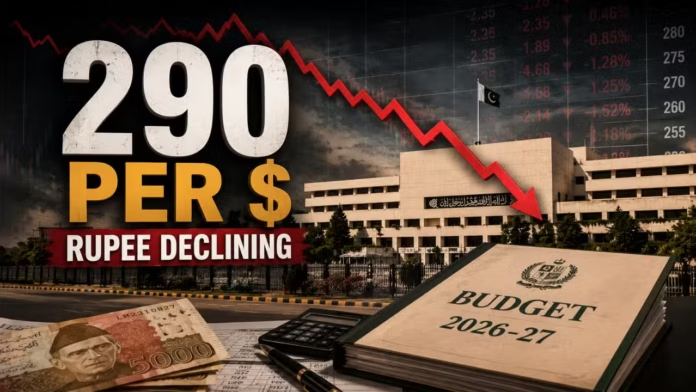
Govt Sets Dollar Rate at Rs. 290 for Budget

The federal government has decided to use an exchange rate of Rs. 290 per US dollar while preparing the FY2026-27 budget.

The Ministry of Finance has asked all government ministries and departments to use this rate when calculating budget estimates, foreign loans, grants, and development projects.

This rate is about Rs. 10 higher than the one used for the current fiscal year’s estimates, showing an expected depreciation of around 3.5% in the value of the rupee.

However, the rupee is currently trading at around Rs. 278.42 per dollar in the interbank market.

The government expects to receive about $3.2 billion (Rs. 927 billion) in foreign funding for development projects during FY2026-27. This amount makes up more than 20% of the country’s total development budget, which is estimated at Rs. 4.3 trillion.

Pakistan will also need significant foreign financing next year. According to IMF estimates, the country’s external financing needs could reach $21.2 billion in FY2026-27 and may rise to $30 billion in FY2027-28.

Despite these requirements, government officials believe Pakistan will be able to meet its financial obligations. The Prime Minister’s Office recently reviewed the situation and was informed that the expected funding needs are manageable.

The government is targeting a current account deficit of 0.7% of GDP, which is equal to about $3.6 billion next year.

At the same time, interest payments on foreign debt alone are expected to reach nearly Rs. 1.1 trillion, while total debt servicing costs could rise to around Rs. 7.8 trillion in FY2026-27.


spot_img

Related articles

Government Expects Higher Revenue from Telecom Sector in FY2026-27

The federal government is expecting to earn significantly more...

Islamabad Raises Annual Token Tax Rates for Vehicle Owners

Vehicle ownership in Islamabad is set to become more...

Federal Budget Raises HEC Development Allocation While Keeping Recurring Funding Unchanged

Pakistan’s higher education sector has received a mixed outcome...

Finance Minister Defends Federal Budget Amid Growing Criticism

The federal government has strongly defended its newly announced...
spot_img
Previous article
Next article
Pakistan is using more solar energy than ever before. In April 2026, electricity generated through net metering reached a record level as more people and businesses relied on solar panels instead of the national power grid. According to data from Arif Habib Limited, based on statistics from National Electric Power Regulatory Authority (NEPRA), the share of electricity coming from net-metered solar systems was the highest ever recorded. It was 117 basis points higher than in April 2025. At the same time, Pakistan’s total electricity generation fell by 9.6% compared to last year. This shows that overall electricity demand remains weak, while more consumers are producing their own power through solar systems. The increase in solar energy has been driven by lower solar panel prices and high electricity bills, encouraging many homes and businesses to install solar panels. Compared with March 2026, net-metered electricity generation jumped by 71.2% in April because longer and sunnier days helped solar systems produce more power. The rapid growth of solar energy is changing Pakistan’s power sector. Consumers are benefiting from lower electricity costs and greater energy independence. However, power companies are worried because many of their biggest customers are buying less electricity from the grid, which could reduce their revenues. Although overall power generation has declined recently, NEPRA expects electricity demand in Pakistan to grow by about 1% during 2026. Regulators and policymakers are closely watching the fast expansion of net metering, which is becoming one of the biggest changes in Pakistan’s energy market. Suggested Title: Pakistan’s Solar Energy Growth Hits Record High as More Consumers Turn to Net Metering