
Pakistan’s mobile phone market remained highly competitive in May 2026. While the changes in market share were small, they still represent hundreds of thousands of mobile users in a country with more than 200 million subscribers. These shifts show which telecom companies are attracting more customers and which ones are slowly losing ground.
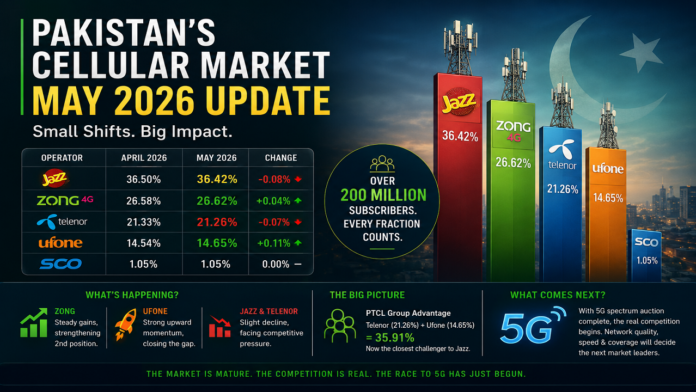
Jazz remained the largest mobile network in Pakistan with a market share of 36.42 percent in May 2026. However, this was slightly lower than its 36.50 percent share in April. Although the decrease was small, it shows that competitors are gradually putting pressure on the market leader.
Zong strengthened its position as Pakistan’s second-largest telecom operator. Its market share increased from 26.58 percent in April to 26.62 percent in May. The increase may seem minor, but it continues a steady trend of growth that Zong has maintained over recent months.
Telenor experienced a slight decline. Its market share dropped from 21.33 percent in April to 21.26 percent in May. Like Jazz, Telenor lost a small portion of its subscriber base compared to its competitors.
Ufone was the biggest winner during the month. Its market share increased from 14.54 percent in April to 14.65 percent in May. For a company that has traditionally been the smallest of Pakistan’s four major telecom operators, this growth is an important achievement and shows that its efforts are producing results.
SCO maintained its market share at 1.05 percent, showing no change from the previous month.
Market Share Comparison
| Operator | April 2026 | May 2026 | Change |
|---|---|---|---|
| Jazz | 36.50% | 36.42% | -0.08% |
| Zong | 26.58% | 26.62% | +0.04% |
| Telenor | 21.33% | 21.26% | -0.07% |
| Ufone | 14.54% | 14.65% | +0.11% |
| SCO | 1.05% | 1.05% | No Change |
Why These Changes Matter
Pakistan’s telecom market is now mature, with mobile penetration exceeding 82 percent of the population. Most people already own a mobile connection, which means telecom companies are no longer focused mainly on finding new users. Instead, they are competing to keep existing customers and convince users to switch from rival networks.
This means even a small increase in market share can be very valuable. It often reflects improvements in network coverage, internet speeds, pricing, customer service, and digital services offered by the operator.
Zong Continues to Grow
Zong’s steady growth suggests that its investment in network expansion and modernization is helping attract more subscribers. The company has built a strong reputation for its 4G services, and many users appear satisfied with its data performance and coverage.
Ufone Shows Strong Momentum
The most interesting development is Ufone’s continued growth. For many years, Ufone remained behind its competitors in terms of subscriber numbers. However, recent gains suggest that customers are responding positively to its affordable packages, promotional offers, and improved services.
If Ufone continues this trend, it could become a stronger competitor in the market over the coming years.
Jazz Still Leads but Faces Pressure
Jazz remains the clear market leader with more than one-third of all mobile subscribers in Pakistan. However, maintaining such a large share is not easy. The slight decline in May shows that competitors are gradually attracting some users away.
The decrease does not indicate any major problem for Jazz, but it highlights the need for continuous investment in network quality, customer experience, and new technologies.
PTCL Group Is Becoming a Major Challenger
One of the most significant developments comes from PTCL’s ownership of both Telenor Pakistan and Ufone.
Although the two operators still run separately, their combined market share reaches 35.91 percent. This is very close to Jazz’s 36.42 percent share.
This means that the PTCL Group now controls almost the same number of subscribers as Jazz. In the future, any decision to integrate networks, improve services, or coordinate strategies between Ufone and Telenor could significantly reshape Pakistan’s telecom market.
The Impact of 5G
The May market share figures come shortly after Pakistan’s first 5G spectrum auction in March 2026, which raised $507 million and allocated spectrum to telecom operators.
The launch of 5G is expected to create a new level of competition. In the coming months and years, customers will pay more attention to internet speed, network quality, coverage, and overall user experience.
Operators that roll out reliable 5G services quickly will likely attract more customers and strengthen their market positions.
For Zong and Ufone, the current growth provides momentum before the 5G era begins. For Jazz, maintaining leadership will depend on delivering a strong 5G experience to its large customer base.
What Consumers Can Expect
For mobile users in Pakistan, increased competition is generally good news. Telecom operators will likely offer:
- Better data packages
- More affordable call and internet bundles
- Improved network coverage
- Faster internet speeds
- Attractive customer retention offers
- Enhanced digital services and mobile apps
The growth of Ufone and Zong also gives consumers more choices, encouraging all operators to improve their services.
Conclusion
Pakistan’s telecom sector remains highly competitive despite its maturity. May 2026 data shows that Jazz continues to lead the market, but it is slowly losing ground. Zong is steadily strengthening its position, while Ufone is emerging as the fastest-growing major operator. Telenor has seen a slight decline, and SCO remains stable.
The real competition, however, is likely to begin with the nationwide rollout of 5G. The operators that can provide the best combination of speed, coverage, and value will be the ones that gain the most subscribers in the years ahead. For now, the market remains close, competitive, and full of opportunities for both telecom companies and consumers.