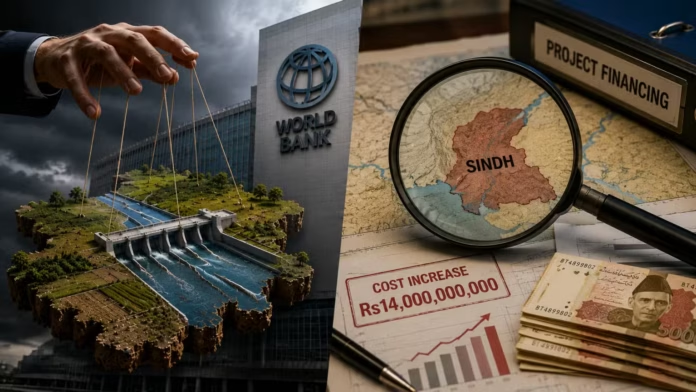

The Senate Standing Committee on Economic Affairs has raised serious concerns about the rising cost of the Sindh Water and Agriculture Transformation Project. Lawmakers claimed that the involvement of the World Bank in the planning and implementation of the project may have increased its total cost by nearly Rs. 14 billion.
The committee discussed the issue during a meeting held on Friday while reviewing several development projects that are being financed with the help of international lenders.
The main focus of the meeting was the Sindh Water and Agriculture Transformation Project, which aims to improve water management, irrigation systems, and agricultural productivity in Sindh. The project is intended to help farmers use water more efficiently, increase crop production, and strengthen the province’s agriculture sector.
During the meeting, members of the committee questioned whether the World Bank had gone beyond its normal role as a financial institution.
According to several lawmakers, the World Bank’s responsibility should mainly be to decide whether it wants to provide funding for a project. They argued that once financing is approved, decisions about the project’s technical design, planning, and implementation should remain with Pakistan’s own government departments and experts.
One senator said that foreign lenders should not influence how development projects are designed or managed because those decisions fall under the authority of Pakistan’s relevant institutions.
The chairman of the committee also expressed concern over changes that were reportedly introduced during the project’s planning process.
He claimed that these changes were made under external pressure and significantly increased the project’s overall cost.
According to the chairman, if the project had continued under its original design, Pakistan could have saved approximately Rs. 14 billion.
He stressed that Pakistan should protect its financial interests and avoid accepting what he described as unnecessary pressure in projects funded by international financial institutions.
Committee members also received a briefing from government officials responsible for development planning.
Officials informed lawmakers that the estimated cost of the Sindh Water and Agriculture Transformation Project had increased considerably since it was first proposed.
The Chairman of the Planning and Development Department told the committee that the project is now expected to cost almost twice its original estimated amount.
Although the exact reasons for the increase were discussed, lawmakers questioned whether all of the design changes were truly necessary.
Some committee members said Pakistan should carefully review any changes suggested by international lenders to ensure they genuinely benefit the country and do not place an unnecessary financial burden on public funds.
During the discussion, lawmakers also referred to another infrastructure project, the Peshawar–Torkham project.
One senator claimed that Pakistan had faced similar issues in the past regarding financing conditions attached to international development projects.
According to him, the Senate committee had previously intervened to protect Pakistan’s financial interests during discussions related to that project.
He urged the government to take a similar approach in the case of the Sindh Water and Agriculture Transformation Project.
Committee members emphasized that while international financial institutions such as the World Bank play an important role in supporting Pakistan’s development through loans and financial assistance, project decisions should remain balanced and should serve Pakistan’s national interests.
Following the discussion, the Senate Standing Committee directed the Economic Affairs Division to hold talks with the World Bank regarding the concerns raised during the meeting.
The committee also instructed officials to arrange a formal meeting with the World Bank to discuss the project’s design, implementation, financing arrangements, and the reasons behind the increase in costs.
The objective of the meeting will be to clarify the issues raised by lawmakers and explore whether any changes can be made to reduce costs while ensuring the project continues to achieve its development goals.
Meanwhile, ProPakistani contacted the World Bank to seek its response to the allegations made by the Senate committee.
However, the World Bank had not provided an official response by the time the report was published.
The publication stated that the story will be updated if the World Bank issues a statement or provides its explanation regarding the concerns raised by the committee.
The discussion highlights the importance of transparency and accountability in large development projects. As Pakistan continues to work with international financial institutions to fund infrastructure, agriculture, and public welfare projects, lawmakers say it is essential to ensure that borrowed funds are used efficiently, project costs remain under control, and decisions are made in the country’s best financial and economic interests