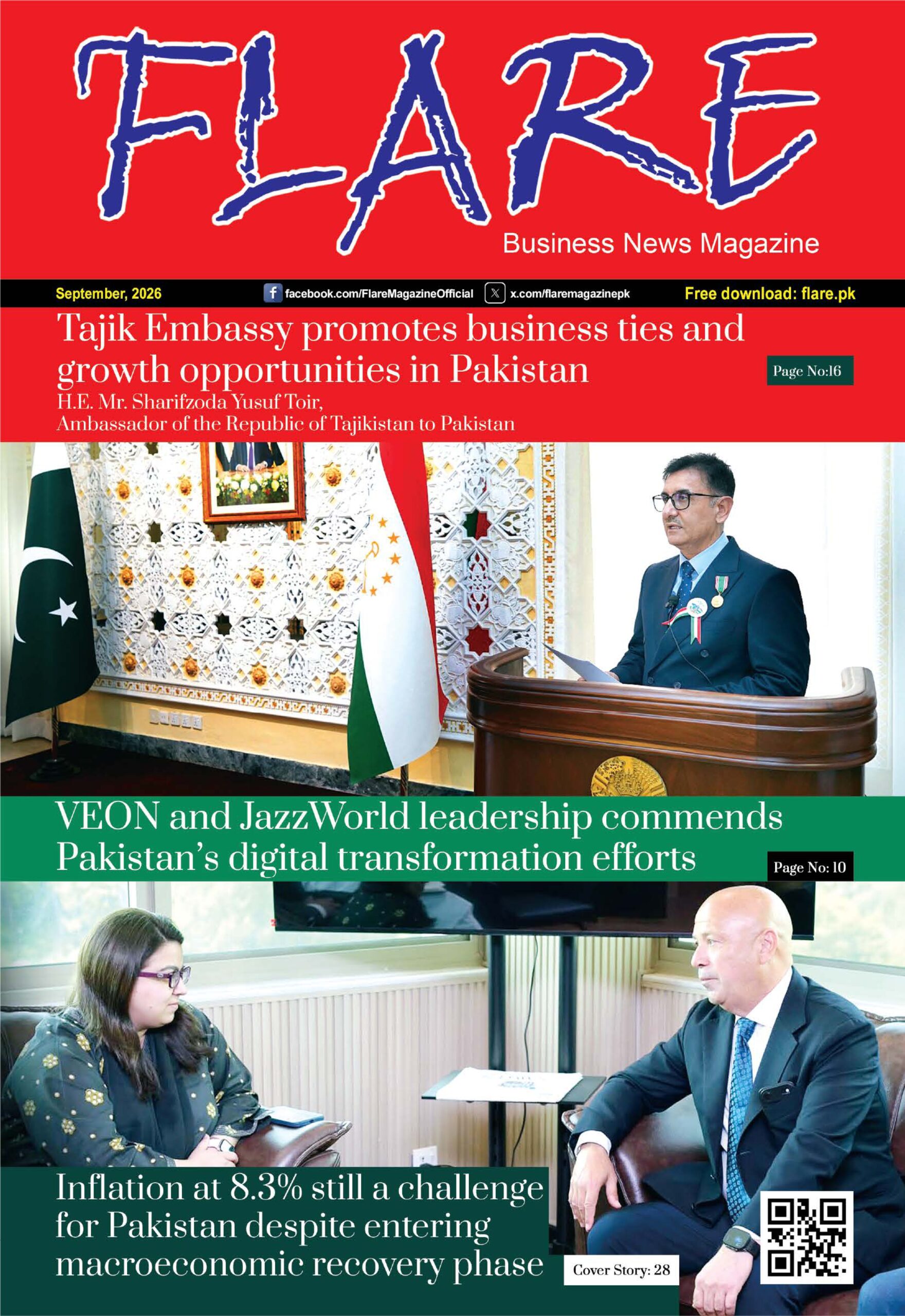
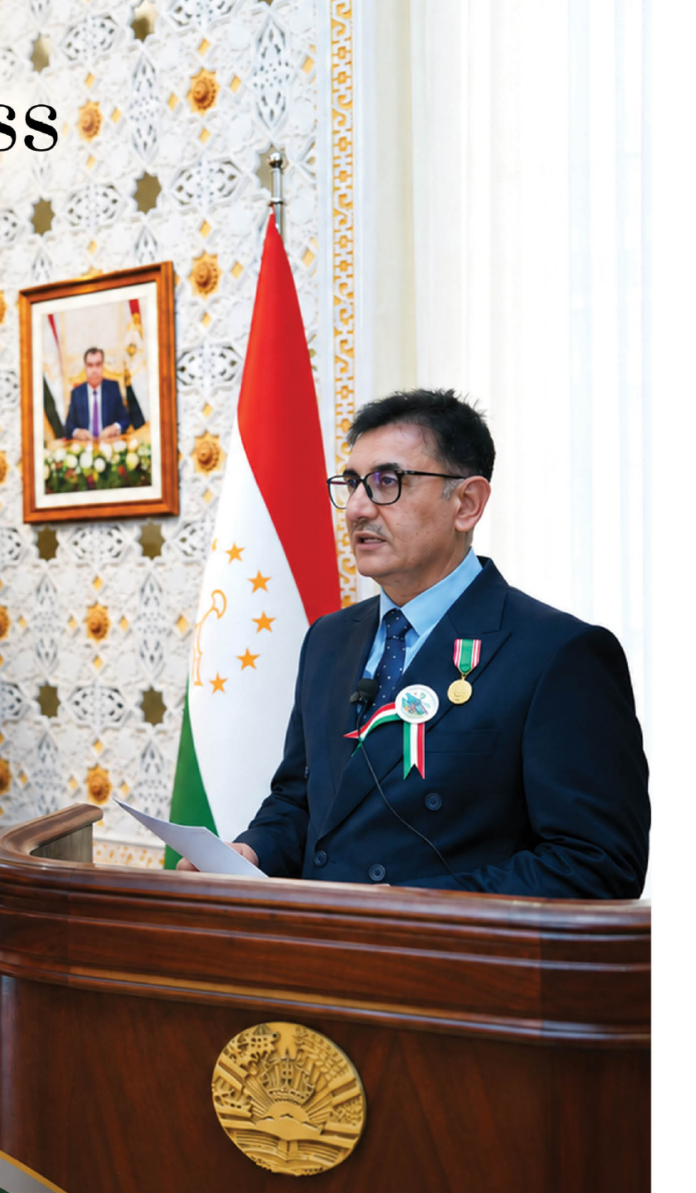

H.E. Mr. Sharifzoda Yusuf Toir, Ambassador of the Republic of Tajikistan to Pakistan
The Flare team had the opportunity to interview H.E. Mr. Sharifzoda Yusuf Toir, Ambassador of the Republic of Tajikistan to Pakistan. He spoke about the strong relations between the two nations and the leadership’s focus on translating them into tangible economic outcomes.
The three-year roadmap to boost bilateral trade to $200 million marks a significant step forward. The Embassy is focused on strengthening business ties, identifying high-growth sectors, expanding trade in agriculture, food products, pharmaceuticals, textiles, light industry and construction materials, while promoting investment, joint ventures, and better connectivity and logistics.
Flare: Pakistan and Tajikistan have a 3-year plan to increase bilateral trade to $200 million. What are the Embassy’s main focus areas and milestones to reach this goal?
H.E. Mr. Sharifzoda Yusuf Toir: Pakistan and Tajikistan enjoy excellent political relations, and our leadership has emphasised translating this understanding into concrete economic results. The three-year roadmap to increase bilateral trade to $200 million is an important step. The Embassy’s priority is to facilitate direct business contacts and identify sectors with strong growth potential.
Our priorities are increasing trade in agricultural and food products, pharmaceuticals, textiles, light industry and construction materials; promoting investment and joint ventures; and improving connectivity and logistics. We are also encouraging participation in trade exhibitions, business forums and investment events, while promoting partnerships between chambers of commerce and private-sector organisations.
The $200 million target is ambitious but achievable if we focus on practical projects, remove trade and logistical barriers, and maintain regular business interaction. Ultimately, our goal is a sustainable and diversified economic partnership.
Flare: The CASA-1000 project is a cornerstone of energy connectivity between Central and South Asia. What is the current status of this initiative, and how soon do you envision it will help ease Pakistan’s energy demands?
H.E. Mr. Sharifzoda Yusuf Toir: CASA-1000 is a major regional connectivity project linking Central and South Asia. For Tajikistan and Pakistan, it represents energy cooperation and a broader vision of regional economic integration.
For Pakistan, CASA-1000 will provide additional electricity from Central Asia during the summer, when demand is high. For Tajikistan, it creates an opportunity to export surplus hydropower and strengthens its role in regional energy cooperation.
Its completion will demonstrate that countries in the region can implement large-scale projects based on mutual interests.
CASA-1000 should also serve as a foundation for further cooperation in energy, transport and regional connectivity.
Flare: Direct flights between Islamabad and Dushanbe are vital for business and travel. What progress is being made to resume flights and streamline visa processing for citizens of both nations?
H.E. Mr. Sharifzoda Yusuf Toir: Direct air connectivity is a key bridge between Tajikistan and Pakistan. We understand the importance of the Islamabad-Dushanbe route for citizens, businesses, students, tourists and families. Work is underway with relevant authorities and stakeholders to resume direct flights, and we hope to restore the connection between the two capitals in the near future.
The resumption of flights will facilitate tourism, business contacts, educational exchanges and people-to-people relations.
Tajikistan has simplified visa procedures for Pakistani citizens, making travel considerably easier. We are also interested in further facilitating travel. Direct flights and simplified visas can boost tourism, trade and investment.
Tajikistan welcomes Pakistani visitors, students, entrepreneurs and tourists. Easier travel will strengthen our bilateral relationship.
Flare: Tajikistan is renowned for its breathtaking Pamir Mountains and rich heritage. How are both countries collaborating to boost cross-border tourism and promote joint Silk Route travel packages?
H.E. Mr. Sharifzoda Yusuf Toir: Tajikistan and Pakistan have enormous potential for tourism cooperation, sharing geographical proximity and centuries of historical and cultural connections. Tajikistan offers destinations including the Pamir and Fann Mountains, lakes, valleys, historical cities and ancient Silk Road sites. Pakistan has extraordinary mountain landscapes, historical heritage and cultural diversity.
We should move from promoting our countries separately to developing joint tourism products. One promising idea is Silk Road packages connecting historical and cultural destinations in Tajikistan and Pakistan.
We can also promote mountain, adventure, cultural and eco-tourism, while encouraging cooperation among tour operators, airlines and tourism authorities. The Embassy is ready to work with tourism authorities, private operators and business communities to promote these opportunities.
Flare: Our nations share deep historical and cultural roots. Are there any upcoming cultural exchange programmes or youth initiatives to strengthen people-to-people connections?
H.E. Mr. Sharifzoda Yusuf Toir: Tajikistan and Pakistan share deep historical, cultural and civilizational ties. Our common heritage in literature, poetry, music, art and traditions continues to connect our peoples.
The Tajikistan Cultural Days held in Islamabad and Lahore at the end of 2025 were warmly welcomed and provided an opportunity to present Tajikistan’s cultural heritage, traditions, music, art and history. We are working to organise further joint cultural programmes, including exhibitions, artistic and literary events, academic cooperation and youth initiatives. We also attach importance to university cooperation, student and academic exchanges, and programmes promoting the study of Tajik and Urdu.
Youth diplomacy and people-to-people contacts are key to strengthening friendship and the strategic partnership between Tajikistan and Pakistan. The Embassy remains committed to bringing young people, cultural institutions and academic communities closer together.
Flare: Which specific sectors, such as textiles, pharmaceuticals, or agriculture, offer the most promising opportunities for Pakistani exporters and investors looking to enter the Tajik market?
H.E. Mr. Sharifzoda Yusuf Toir: There is significant potential for Pakistani exporters and investors in the Tajik market. To reach the $200 million trade target, we need to focus on complementary sectors.
First, pharmaceuticals and healthcare. Pakistan has a strong pharmaceutical industry and experience producing and distributing medicines and medical products.
Second, textiles and garments. Pakistan has a highly developed textile sector, while Tajikistan has raw materials, a growing domestic market and access to Central Asia. Joint ventures in textile production and processing could be mutually beneficial.
Third, agriculture and food processing. Opportunities exist in agricultural machinery, food processing, packaging, storage, technologies and exports of fruits and other products.
Other promising areas include construction materials, mining, energy, information technology, tourism and logistics. For investors, Tajikistan offers access to its domestic market and a platform for entering other Central Asian markets.
Our priority is to encourage Pakistani companies to establish joint ventures, production facilities and long-term partnerships. The Embassy is ready to facilitate contacts and help investors identify partners and opportunities.
Flare: Are there active university partnerships or academic exchange programmes currently in place? Does Tajikistan offer scholarships or educational incentives for Pakistani students?
H.E. Mr. Sharifzoda Yusuf Toir: Education is an important area of cooperation. We already have a growing number of Pakistani students studying in Tajikistan, particularly medicine. There are opportunities to expand university cooperation through academic and faculty exchanges, joint research, conferences and educational programmes.
We would like to see more Pakistani students choosing Tajikistan for engineering, information technology, agriculture, energy, water management, tourism and other fields. Tajikistan also provides opportunities for international students through higher education institutions and scholarship programmes. We are interested in expanding educational opportunities and academic mobility.
Education creates a sustainable form of cooperation. Pakistani students who spend years in Tajikistan gain professional knowledge and a personal understanding of our country and culture, becoming potential bridges between our societies.
Flare: Regional stability, particularly in the context of Afghanistan, is vital for economic integration. How does Tajikistan view Pakistan’s role in promoting peace and security across the region?
H.E. Mr. Sharifzoda Yusuf Toir: Tajikistan considers regional peace and stability essential for economic development and connectivity. Without security, sustainable trade, investment, tourism and infrastructure development are difficult.
Pakistan is an important South Asian country and plays a significant role in regional security. We recognise its position in addressing regional security challenges. Afghanistan is particularly important. Tajikistan and Pakistan are both directly affected by developments there and share an interest in seeing Afghanistan become peaceful, stable and economically integrated.
Security challenges cannot be addressed through military means alone. Political dialogue, economic development, regional cooperation and addressing the root causes of instability are equally important.
Tajikistan supports closer cooperation with Pakistan against terrorism, extremism, drug trafficking and other transnational threats. Regional countries should maintain regular dialogue and coordinate their efforts. A peaceful Afghanistan can become a bridge between Central and South Asia rather than a source of instability. This is why Tajikistan attaches importance to regional connectivity and peaceful economic relations involving Afghanistan.
Flare: Tajikistan needs efficient sea access for trade. Is there interest in using Pakistan’s Gwadar and Karachi ports for Tajik exports and imports?
H.E. Mr. Sharifzoda Yusuf Toir: As a landlocked country, Tajikistan attaches great importance to reliable access to international markets and seaports.
Pakistan, with its Karachi and Gwadar ports, has significant potential to serve as a gateway for Tajikistan to the Arabian Sea and international markets, particularly as Tajikistan seeks to diversify its trade and transport routes.
We are interested in exploring the potential of Pakistani ports for Tajik exports and imports. For this to become a large-scale, commercially viable route, we need efficient road and rail connectivity, competitive transit costs, simplified customs procedures and reliable logistics. North-south transport corridors linking Central Asia with Pakistani ports could transform regional trade. Tajikistan can provide Central Asian markets with access to South Asia, while Pakistan can gain greater access to Central Asian markets.
This is not simply about Tajikistan using Pakistani ports, but about creating a mutually beneficial Central Asia-South Asia trade corridor.
Flare: As Tajikistan approaches its 35th independence anniversary, what is your Excellency’s long-term vision for Pakistan-Tajikistan relations in the next decade?
H.E. Mr. Sharifzoda Yusuf Toir: As Tajikistan approaches the 35th anniversary of its independence, I see the relationship with Pakistan entering an important new stage.
Our political relations are already very strong. Our leaders maintain regular high-level contacts, and our countries cooperate closely at the United Nations, OIC, ECO, the Shanghai Cooperation Organization (SCO) and other international and regional platforms.
The task for the coming decade is to transform this political relationship into an equally strong economic, humanitarian and people-to-people partnership. Our priorities are increasing bilateral trade and investment; strengthening connectivity through direct flights, transport corridors and greater use of Pakistani seaports; expanding energy cooperation through CASA-1000 and future hydropower and renewable-energy projects; and deepening cooperation in education, science, tourism, culture and youth exchanges.
We should also strengthen cooperation in promoting regional peace and stability. Tajikistan and Pakistan have important roles in connecting Central and South Asia and creating conditions for shared development.
My vision is that the already strong strategic partnership will deepen into a comprehensive and mutually beneficial partnership, driven by greater trade, connectivity, energy cooperation, education, culture and shared prosperity. The potential is enormous. What we need now is to convert that potential into concrete projects and tangible results for the peoples of both countries.