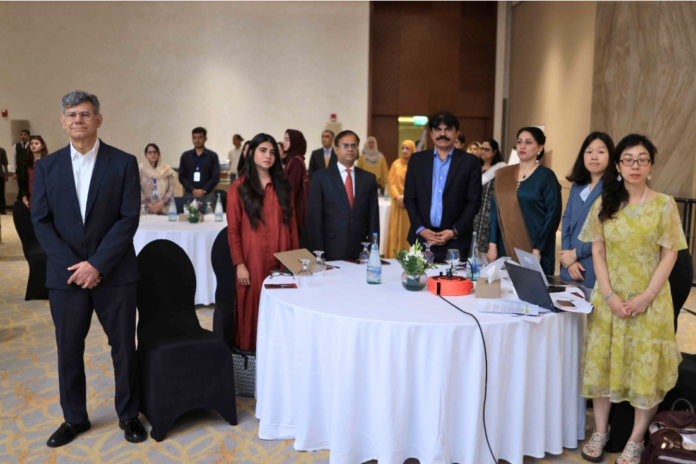

Islamabad, October 2, 2026 – The Government of Pakistan, through the Ministry of Human Rights, in partnership with UN Women, inaugurated the Knowledge Exchange and Action-Oriented Forum on Transforming Care Systems and formally launched Pakistan’s first Multi-Sectoral Care Working Group (MCWG), creating a national platform to recognize, reduce and redistribute unpaid care work, and to unlock women’s full economic participation.
The two-day forum brought together representatives from federal and provincial governments, development partners, academia, civil society, the private sector and care practitioners to move from dialogue to delivery: strengthening institutional capacity and building consensus around priority actions for transforming care systems in Pakistan.
In his keynote address, Abdul Khalique Shaikh, Federal Secretary, Ministry of Human Rights, reaffirmed the Government’s commitment for integrating care into national development priorities. He emphasized that care is fundamentally a human rights issue and called for a comprehensive approach that recognizes, protects and supports both care recipients and caregivers, while advancing Pakistan’s commitments under SDG Target 5.4 on recognizing and valuing unpaid care, and its international human rights obligations.
Opening the forum, Fahmida Iqbal, Country Representative a.i., UN Women Pakistan, underscored the critical link between care and women’s economic empowerment. She highlighted that women continue to undertake a disproportionate share of unpaid care and domestic work, creating significant barriers to their access to education, employment, entrepreneurship and leadership.
“Financing care is not a cost, but an investment in people, economies and gender equality. Transformative care systems can help reduce the unequal burden of unpaid care, create decent employment opportunities and enable more women to participate fully in the economy and public life,” she said.
The forum was organized under UN Women’s global initiative to transform care systems, implemented through the TransformCare Investment Initiative Asia-Pacific. It was organized in collaboration with the UN Women Knowledge and Partnerships Centre in the Republic of Korea, with support from the Ministry of Gender Equality and Family of the Republic of Korea. The forum builds on regional momentum, positioning Pakistan within a growing Asia-Pacific movement to treat care as a public investment priority.
The forum also built on Pakistan’s first national dialogue on care, held in 2025, and the publication of “Transforming Care Systems in Pakistan: A Roadmap for Economic Growth and Social Equity,” developed with support from the Royal Norwegian Embassy. The policy brief highlighted the need to recognize care as a public good, strengthen care infrastructure and services, improve data and measurement systems, and establish mechanisms for sustained coordination on care-related reforms.
Over the two days, participants examined practical approaches to care financing, social protection, gender-responsive budgeting and care expenditure tagging, while identifying priority actions for the development of a policy and a future National Care Roadmap. The forum also provided an opportunity to exchange good practices, regional experiences and lessons from countries building comprehensive and gender-responsive care systems.
About the Multi-Sectoral Care Working Group
The MCWG is a national coordination platform bringing together government institutions, development partners, civil society, research institutions, private sector actors and care practitioners. The Working Group will coordinate action on care-related reforms and support the development of a National Care Roadmap.
The Working Group will strengthen evidence and data, advance care-responsive budgeting and financing, promote the professionalization of the care workforce, and improve policy coherence across sectors. It will focus on expanding care infrastructure and services, strengthening family-friendly workplace policies, integrating care into public planning and budgeting, and addressing the unequal distribution of unpaid care and domestic work.
The establishment of the Working Group signals a shift in how Pakistan values care: from a private burden carried largely by women to a shared responsibility and a strategic investment in human capital, economic growth and gender equality. Through #TransformCare, UN Women will continue to work alongside the Government and partners to build care systems that reduce inequalities, expand women’s economic opportunities, create decent jobs, strengthen social protection and advance inclusive and sustainable development.