

Introduction
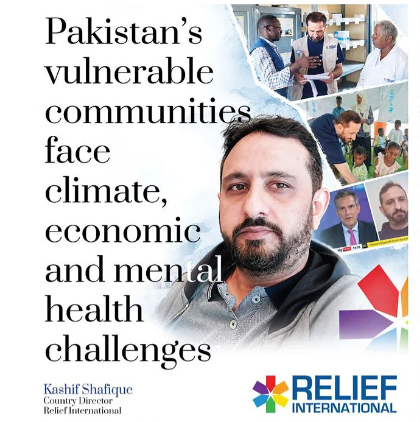
Flare interviewed Kashif Shafique, Country Director, Relief International, who shared insights into the humanitarian situation in Pakistan, Afghanistan and Sudan. Drawing on frontline experience, he highlights the power of people, trust and decisive leadership, with a focus on Pakistan on mental health, livelihoods, inclusion, climate resilience and preparedness.
Q&A Section (Question & Answer)
Flare: What experiences have shaped your approach to humanitarian leadership?
Kashif Shafique: Working across Pakistan, Afghanistan and Sudan has taught me that humanitarian leadership is about people, trust and sound decisions under pressure. Sudan was particularly defining. Leading operations during active conflict required difficult decisions on staff safety, humanitarian access, programme continuity and where limited resources could have the greatest impact. Afghanistan reinforced another lesson: country-office decisions only matter when they translate into better community services. These experiences shaped my leadership around three principles: staying close to frontline realities, trusting capable teams and creating systems that enable timely decisions. Leadership in a crisis cannot be exercised effectively from a distance.
Flare: What are the most pressing humanitarian and development challenges currently facing vulnerable communities in Pakistan and Afghanistan?
Kashif Shafique: Communities are rarely dealing with only one crisis. Climate shocks, displacement, unemployment, poverty, pressure on public services, malnutrition and mental-health needs increasingly overlap. In Afghanistan, healthcare and nutrition systems remain under pressure while families face economic hardship and repeated climate shocks. In Pakistan, vulnerable communities face climate emergencies, limited economic opportunities, psychosocial pressures and continued challenges accessing quality services. With humanitarian funding increasingly constrained, organisations must make limited resources work more effectively while strengthening local systems and resilience.
Flare: How is Relief International responding to climate-related shocks, displacement and growing pressure on health and livelihood systems in the region?
Kashif Shafique: Relief International increasingly uses an integrated approach rather than treating challenges separately. In Afghanistan, health and nutrition remain central, alongside mental health and psychosocial support, WASH, climate resilience and stronger community and frontline systems. In Pakistan, programmes include protection, mental-health and psychosocial support, education, livelihoods, skills development and support for communities affected by displacement and climate shocks. The focus is shifting from immediate needs towards helping communities withstand future shocks through stronger services, preparedness, sustainable livelihoods and resilience.
Flare: From your experience, how important is localisation and partnership with local organisations and communities in delivering effective humanitarian assistance?
Kashif Shafique: Localisation is not simply about transferring activities to local organisations. Communities, local institutions and national organisations possess knowledge, relationships and capacity that international organisations cannot replace. Effective humanitarian response combines international resources and technical expertise with local knowledge and leadership. Meaningful localisation involves communities in identifying priorities, designing solutions and monitoring results, while investing in local partners beyond individual projects. Stronger local institutions can ensure impact lasts beyond the funding cycle.
Flare: How can technology and innovation improve humanitarian response?
Kashif Shafique: Technology can improve humanitarian work when it addresses real operational or community needs. Digital data collection can accelerate needs assessment, geographic information systems can improve targeting and emergency planning, and digital supply chains can strengthen visibility of medicines and essential commodities. Technology can also improve accountability, monitoring and financial controls, while AI can accelerate analysis and identify trends. However, technology must remain a tool, with data protection, digital inclusion and human judgement remaining essential.
Flare: What lessons from Sudan can guide humanitarian operations elsewhere?
Kashif Shafique: A key lesson from Sudan is that preparedness cannot begin after a crisis escalates. Organisations need decentralised decision-making, strong field leadership, reliable communications, scenario planning, alternative supply chains and clear business-continuity arrangements. Sudan also demonstrated the importance of national staff, who continued delivering assistance when international access was extremely difficult. Staff care is another lesson: supporting humanitarian workers is both a moral responsibility and an operational necessity.
Flare: How can governments, global donors and NGOs help communities move from relief to resilience?
Kashif Shafique: We need to move away from treating humanitarian response and development as separate processes. Governments, donors, UN agencies, NGOs and local organisations should agree on common community outcomes rather than creating parallel systems. Multi-year, flexible financing is essential because resilience cannot be built through short funding cycles. Greater investment in local institutions, shared data, coordinated planning and stronger links with public services can help communities become less dependent on emergency assistance.
Flare: What are Relief International’s key priorities in Pakistan and Afghanistan?
Kashif Shafique: Our priorities are to address immediate humanitarian needs and longer-term resilience. In Afghanistan, maintaining access to healthcare and nutrition remains critical, alongside mental health, WASH, stronger local health systems, climate resilience and sustainable livelihoods. In Pakistan, priorities include protection and mental health, youth and livelihoods, economic inclusion, climate resilience and emergency preparedness. Across both countries, we aim to strengthen partnerships and connect humanitarian assistance with sustainable systems and economic opportunities.
Flare: You have engaged with international media including BBC and Sky News. How important is responsible media coverage in highlighting humanitarian crises and affected communities?
Kashif Shafique: Responsible media coverage is important because crises can disappear from international attention while communities’ needs remain. During the Sudan crisis, international media engagement helped explain people’s experiences when humanitarian access was extremely constrained. However, humanitarian communication must protect dignity. People affected by crises should not become merely images, statistics or stories. Their voices, experiences and priorities should remain central, while good journalism can highlight both humanitarian needs and community resilience.
Flare: What is your message to policymakers and partners on strengthening humanitarian action?
Kashif Shafique: Humanitarian assistance should not be viewed simply as charity; it is an investment in human dignity, stability and resilience. Communities affected by conflict, displacement or disaster are not passive beneficiaries but often the first responders to their crises. We need to listen to communities, invest in local capacity, protect essential services and provide longer-term, flexible support. Ultimately, humanitarian action should help people move from surviving crises to shaping their own futures.


