

COMPANY PROFILE
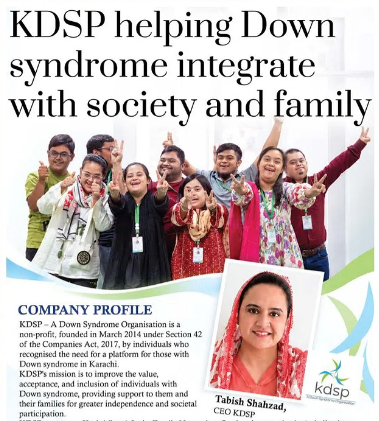
KDSP – A Down Syndrome Organisation is a non-profit, founded in March 2014 under Section 42 of the Companies Act, 2017, by individuals who recognised the need for a platform for those with Down syndrome in Karachi.
KDSP’s mission is to improve the value, acceptance, and inclusion of individuals with Down syndrome, providing support to them and their families for greater independence and societal participation.
KDSP serves as a Kashti (boat) for its Family Network, reflecting the organisation’s dedication to helping families navigate the challenges of Down syndrome. Kashti covers six support areas: Khandani Sahara: Family Support, Agaahi: Awareness, Sehat: Healthcare, Hunar: Skills Development, Taleem: Education, and Ibtidai Bunyad: Early Childhood Intervention. By addressing these six areas, KDSP offers comprehensive support to individuals with Down syndrome and their families, while collaborating with educators, healthcare professionals, and the community.
KDSP envisions a society where individuals with Down syndrome are respected, accepted, and included, with opportunities to pursue their goals and contribute to the community.
Q&A Section (Question & Answer)
Here is the question-and-answer session with Tabish Shahzad
Flare: How does KDSP’s founding experience continue to shape its approach to supporting families today?
Tabish Shahzad: KDSP’s founding experience remains central to its work. The lack of reliable information and support once left families helpless after a diagnosis. Today, KDSP ensures families feel supported, informed and understood.
Every family has different needs, so KDSP listens first, responds with empathy, provides accurate information and connects families with appropriate services. Its founding story reminds KDSP that every family deserves dignity, understanding, knowledge and hope.
Flare: What are the key challenges facing Pakistan’s Down syndrome community, and how is KDSP responding?
Tabish Shahzad: More than 3,000 registered individuals reflect both the scale of need and families’ trust in KDSP, while many more may still lack adequate information, healthcare, education and support.
Awareness and stigma remain major challenges, including misconceptions about education, employment and independence. Families also need lifelong healthcare, early intervention, education, skills development and employment opportunities. KDSP therefore works beyond individual services to address attitudes and systems that limit inclusion.
Flare: How does KDSP support families in the crucial period following a Down syndrome diagnosis?
Tabish Shahzad: The period after diagnosis can be overwhelming. Families need information, emotional support and reassurance about their child’s future.
KDSP begins with a Family First Counselling session, where families discuss concerns, understand the journey ahead and learn about healthcare, therapies, financial assistance and counselling.
Humrahi connects new families with experienced parents, offering lived experience, reassurance and hope that professional services alone cannot provide.
Flare: How does KDSP measure the impact and success of its KASHTI programmes?
Tabish Shahzad: KDSP measures progress through annual plans, clear objectives and KPIs. Because healthcare, education, family support, awareness and employment are interconnected, teams collaborate rather than work in isolation.
Beyond numbers, KDSP assesses outcomes such as access to education and therapy, family advocacy, skills and employment among young adults, and greater independence and community participation.
Ultimately, success is measured by meaningful, lasting impact.
Flare: How has KDSP’s partnership with Aga Khan University Hospital improved healthcare access?
Tabish Shahzad: KDSP’s 2017 partnership with Aga Khan University Hospital made healthcare more accessible and coordinated. The one-stop Down syndrome clinic brought multiple specialists together, reducing the burden on families and providing specialised care.
Building on this model, KDSP has partnered with more healthcare institutions and clinics to expand inclusive, affordable and specialised services.
Flare: What reforms are needed to make inclusive education meaningful for children with Down syndrome in Pakistan?
Tabish Shahzad: Inclusion must go beyond school admission. Without trained teachers, learning support, resources and an inclusive culture, admission alone does not ensure meaningful education.
KDSP’s experience shows that children with Down syndrome can learn and participate alongside peers when properly supported. Reform should include clear inclusion standards, teacher training, learning support systems and appropriate resources.
Success should be measured by learning, participation, relationships and opportunities to reach potential—not simply classroom admission.
Flare: How is KDSP expanding access to quality therapy and support for families across Pakistan, especially in underserved areas?
Tabish Shahzad: Families outside KDSP’s centres often struggle to access occupational, speech and physical therapy. KDSP is using technology to extend its reach, including a developing app with therapy videos and developmental milestones for home use.
Phone-based therapist guidance and home plans will provide continued support. KDSP also aims to expand therapist training outside major cities through partnerships with universities, hospitals and training institutions.
Technology can extend reach, but the goal is affordable, quality support regardless of location.
Flare: How is KDSP creating employment and entrepreneurship opportunities for individuals with Down syndrome?
Tabish Shahzad: KDSP has seen young people move from skills development into internships and sustainable employment. Examples include Danish at Habib University, Hamza at Bachaa Party and Azrem Nadeem, who secured employment at Studio Seven after internships with Soorty Foundation and Martin Dow.
Through Education for Life, KDSP promotes entrepreneurship and independent livelihoods. Businesses can support inclusion through internships, apprenticeships, inclusive recruitment, staff training and workplaces that recognise abilities rather than disability.
Flare: How can language and media representation help promote dignity, inclusion and equal opportunities for people with Down syndrome?
Tabish Shahzad: Language shapes public attitudes. KDSP discourages harmful terms such as “retarded,” “mad,” “insane,” “pagal,” “abnormal,” and “suffering from” Down syndrome, which can reduce people to their diagnosis.
Down syndrome does not prevent people from studying, working, building careers, forming relationships or pursuing ambitions. KDSP promotes person-first, respectful language and media representation based on dignity rather than pity.
Flare: What is KDSP’s vision for the next five years, and how does it plan to expand support across Pakistan?
Tabish Shahzad: KDSP aims to ensure access to opportunity is not determined by where a person lives. It will strengthen its centres and chapters while expanding into underserved communities and supporting people across the life course—from early intervention and healthcare to education, skills, employment and independent living.
A dedicated mobile app is also being developed to make KDSP’s resources and support more accessible nationwide.
Achieving this vision requires collaboration among government, healthcare institutions, schools, businesses, donors and media. Ultimately, KDSP aims to build an ecosystem where individuals with Down syndrome and their families can access healthcare, education, employment and community participation with dignity and independence.


