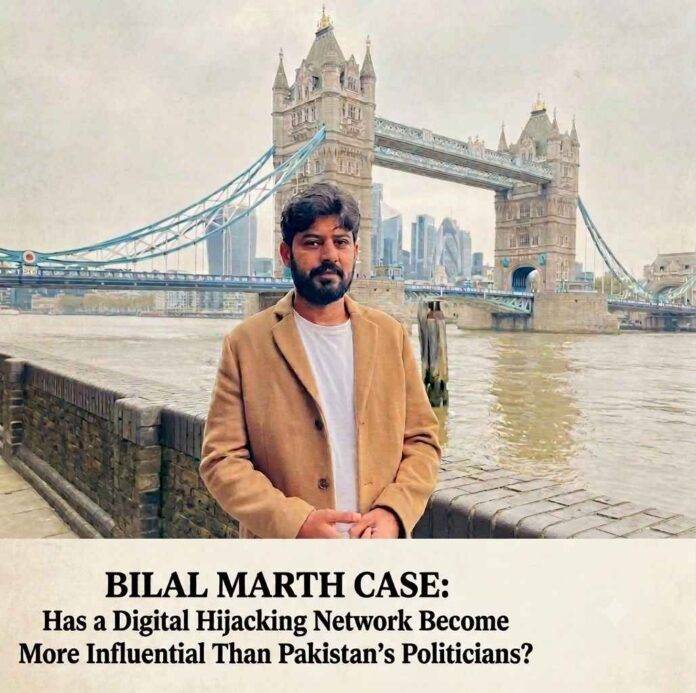

The arrest of social media personality Bilal Marth and several associates has triggered one of the most significant conversations in Pakistan regarding digital influence, online power structures, social media manipulation, and the future of internet-driven influence. What initially appeared to be a law enforcement matter related to the public display of firearms has evolved into a much broader debate about the growing power of digital personalities and whether social media networks are beginning to rival traditional political institutions in terms of influence and reach.
The case has exposed an important reality of the modern digital age. Influence is no longer exclusively controlled by political parties, elected representatives, television networks, newspapers, or state institutions. Today, a smartphone, an internet connection, and a carefully managed online presence can potentially generate audiences that exceed those of some of the country’s most recognizable public figures.
The controversy surrounding Bilal Marth has raised critical questions about how social media fame is created, how online audiences are built, whether digital popularity reflects genuine public support, and what risks emerge when massive influence develops outside traditional systems of accountability.
As investigators continue examining various aspects of the case, the broader discussion has shifted toward understanding the mechanics of digital influence and the implications such influence may have for society, governance, public opinion, and national security.
The Rise of a New Class of Digital Influencers
The emergence of social media has fundamentally transformed the concept of influence.
Historically, individuals gained public recognition through politics, business leadership, academia, entertainment, journalism, sports, or public service. Building influence typically required years of professional achievement and public engagement.
The digital era has disrupted this model.
Today, individuals can acquire millions of followers within a relatively short period through social media platforms. Online audiences often respond to entertainment, lifestyle content, controversy, humor, trends, and viral moments rather than traditional indicators of expertise or institutional authority.
As a result, a new category of influencers has emerged—individuals who possess enormous digital reach despite having little or no connection to conventional power structures.
This shift has significantly altered the balance of influence in many societies, including Pakistan.
The Bilal Marth case has become a prominent example of this transformation and has prompted renewed scrutiny of how digital audiences are accumulated and maintained.
When Digital Reach Exceeds Political Influence
One of the most striking aspects of the controversy is the comparison between social media influence and political influence.
For decades, political leaders were considered the most influential public figures in the country. Their speeches shaped public discourse, their policies affected millions of citizens, and their media presence dominated national conversations.
However, social media platforms have created alternative channels of influence that often operate independently of political systems.
A digital personality with millions of followers can potentially generate engagement levels that rival or exceed those of many established political leaders.
This does not necessarily mean that social media personalities possess equivalent political authority. However, it does indicate that they can command attention, shape conversations, and influence perceptions on a scale that would have been unimaginable only a decade ago.
The ability to attract large audiences without political office, institutional support, or traditional media exposure has fundamentally changed the dynamics of public influence.
The Economics Behind Massive Online Followings
One of the key questions emerging from the case concerns the economics of digital influence.
Building and maintaining large online audiences often requires significant resources. Content production, promotional campaigns, audience engagement strategies, branding efforts, and digital marketing activities can all contribute to audience growth.
In many cases, influencers generate revenue through advertising partnerships, sponsorship agreements, merchandise sales, and other commercial opportunities.
However, when online growth appears unusually rapid or disproportionate to observable factors, questions naturally arise regarding the mechanisms behind that expansion.
Digital investigators around the world increasingly study the role of paid promotions, coordinated campaigns, automated accounts, and artificial engagement systems in shaping online popularity.
The debate surrounding Bilal Marth has intensified public interest in understanding how digital audiences are created and whether all online influence reflects genuine public engagement.
As social media platforms continue to grow, these questions are likely to become increasingly important.
The Growing Concern Over Digital Manipulation
Digital manipulation has emerged as one of the most significant challenges facing modern societies.
Social media platforms provide unprecedented opportunities for communication and community building. However, they also create opportunities for manipulation through coordinated networks, artificial engagement systems, and misleading narratives.
Experts frequently warn that online popularity metrics do not always reflect authentic public support.
Follower counts, likes, shares, comments, and views can sometimes be influenced through techniques designed to create the appearance of widespread popularity.
The existence of such practices has raised concerns among regulators, technology experts, policymakers, and security professionals around the world.
The Bilal Marth case has contributed to this discussion by highlighting the need for greater transparency regarding how influence is generated and measured in digital environments.
As online platforms continue to play a larger role in shaping public opinion, ensuring the authenticity of digital engagement may become an increasingly important policy objective.
Social Media Algorithms and Viral Culture
A major factor behind the rapid rise of online personalities is the design of modern social media algorithms.
These algorithms prioritize content that generates engagement. Videos, posts, and trends that attract strong reactions are often promoted to wider audiences.
As a result, content that evokes excitement, controversy, shock, aspiration, or emotional responses frequently receives greater visibility.
This dynamic has contributed to the development of viral culture, where individuals can gain massive exposure within a short period of time.
While viral content can be entertaining and harmless, critics argue that algorithmic systems sometimes reward extreme behavior over constructive contributions.
Educational content, public service information, and thoughtful discussions may struggle to compete against highly sensationalized material designed to maximize engagement.
The case has reignited discussions about whether social media platforms should bear greater responsibility for the content they amplify and the behaviors they incentivize.
The Impact on Young Audiences
One of the most important dimensions of the debate concerns the influence of social media on young people.
Millions of young Pakistanis consume digital content daily and often view online personalities as role models.
The values, behaviors, lifestyles, and attitudes presented by influencers can significantly shape perceptions and aspirations among younger audiences.
Critics argue that content glorifying wealth, power, intimidation, or lawlessness may have harmful effects if presented as desirable or admirable.
Supporters of digital freedom, on the other hand, caution against excessive regulation and emphasize the importance of individual responsibility and freedom of expression.
Finding an appropriate balance between protecting young audiences and preserving open digital spaces remains a complex challenge for policymakers.
The Bilal Marth case has brought this issue into sharper focus and highlighted the broader societal implications of digital influence.
National Security and the Digital Environment
The controversy has also sparked discussions about national security in the digital age.
Traditionally, national security threats were associated with physical activities, political movements, or external actors. However, the rise of social media has introduced new dimensions of influence and information control.
Large online networks possess the ability to mobilize audiences, spread narratives, shape perceptions, and influence behavior on a massive scale.
This has led governments around the world to pay closer attention to digital ecosystems and the potential risks associated with unregulated online influence.
Security experts increasingly emphasize the importance of monitoring coordinated digital activities while simultaneously respecting fundamental rights and freedoms.
The challenge lies in identifying genuine threats without undermining legitimate online expression and participation.
The case has become part of a broader conversation regarding how countries can adapt their institutions and policies to the realities of a rapidly evolving digital landscape.
The Need for Digital Literacy
One lesson emerging from the controversy is the growing importance of digital literacy.
As online influence becomes more powerful, citizens need the skills necessary to evaluate information critically and understand how digital platforms operate.
Digital literacy includes the ability to recognize manipulation, identify credible sources, assess online claims, and understand the incentives that drive content creation.
Educated and informed users are generally less vulnerable to misinformation, artificial popularity campaigns, and manipulative digital strategies.
Governments, educational institutions, technology companies, and civil society organizations all have a role to play in promoting digital literacy and responsible online engagement.
Strengthening public awareness may prove more effective than relying solely on regulation to address the challenges of the digital age.
Regulation Versus Freedom of Expression
The Bilal Marth case has also revived an important policy debate regarding the balance between regulation and freedom of expression.
Supporters of stronger oversight argue that digital platforms require clearer rules to prevent harmful content, illegal activities, and manipulation.
They believe that greater accountability is necessary to protect users and maintain public order.
Others warn that excessive regulation could limit creativity, suppress legitimate expression, and discourage innovation.
They argue that social media has democratized communication and provided opportunities for individuals who previously lacked access to traditional platforms.
Finding a balance between these competing priorities will be one of the defining challenges of digital governance in the coming years.
The outcome of this debate will shape the future of online communication, influence, and public discourse.
A Turning Point for Pakistan’s Digital Future
The Bilal Marth case represents more than a criminal investigation or a social media controversy. It has become a symbol of a broader transformation occurring across Pakistan’s digital landscape.
The rise of powerful online personalities demonstrates how technology has reshaped influence, authority, and public engagement. Social media platforms now possess the ability to elevate individuals to extraordinary levels of visibility and influence, sometimes surpassing traditional political and institutional figures in terms of audience reach.
At the same time, the case highlights important concerns regarding digital manipulation, algorithmic amplification, youth influence, public accountability, and national security.
As Pakistan continues its digital transformation, policymakers, technology platforms, educators, and citizens will face increasingly complex questions about how influence should be measured, regulated, and understood.
The controversy serves as a reminder that the internet is no longer merely a communication tool. It has become a powerful ecosystem capable of shaping perceptions, mobilizing communities, influencing behavior, and redefining the nature of influence itself.
Whether the future belongs to traditional institutions or digitally empowered networks remains an open question. What is certain, however, is that the balance of influence in Pakistan is changing rapidly, and the lessons emerging from this case are likely to shape discussions about digital power for years to come.
Read More
Budget May Bring Tax Relief for Salaried Individuals Earning Up to Rs. 300,000 Monthly