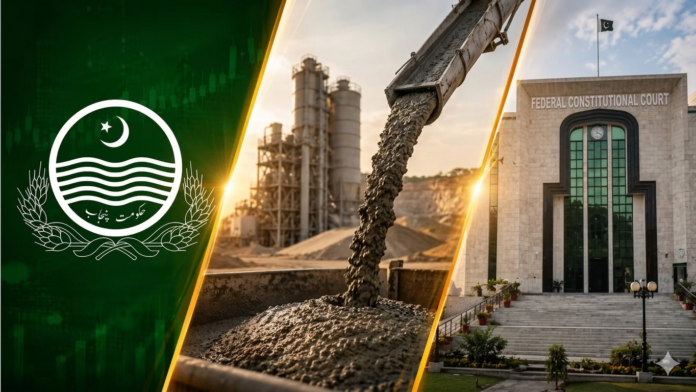

Pakistan’s cement industry is closely monitoring a significant legal dispute after the Federal Constitutional Court raised questions about the Punjab government’s method of collecting royalty on cement production rather than on the extraction of raw minerals. The case has the potential to reshape royalty policies, influence cement prices, affect manufacturing costs, and alter competitive dynamics within one of the country’s most important industrial sectors.
The court’s observations have sparked widespread debate among industry stakeholders, policymakers, legal experts, and investors regarding the distinction between royalty and taxation. At the center of the controversy is the Punjab government’s decision to calculate royalty payments based on the ex-factory price of cement rather than on the value or quantity of minerals extracted from mines.
The issue carries major implications because limestone and argillaceous clay are the primary raw materials used in cement manufacturing. Any change in the royalty framework could affect profitability, pricing structures, and future investment decisions throughout the sector.
The case also highlights broader questions about provincial authority, mineral resource management, industrial competitiveness, and the balance between government revenue generation and business sustainability.
Understanding the Royalty Dispute
The dispute originated after the Punjab government revised its royalty collection mechanism for limestone and argillaceous clay used in cement production.
Traditionally, royalty payments associated with mining activities are charged on extracted minerals. These payments are generally considered compensation to the government for the use and depletion of natural resources.
However, under the revised framework, royalty is linked to the ex-factory price of cement, meaning the amount payable increases or decreases depending on the market value of the finished product rather than the quantity or value of raw minerals extracted.
This shift has generated strong opposition from cement manufacturers operating in Punjab. Industry representatives argue that royalty should only apply to mineral extraction and should not be calculated based on the sale price of a finished industrial product.
Manufacturers contend that the revised formula effectively transforms royalty into a form of taxation on cement production rather than a charge related to the extraction of natural resources.
The legal challenge seeks clarification on whether the provincial government possesses the authority to impose such a framework under existing laws governing mineral resources and mining activities.
Court Raises Questions Over the Current Formula
During the proceedings, members of the Federal Constitutional Court expressed concerns regarding the basis of the revised royalty structure.
The bench observed that royalty is generally associated with minerals extracted from the ground rather than with finished products produced through industrial processing. This distinction forms the foundation of the court’s preliminary concerns regarding the legality and nature of the current system.
The judges questioned whether calculating royalty as a percentage of cement prices aligns with the traditional definition and purpose of royalty payments.
According to the court’s observations, linking royalty directly to cement prices appears to move beyond the extraction stage and into the manufacturing process. This raises important legal questions regarding whether such charges should be classified as royalties or taxes.
The distinction is critical because different legal frameworks govern royalties and taxes. The final interpretation could influence not only the cement industry but also future resource-related policies across other sectors.
While the court has not yet delivered a final verdict, its observations have attracted significant attention from market participants and industry analysts.
Why the Difference Between Royalty and Tax Matters
The debate surrounding the case centers largely on the distinction between royalties and taxes.
Royalties are generally imposed on the extraction of natural resources such as minerals, oil, gas, or other valuable materials. They are intended to compensate governments for the use of publicly owned resources.
Taxes, on the other hand, are typically levied on income, sales, production, or economic activities and are governed by separate legal principles.
Industry stakeholders argue that calculating royalty based on cement prices effectively creates a production-based tax rather than a mineral extraction charge.
If courts ultimately agree with this interpretation, the existing framework could face significant legal challenges.
The outcome may establish an important precedent regarding how governments calculate resource-related charges and how such levies should be distinguished from conventional taxes.
The ruling could therefore have implications extending far beyond the cement industry.
Impact on Cement Manufacturers
The case is particularly important for cement manufacturers operating in Punjab because the revised royalty structure significantly affects production costs.
Under the current formula, royalty expenses have reportedly increased substantially compared to previous arrangements. Manufacturers argue that the higher costs place additional pressure on profitability and competitiveness.
The cement industry already faces multiple challenges, including fluctuating energy costs, transportation expenses, financing costs, and evolving market conditions.
Additional royalty burdens can further increase operational expenses and reduce margins, particularly during periods of weaker demand or economic uncertainty.
For companies with major production facilities in Punjab, the outcome of the case could influence future investment decisions, expansion plans, and pricing strategies.
Many industry participants believe that a favorable ruling could reduce cost pressures and improve the overall business environment for manufacturers operating within the province.
Competitive Disadvantages Within the Industry
One of the most significant concerns raised by industry representatives is the growing disparity between royalty costs in Punjab and those in other provinces.
Manufacturers argue that the revised framework has created a cost disadvantage for producers operating in Punjab compared with competitors located elsewhere.
When production costs differ significantly between regions, companies may face challenges competing on price, particularly in a market where margins are often influenced by transportation costs, regional demand, and economic conditions.
The cement industry is highly competitive, and even relatively small differences in production expenses can influence market share and profitability.
Higher royalty costs may also affect investment decisions regarding future plant expansions, modernization projects, and capacity enhancements.
Businesses generally prefer predictable and equitable regulatory frameworks that allow them to compete on operational efficiency rather than differences in regional policy structures.
Potential Impact on Cement Prices
The court also highlighted concerns regarding the effect of higher royalty payments on consumers.
Industry experts note that increased production costs are often passed on to end users through higher product prices. In the case of cement, rising costs can affect a broad range of economic activities, including construction, housing, infrastructure development, and industrial projects.
Cement is one of the most important construction materials in Pakistan’s economy. Any increase in cement prices can influence the cost of residential developments, commercial projects, public infrastructure, and industrial investments.
As a result, the implications of the royalty dispute extend beyond manufacturers and directly affect consumers, developers, contractors, and government infrastructure programs.
If the court ultimately concludes that the current framework imposes excessive costs, policymakers may need to reassess the balance between revenue generation and maintaining affordable construction materials.
The outcome could therefore have broader economic consequences beyond the mining and cement sectors.
Importance of Limestone and Clay in Cement Production
Limestone and argillaceous clay are essential raw materials in cement manufacturing.
These minerals are extracted from quarries and processed through a series of industrial stages to produce cement used throughout the construction industry.
Because the manufacturing process adds substantial value beyond the extraction stage, manufacturers argue that royalty should be calculated based on the raw materials rather than the final product.
The transformation from raw minerals to finished cement involves significant investments in machinery, labor, energy, transportation, environmental compliance, and industrial infrastructure.
Industry representatives contend that linking royalty to the final product fails to recognize the distinction between natural resource extraction and value-added manufacturing.
This argument forms a central component of the legal challenge currently under review by the court.
Broader Implications for Pakistan’s Industrial Policy
The case has attracted attention beyond the cement sector because it touches upon broader questions regarding industrial policy and investment incentives.
Pakistan is actively seeking to increase industrial output, attract investment, and support economic growth through manufacturing expansion.
Businesses frequently emphasize the importance of stable regulatory environments when making long-term investment decisions. Uncertainty surrounding taxes, royalties, and compliance requirements can discourage new investments or delay expansion plans.
A clear legal interpretation of royalty frameworks may therefore contribute to greater certainty for investors operating in resource-based industries.
The court’s ruling could help establish guidelines for how governments structure future royalty systems and interact with industrial sectors that rely on natural resources.
Such clarity would benefit both policymakers and businesses by reducing uncertainty and promoting consistent regulatory practices.
Economic Significance of the Cement Industry
The cement industry plays a vital role in Pakistan’s economy and remains closely linked to construction activity, infrastructure development, and economic growth.
The sector supports thousands of jobs across mining, manufacturing, transportation, logistics, engineering, and related industries.
Cement production also serves as an important indicator of economic activity because demand typically rises during periods of infrastructure investment and construction growth.
Pakistan possesses significant installed cement production capacity and continues to be one of the major cement-producing countries in the region.
Maintaining a competitive and sustainable cement sector is therefore considered important for supporting broader economic development objectives.
Any policy changes that significantly affect production costs or market competitiveness can have ripple effects throughout the economy.
Investor Interest in the Court Proceedings
The ongoing case is being closely watched by investors and market participants due to its potential financial implications.
A ruling that favors manufacturers could reduce cost burdens and improve profitability for affected companies. This possibility has attracted attention from shareholders, analysts, and industry observers evaluating future sector performance.
At the same time, government authorities must consider the potential impact on provincial revenues generated through royalty collections.
The challenge lies in balancing the need for public revenue with the objective of maintaining a competitive industrial environment.
Investors generally welcome regulatory clarity because it improves forecasting accuracy and reduces uncertainty regarding future operating costs.
The final outcome of the case is therefore likely to influence both market sentiment and long-term investment strategies within the sector.
What Happens Next?
The court has sought additional information from the Punjab government regarding the rationale behind the current royalty structure and its impact on cement prices.
Government representatives have been asked to provide further explanations and clarify the legal basis for linking royalty payments to cement prices rather than mineral extraction.
Once these submissions are reviewed, the court will continue examining the constitutional, legal, and economic dimensions of the dispute.
The final verdict could either uphold the existing framework, require modifications, or potentially lead to a broader reassessment of royalty collection mechanisms.
Regardless of the outcome, the decision is expected to have significant implications for the cement industry, provincial revenue policies, and future approaches to mineral resource management.
Outlook for the Cement Sector
The Federal Constitutional Court’s observations have introduced an important debate regarding the nature of royalty payments and the proper method for calculating charges associated with mineral extraction.
For cement manufacturers, the case represents a potentially significant opportunity to challenge rising costs and improve competitiveness. For policymakers, it highlights the need to balance revenue generation with industrial growth and consumer interests.
As the proceedings continue, industry participants remain focused on the potential consequences for production costs, pricing structures, investment decisions, and market dynamics.
The final ruling could reshape how royalties are calculated in Punjab and potentially influence resource-related policies across Pakistan. Given the economic importance of the cement industry and its role in supporting construction and infrastructure development, the outcome of this case is likely to remain one of the most closely watched legal and industrial developments in the country.
Read More
Pakistan’s Gig Economy Gets a Boost Through DIB Pakistan-Pocket Money Collaboration