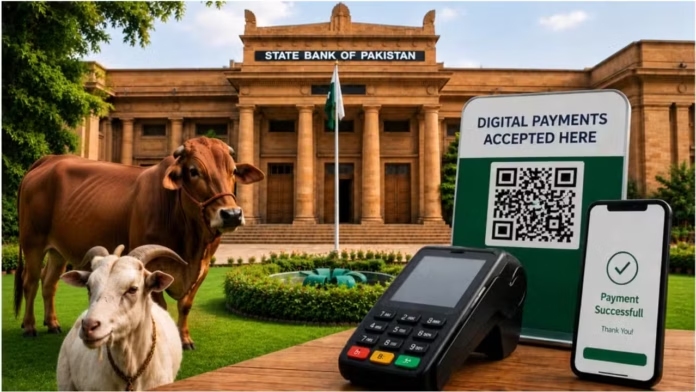

Pakistan witnessed a major increase in digital payments during the Eid ul Azha season as the State Bank of Pakistan’s nationwide “Go Cashless” campaign generated more than Rs. 34 billion in digital transactions across cattle markets throughout the country.
The campaign marks a significant step forward in Pakistan’s efforts to promote digital banking and reduce dependence on cash transactions. Traditionally, cattle markets have been among the most cash-dependent sectors of the economy, with buyers and sellers often carrying large amounts of cash to complete transactions.
However, this year’s results show that more people are becoming comfortable using digital payment methods for even high-value purchases such as sacrificial animals.
According to data released by the State Bank of Pakistan (SBP), more than 480,000 digital transactions were carried out during the campaign. The total value of these transactions exceeded Rs. 34 billion, demonstrating strong public interest in secure and convenient payment solutions.
The campaign was organized across 123 cattle markets nationwide, making it the largest digital payment initiative ever conducted during the Eid ul Azha season in Pakistan.
The scale of the program was much larger compared to the previous year. In 2025, the campaign covered only 54 cattle markets and recorded approximately 65,000 digital transactions worth around Rs. 4.6 billion.
In comparison, the 2026 campaign recorded over 481,000 transactions worth Rs. 34 billion. This represents a massive increase in both transaction volume and value within just one year.
The impressive growth highlights the rapid adoption of digital financial services across Pakistan and reflects changing consumer behavior as more people embrace modern banking technologies.
Eid ul Azha is one of the busiest periods of economic activity in Pakistan. Millions of people purchase sacrificial animals, generating billions of rupees in transactions over a short period.
Historically, these transactions have been conducted almost entirely in cash. Buyers often withdraw large sums of money before visiting cattle markets, while sellers receive cash payments and face challenges related to security, cash handling, and transportation.
Large cash transactions also create risks such as theft, fraud, and difficulties in maintaining proper financial records.
To address these challenges, the State Bank launched the Go Cashless campaign to encourage buyers and sellers to use digital payment methods instead of physical cash.
The campaign involved extensive collaboration between the central bank and commercial banks operating across the country.
A total of 22 participating banks took part in the initiative. These banks established dedicated service camps and kiosks inside cattle markets to provide financial services directly to market participants.
The presence of banking facilities within the markets allowed buyers and sellers to access digital payment solutions without needing to visit bank branches.
Bank representatives assisted cattle sellers, transporters, traders, and service providers in opening accounts and registering for digital payment services.
One of the key features of the campaign was the use of real-time biometric verification systems. This technology enabled banks to quickly verify customer identities and open accounts efficiently.
As a result, many individuals who previously had limited access to formal banking services were able to join the digital financial system.
Participating banks also issued QR codes to cattle sellers and service providers. These QR codes allowed buyers to make payments directly through mobile banking applications and digital wallets.
Instead of carrying large amounts of cash, buyers could simply scan a QR code using their smartphone and transfer funds instantly.
This made transactions faster, safer, and more convenient for both parties.
The introduction of QR-based payments proved particularly useful for high-value cattle purchases, where cash transactions can involve hundreds of thousands or even millions of rupees.
By reducing the need for physical cash, digital payments helped minimize security risks while improving transparency.
To further support the campaign, banks deployed mobile banking vans at selected cattle markets.
These mobile banking units were equipped with ATMs, cash deposit machines, and banking counters.
The vans provided on-site banking services, allowing customers to withdraw cash, deposit funds, transfer money, and receive assistance with digital banking services without leaving the market.
This mobile banking infrastructure played an important role in ensuring smooth operations during the busy Eid season.
The State Bank of Pakistan itself also played an active role in the campaign’s implementation.
SBP teams were deployed across cattle markets around the clock to monitor operations, assist participating banks, and resolve any technical or operational issues that arose during the campaign.
Their presence helped ensure that digital payment systems functioned smoothly throughout the Eid period.
To facilitate larger transactions associated with cattle purchases, the central bank temporarily increased transaction limits between May 14 and June 5.
The higher limits enabled buyers to make larger digital payments without facing restrictions that normally apply to banking transactions.
This measure was particularly important because the prices of sacrificial animals can range from tens of thousands to several hundred thousand rupees, while premium animals may cost even more.
By increasing transaction limits, the State Bank ensured that digital payments could accommodate the needs of buyers purchasing expensive animals.
In addition to operational support, the central bank launched a nationwide public awareness campaign.
The awareness initiative utilized television channels, radio stations, newspapers, social media platforms, and digital advertising to educate the public about the benefits of digital payments.
The campaign highlighted the convenience, security, and efficiency of cashless transactions.
Consumers were informed about how to use QR codes, mobile banking apps, and digital wallets for cattle purchases.
Educational content also emphasized the importance of financial inclusion and encouraged individuals to become part of Pakistan’s formal banking system.
The results of these efforts were highly encouraging.
Compared to last year’s figures, the number of digital transactions increased by more than seven times.
Transaction value also recorded remarkable growth, increasing from Rs. 4.6 billion in 2025 to Rs. 34 billion in 2026.
These numbers demonstrate that consumers are becoming increasingly comfortable with digital financial services.
One of the most important outcomes of the campaign was the opening of approximately 12,500 new bank accounts.
Many of these accounts were opened by cattle farmers, livestock traders, transport operators, and other individuals associated with the livestock sector.
For many account holders, this may be their first experience with formal banking services.
Financial inclusion remains a major objective for Pakistan’s banking sector.
A significant portion of the population still operates outside the formal financial system, relying primarily on cash transactions.
By bringing thousands of new users into the banking network, the Go Cashless campaign contributed to broader national efforts aimed at expanding financial access.
Experts believe that increased financial inclusion can have several positive effects on the economy.
People with access to bank accounts can save money more securely, access financing opportunities, receive government payments more efficiently, and participate more fully in economic activities.
Digital payments also improve transparency and help create documented financial records, which can support economic planning and policy development.
The success of the campaign demonstrates that even traditionally cash-based sectors can successfully adopt digital payment solutions when provided with the right infrastructure and support.
Cattle markets have long been viewed as one of the most challenging environments for digital financial services due to their size, complexity, and reliance on cash.
The strong results achieved during the Eid season suggest that similar approaches could be applied to other sectors of the economy.
Market observers believe that digital payments may continue to grow in livestock markets in the coming years.
As more buyers and sellers become familiar with the technology, adoption rates are expected to increase further.
The success of the initiative may also encourage the development of additional digital financial products tailored specifically to the needs of farmers, livestock traders, and rural communities.
The State Bank has described the campaign as an important milestone in Pakistan’s digital transformation journey.
According to the central bank, the strong growth in transaction volume and value reflects rising public confidence in digital banking solutions.
Officials believe the campaign demonstrates how technology can improve efficiency, enhance security, and promote financial inclusion across various sectors of the economy.
The experience gained from the Go Cashless campaign is expected to support future efforts to digitize other seasonal and high-volume markets throughout Pakistan.
As digital infrastructure continues to improve and smartphone usage expands, cashless transactions are likely to become an increasingly important part of everyday economic activity.
The Rs. 34 billion generated through digital payments during Eid ul Azha serves as clear evidence that Pakistan is moving steadily toward a more modern and digitally connected financial system.
The success of the campaign not only benefits consumers and businesses but also supports broader economic goals, including financial inclusion, transparency, efficiency, and sustainable economic growth.
With hundreds of thousands of successful transactions completed and thousands of new users entering the banking system, the Go Cashless campaign has set a new benchmark for digital payment adoption in Pakistan and provided a strong foundation for future expansion of digital financial services across the country.