
A Shifting Global Order and Emerging Security Realignments
The global geopolitical order is undergoing a profound transformation, reshaping long-established assumptions about power, security, and influence. The post–World War II system, long dominated by Western strategic structures, is increasingly being questioned as new regional powers assert themselves and traditional alliances face strain.
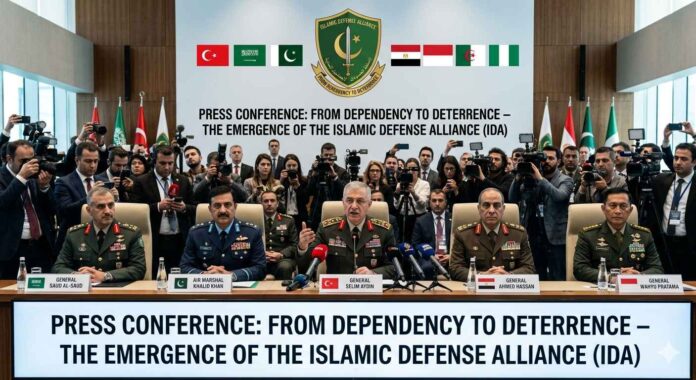
At the center of this transformation is a growing debate over whether Muslim-majority countries can move from fragmented dependency toward collective strategic strength. The idea of a coordinated security framework, often described as a “Muslim NATO,” has begun to surface in strategic discussions as regional actors reassess long-term vulnerabilities and shifting global alignments.
This emerging concept reflects not only military considerations but also broader questions of sovereignty, autonomy, and geopolitical balance in a rapidly evolving world.
Historical Patterns of Dependency and External Security Reliance
Historically, several regions in the Muslim world have relied on external powers for security guarantees. This arrangement often took the form of strategic partnerships in which military protection was exchanged for political alignment or economic cooperation.
In practice, this has created a long-standing dependency on external security frameworks, particularly those led by major global powers. Many states have depended on foreign military presence or defense agreements to maintain stability in a volatile regional environment.
However, recent developments have highlighted the limitations of such arrangements. Questions about reliability, responsiveness, and strategic priorities have become more prominent, particularly in moments of regional escalation where expectations of external protection were not fully met.
Changing Regional Power Dynamics in the Middle East
The Middle East remains one of the most strategically sensitive regions in the world, with evolving power dynamics that continue to reshape alliances and rivalries. Iran’s growing ability to project influence has significantly altered the regional balance.
Control over key maritime routes and strategic waterways has reinforced the importance of asymmetric and hybrid forms of power projection. This has challenged traditional assumptions that naval or conventional military superiority alone determines regional dominance.
Instead, modern geopolitical influence is increasingly shaped by technological capability, strategic depth, and the ability to sustain long-term deterrence.
Limitations of External Military Guarantees
The reliance on external security guarantees has come under increasing scrutiny. While such arrangements have historically provided deterrence and stability, recent geopolitical events have raised concerns about their effectiveness under rapidly changing conditions.
Instances where regional crises did not receive expected levels of external intervention have fueled debate about the reliability of long-term defense commitments. This has led some states to reconsider the structure and sustainability of their security partnerships.
The growing perception is that external guarantees may prioritize broader strategic interests, which do not always align fully with the immediate security needs of host nations.
Emerging Dialogue on a Muslim Security Framework
In response to these shifts, discussions have increasingly turned toward the possibility of a more integrated regional defense framework among Muslim-majority countries. This idea is often described as a proposed “Muslim NATO,” though it remains conceptual rather than institutional.
The concept is based on the idea of collective defense, where member states would cooperate on security challenges, deterrence strategies, and defense coordination. The goal is to reduce dependency on external powers and strengthen internal strategic resilience.
While still at an early stage, the idea reflects a broader desire for greater autonomy in security and defense matters.
Strategic Role of Pakistan, Iran, and Turkey
Three countries are often highlighted as potential pillars in any emerging regional security framework: Pakistan, Iran, and Turkey.
Pakistan brings nuclear capability, a large conventional military structure, and significant operational experience in regional security environments. Its strategic location and defense partnerships further enhance its importance in regional dynamics.
Turkey contributes advanced defense manufacturing capabilities, particularly in drone technology and modern military systems. Its expanding defense industry and geopolitical positioning between Europe and Asia add to its strategic weight.
Iran, despite geopolitical tensions, has developed significant asymmetric defense capabilities and maintains influence over key regional corridors. Its strategic doctrine emphasizes deterrence and regional reach.
Together, these three countries represent a concentration of military, technological, and strategic capabilities that could form the foundation of a broader security architecture.
Diverging Strategic Interests and Regional Complexity
Despite shared interests in regional stability, differences in strategic priorities remain a significant challenge. Each state has its own security concerns, alliances, and geopolitical considerations that shape its approach to cooperation.
These differences reflect the complexity of forming any unified defense framework in a region marked by historical rivalries, political diversity, and varying foreign policy orientations.
As a result, any future cooperation would likely evolve gradually, starting with limited coordination rather than immediate institutional integration.
The Geopolitical Legacy of Fragmentation
The current political map of the Muslim world is deeply shaped by historical fragmentation. The dissolution of earlier centralized political structures created a landscape of multiple independent states with varying levels of influence and capability.
This fragmentation has often limited the ability to form unified responses to external challenges, contributing to long-standing debates about collective identity and strategic coordination.
In modern geopolitical terms, fragmentation has also affected economic integration, defense cooperation, and diplomatic alignment across the region.
Global Power Competition and Strategic Rebalancing
At the global level, the international system is increasingly characterized by multipolar competition. Established powers continue to play dominant roles, but emerging centers of influence are reshaping global alignments.
In this environment, regional blocs and strategic alliances are becoming more important as states seek to balance external pressures with internal cohesion.
The idea of a Muslim-led security framework fits within this broader trend of regional consolidation seen in other parts of the world.
Economic and Strategic Dimensions of Cooperation
Beyond military considerations, economic integration is a key factor in any potential regional alignment. Trade, energy cooperation, infrastructure development, and financial connectivity all play important roles in shaping long-term strategic partnerships.
A coordinated approach to economic and defense cooperation could enhance regional stability and reduce external dependencies.
However, achieving such integration requires overcoming structural challenges, including economic disparities, political differences, and institutional limitations.
Potential Expansion of Regional Cooperation
While Pakistan, Iran, and Turkey are often viewed as core actors in this evolving discussion, other countries may also play important roles over time. Nations with significant populations, economic influence, or geographic importance could gradually become part of broader cooperative frameworks.
Countries in South Asia, the Middle East, Southeast Asia, and Africa may each contribute to a wider network of strategic collaboration depending on evolving geopolitical conditions.
The expansion of such cooperation would likely be gradual and shaped by shared interests rather than formal alliances in the early stages.
Shifting Balance Between Dependency and Strategic Autonomy
A central theme in this evolving discourse is the shift from dependency to strategic autonomy. Many states are reassessing long-standing security arrangements in light of changing global realities.
This reassessment reflects a broader desire for self-reliance, resilience, and greater control over national security decisions.
In this context, regional cooperation is increasingly seen as a pathway toward strengthening collective capacity while reducing reliance on external actors.
Future Outlook: Toward a New Security Architecture
The concept of a Muslim NATO remains theoretical, but it reflects real and growing debates about the future of regional security architecture. Whether or not it materializes in formal terms, the underlying trend toward greater cooperation among key regional states is already underway.
If strengthened over time, such coordination could influence global geopolitics by creating an additional center of strategic influence alongside existing global powers.
Pakistan, Iran, and Turkey are likely to remain central to this evolving discussion, with their roles shaped by both internal developments and external pressures.
Conclusion: A Transition Toward Collective Strategic Strength
The emerging discourse around regional security cooperation reflects a broader transition in global politics. As traditional power structures evolve, new frameworks for collaboration are being explored.
The idea of moving from reliance on external guarantees toward collective strategic strength represents a significant shift in thinking across parts of the Muslim world.
While challenges remain substantial, the growing emphasis on cooperation, deterrence, and regional alignment signals a changing geopolitical landscape—one where new alliances and frameworks may gradually redefine the balance of global power in the years ahead.
Read More
VEON CEO Praises Mobilink Bank for Achieving 35% Shift to Green Energy