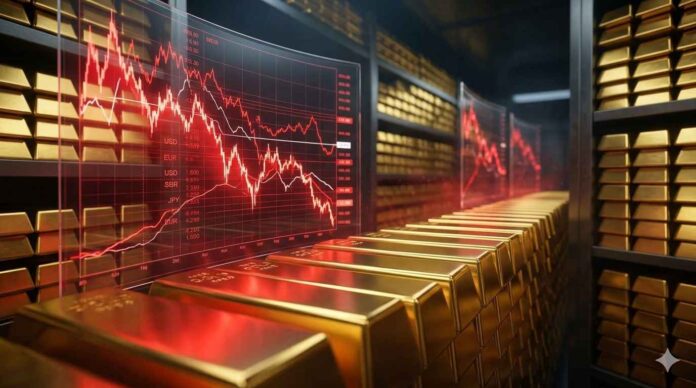

Gold prices in Pakistan continued their downward trajectory at the start of the new trading week, with local rates registering another significant decline following weakness in international bullion markets. The latest reduction pushed the price of gold back toward the Rs. 450,000 level, marking one of the most notable corrections after a prolonged period of elevated prices.
The decline has attracted widespread attention from investors, jewelers, traders, and consumers who closely monitor movements in precious metals. Gold has long been considered one of the most preferred investment assets in Pakistan, serving as a store of value during periods of economic uncertainty, inflationary pressure, and currency volatility.
The latest price correction reflects broader developments in global commodity markets, where gold prices came under renewed pressure during the opening trading session of the week. As international prices weakened, domestic markets followed suit, resulting in substantial reductions in both gold and silver rates across the country.
The development comes after several months of exceptional volatility in precious metals, during which gold repeatedly reached record highs before experiencing periodic corrections driven by changing market conditions and investor sentiment.
Gold Prices Record Significant Decline in Pakistan
The local bullion market witnessed another major adjustment as the price of gold per tola fell sharply to Rs. 452,222 following a decline of Rs. 3,094 during Monday’s trading session.
The reduction came on the heels of an even larger decline recorded during the previous trading session when gold lost more than Rs. 12,000 per tola. Combined, the back-to-back decreases represent a substantial correction from recent highs and indicate that the market is currently undergoing a period of price consolidation.
The price of 10 grams of gold also declined significantly, dropping by Rs. 2,785 to settle at Rs. 386,987.
For many consumers, the latest decline may offer some relief after months of exceptionally high gold prices that had made jewelry purchases increasingly expensive. However, market participants remain cautious as ongoing global uncertainty continues to influence price movements.
Despite the recent decline, gold remains historically expensive when compared to long-term averages, reflecting the broader strength the precious metal has demonstrated over recent years.
International Gold Market Drives Local Prices Lower
The domestic gold market is heavily influenced by developments in international bullion markets. Changes in global prices are often reflected in local rates after accounting for currency movements, import costs, and market dynamics.
During the latest trading session, international gold prices declined by approximately $30 per ounce, bringing the global rate down to around $4,297 per ounce.
This decline contributed directly to the reduction observed in Pakistan’s local market. When international prices fall, domestic bullion dealers generally adjust rates accordingly, resulting in lower prices for investors and consumers.
Several factors can influence international gold prices, including changes in interest rates, inflation expectations, economic growth forecasts, geopolitical developments, central bank policies, and investor sentiment.
Because gold is considered a safe-haven asset, its value often rises during periods of uncertainty and declines when investors become more willing to take risks in other financial markets.
The latest pullback suggests that global investors may be reassessing market conditions, leading to temporary selling pressure in precious metals.
Why Gold Remains Important for Pakistani Investors
Gold continues to play a vital role in Pakistan’s financial landscape despite short-term fluctuations in prices.
For decades, families and investors have relied on gold as a trusted store of wealth and a hedge against inflation. Unlike many financial assets, gold has a long history of retaining value during periods of economic instability.
Many households consider gold an essential component of their savings strategy. Jewelry purchases are often viewed not only as cultural traditions but also as long-term investments capable of preserving purchasing power.
Investors are attracted to gold because it is generally perceived as a safe asset during uncertain economic conditions. When concerns about inflation, currency depreciation, or financial instability increase, demand for gold often rises.
This demand can drive prices higher, making gold one of the most closely watched commodities in the country.
Even with the recent decline, many investors continue to view gold as an important part of diversified investment portfolios.
Impact on Jewelry Buyers and Consumers
The latest decline in gold prices may provide a temporary opportunity for consumers who have postponed purchases due to high costs.
Wedding seasons, cultural celebrations, and family events typically generate strong demand for gold jewelry across Pakistan. However, sustained increases in gold prices over recent years have significantly raised the cost of purchasing jewelry.
For many households, affordability has become a major concern as gold prices repeatedly reached record levels.
The recent correction could encourage some consumers to return to the market, particularly those who were waiting for prices to ease before making purchases.
Jewelry retailers may also experience increased customer activity if buyers perceive current prices as more attractive compared to recent highs.
Nevertheless, market participants remain cautious because gold prices can change rapidly depending on developments in international markets.
Many buyers prefer to wait for greater stability before committing to large purchases.
Silver Prices Also Move Lower
The weakness in precious metals was not limited to gold alone.
Silver prices also recorded losses during the latest trading session, reflecting broader downward pressure across commodity markets.
The value of silver per tola declined by Rs. 94, bringing the rate down to Rs. 7,173.
Like gold, silver is influenced by international market trends and investor sentiment. However, silver differs from gold because it has significant industrial applications in addition to its role as an investment asset.
Demand for silver is closely linked to manufacturing activity, electronics production, renewable energy technologies, and industrial development.
As a result, silver prices often respond to a wider range of economic factors than gold.
The simultaneous decline in both metals highlights the extent of the correction currently affecting precious metal markets.
Factors Influencing Gold Price Volatility
Gold prices are influenced by a complex combination of domestic and international factors.
One of the most important drivers is global investor sentiment. When economic uncertainty rises, investors often increase their exposure to safe-haven assets such as gold. Conversely, improved confidence in financial markets can reduce demand and place downward pressure on prices.
Interest rates also play a crucial role. Higher interest rates generally reduce the appeal of non-yielding assets like gold because investors can earn greater returns from interest-bearing investments.
Currency movements represent another major factor. Since gold is traded internationally in U.S. dollars, fluctuations in exchange rates can affect local prices significantly.
Inflation expectations, geopolitical tensions, central bank purchases, and global economic growth forecasts further contribute to price volatility.
These factors interact continuously, creating an environment where gold prices can change rapidly in response to new information.
Recent Correction Does Not Erase Long-Term Gains
Although gold has experienced a sharp decline over the past few trading sessions, it is important to recognize that the precious metal remains significantly higher than levels recorded in previous years.
The recent correction follows an extended period of strong gains during which gold benefited from global economic uncertainty, inflation concerns, and robust investor demand.
Many analysts view such corrections as a normal feature of commodity markets.
After prolonged rallies, prices often undergo temporary declines as investors take profits and reassess market conditions. These pullbacks can help stabilize markets and create opportunities for new buyers.
The current decline therefore does not necessarily indicate a long-term reversal in trend. Instead, it may represent a period of adjustment following a substantial rise in prices.
Future movements will likely depend on developments in global economic conditions and investor sentiment.
What Investors Should Watch Going Forward
Market participants will closely monitor several factors that could influence gold prices in the coming weeks.
International economic data, inflation reports, central bank decisions, and developments in major financial markets will remain key drivers of sentiment.
Investors will also pay attention to movements in the U.S. dollar, global bond yields, and geopolitical developments, all of which can have a significant impact on precious metal prices.
Domestically, currency stability and economic conditions will continue to influence local gold rates.
Any major changes in these factors could result in renewed volatility and potentially alter the direction of the market.
For investors, maintaining a long-term perspective remains important. While short-term fluctuations can be significant, gold has historically demonstrated resilience during periods of economic uncertainty.
Outlook for Pakistan’s Gold Market
The latest decline has brought gold prices back toward the Rs. 450,000 level, marking a significant adjustment after recent highs. The correction reflects ongoing developments in international markets and changing investor sentiment regarding precious metals.
Although prices have moved lower, gold continues to hold its position as one of the most important investment assets in Pakistan. Strong cultural demand, its role as a hedge against inflation, and its reputation as a store of value continue to support long-term interest in the metal.
The coming weeks will determine whether the current decline develops into a broader correction or whether renewed demand helps stabilize prices.
For now, investors, traders, and consumers are watching closely as global market conditions continue to shape the direction of gold and silver prices. With international markets remaining highly sensitive to economic and geopolitical developments, volatility is likely to remain a defining feature of the precious metals market in the near future.
Read More
SECP Eliminates Lengthy Approval Process for Foreign-Backed Businesses