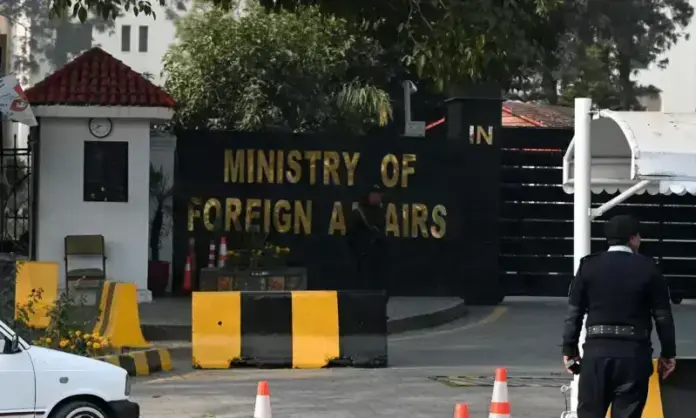

ISLAMABAD By Zubair Kasuri: Sample documents and QR code reveal how suspicious link mimicked official Foreign Office portal; six MOFA officials among 22 booked as FIA probes scale and possible overseas use. The News has uncovered a key digital trail in the alleged apostille and document-attestation fraud under investigation by the Federal Investigation Agency (FIA), obtaining sample documents and QR material showing how an apparently official-looking document could lead to a suspicious verification website closely resembling the Ministry of Foreign Affairs’ official apostille portal.
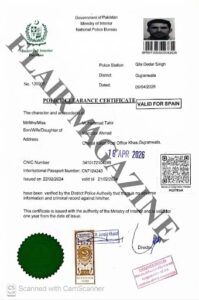
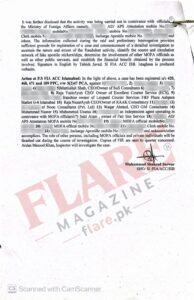
An examination by The News of the available sample material indicates that the alleged operation was potentially more sophisticated than conventional forgery involving fake stamps or stickers.
The documents available with The News carry features associated with an apparently authenticated apostille document, including an official-looking format, document details and a QR code. For an ordinary applicant or non-technical recipient, distinguishing such material from a genuine document at first sight could be difficult.
The QR code provides a particularly significant digital dimension.
When the QR material examined by The News is followed, it leads to an address that begins prominently with the words “apostille.mofa.gov.pk”, creating the appearance of a Ministry of Foreign Affairs web address.
The suspicious QR-linked address examined by The News reads:
apostille.mofa.gov.pk.verify-attestation.com/by-qr!apostille_number=APO-NPDQ-JPCX-DJUL&day=02&month=09&year=2026
The genuine Ministry of Foreign Affairs apostille verification service, however, operates under the government domain:
https://apostille.mofa.gov.pk/verify-attestation
The difference is small to the eye but technically fundamental.
The genuine website is controlled under the government domain mofa.gov.pk. The suspicious address, despite displaying “apostille.mofa.gov.pk” prominently at its beginning, ultimately falls under the separate controlling domain verify-attestation.com.
Internet domain names are hierarchical. Placing the words “apostille.mofa.gov.pk” before another domain does not make that website part of the Ministry of Foreign Affairs’ official domain.
This means an applicant, embassy official, employer or other verifier scanning the QR code and looking only at the beginning of the web address could potentially receive the impression that the document was being digitally verified through the Foreign Office’s official system.
The apparent mechanism therefore potentially created two layers of perceived authenticity.
An official-looking apostille, stamp and document could provide the first layer. The QR code leading to a MOFA-looking web address could provide the second.
In simple terms, the apparent mechanism could work as follows:
Document → official-looking apostille/stamp → QR code → MOFA-looking web address → apparent digital verification.
The existence and structure of the suspicious link provide an important technical lead. The URL alone, however, does not establish who created, controlled or operated the website, or whether it was connected with any particular accused person. Those links remain for FIA investigators to establish.
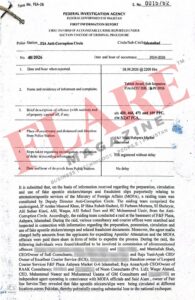
According to FIR No. 48/2026, registered by the FIA Anti-Corruption Circle Islamabad on September 18, a copy of which is available with The News, 22 persons, including six officials of the Ministry of Foreign Affairs and 16 private individuals, have been nominated in the case.
The case has been registered under Sections 420, 468, 471 and 109 of the Pakistan Penal Code, read with Section 5(2) of the Prevention of Corruption Act.
The allegations remain under investigation and have not been adjudicated by a court.
The FIR alleges that fake apostille stickers and stamps, fraudulent slips and other documents were being prepared, possessed and circulated. It further alleges that applicants were charged substantial amounts for expedited apostille and attestation services and that money was allegedly paid to officials for facilitating the process.
Director General FIA, while talking to The News, said the agency was treating the matter seriously and senior officers had been assigned to investigate all aspects of the case.
He said the investigation would be taken to its logical conclusion and no person found involved would be spared, whether from the government or private sector.
The DG FIA said all persons linked with the alleged network were being thoroughly investigated and government officials found involved would also face action, including arrest, in accordance with law. The precise scale of the alleged fraud and the number of documents involved would become clear as the investigation progressed, he added.
A senior official of the Ministry of Foreign Affairs, while explaining the significance of the case to The News, said apostilled documents are primarily intended for official use abroad and cover a wide range of purposes, including education, employment, immigration, residency, family matters and legal or commercial transactions.
Educational degrees, diplomas, transcripts and certificates may be required for foreign university admissions, higher studies, employment and verification of professional qualifications.
Police clearance certificates are used for immigration, residency, work permits and employment, while birth and marriage certificates are required in family, immigration and other official proceedings abroad. Powers of attorney and commercial documents may similarly require authentication for overseas legal and business use.
“The purpose of an apostille is to establish the authenticity of a Pakistani public document for its use abroad,” the senior official said, adding that manipulation of the system could therefore have implications extending beyond financial losses suffered by individual applicants.
The official said a crucial question was whether documents carrying allegedly fake apostille material had reached foreign embassies, immigration authorities, universities, employers or other overseas institutions.
Establishing how many such documents were produced, their destinations and where they were ultimately presented would be critical to determining the actual scale and international impact of the alleged operation.
Any misuse of the mechanism, the official said, could potentially affect confidence in genuine Pakistani documents presented abroad.
The News has not independently established that any particular embassy, university, employer, immigration authority or other foreign institution accepted a fraudulent document. Establishing that trail remains a key task for investigators.
The official Ministry of Foreign Affairs portal shows why the digital aspect of the case is particularly significant.
The genuine apostille system involves multiple stages, including document review, uploading scanned documents, verification of the issuing authority’s credentials, approval by a competent authority and printing of a system-generated apostille. The official portal also provides verification through QR codes and tracking numbers.
Investigators will therefore have to establish whether the alleged network merely forged physical material or whether a parallel digital verification mechanism was deliberately created to reinforce the appearance of authenticity.
They will also have to determine who registered and controlled the suspicious digital infrastructure, how individual QR codes were generated or linked with documents, how many documents were processed through it and whether the digital trail can be connected to persons nominated in the FIR.
A review by The News of online discussions predating the FIA case also indicates the existence of demand for expedited apostille services.
During 2026, applicants publicly sought intermediaries and agents claiming to arrange apostilles considerably faster than ordinary processing. Some users claimed online that they had been quoted or had paid tens of thousands of rupees for agent-assisted processing completed within a few working days.
These social-media claims could not independently be verified by The News and do not establish wrongdoing by any particular intermediary. They nevertheless illustrate the existence of demand for a paid fast-track market around document attestation and apostille services.
That background is relevant to the FIA allegation that applicants were charged substantial amounts for expedited processing and that money was allegedly shared with officials.
The role of courier services also requires an important distinction.
The Ministry of Foreign Affairs officially lists TCS, Gerry’s International, Excellent Courier Services, Leopards Courier Service and M&P Express Logistics as authorised courier companies for document attestation services.
The FIR identifies particular individuals, consultancy businesses and persons associated with certain courier operations. Any allegations relate to the individuals and operations identified in the investigation and should not, merely because an individual, office or franchise has been mentioned, be interpreted as a finding of wrongdoing against an entire courier company.
Investigators are expected to examine whether legitimate document collection and courier channels were misused by particular individuals and whether any such activity received facilitation from within the official system.
Meanwhile, a separate high-level inquiry into alleged irregularities in the apostille and document-attestation system has also been constituted.
Deputy Prime Minister and Foreign Minister Senator Ishaq Dar has formed a three-member inquiry committee headed by Petroleum Secretary Hamid Yaqoub Sheikh. Law Secretary Raja Naeem Akbar and Special Secretary Finance Qamar Sarwar Abbasi are its members.
The committee has been tasked with examining alleged misuse or irregularities in the apostille and attestation system, reviewing the role of courier services, determining possible involvement of Foreign Ministry officials and recommending reforms. It has been directed to submit its findings and recommendations within two weeks.
The FIA investigation now faces a question substantially larger than identifying who allegedly produced a fake stamp or sticker.
It must determine whether an organised network was able to create an end-to-end appearance of official authentication, beginning with the collection and fast-tracking of documents, extending to apparently authentic physical material and culminating in a QR-linked digital verification mechanism that could resemble the government’s own system.
Most importantly, investigators must establish how many such documents were produced, where they went and how far the alleged network ultimately extended.