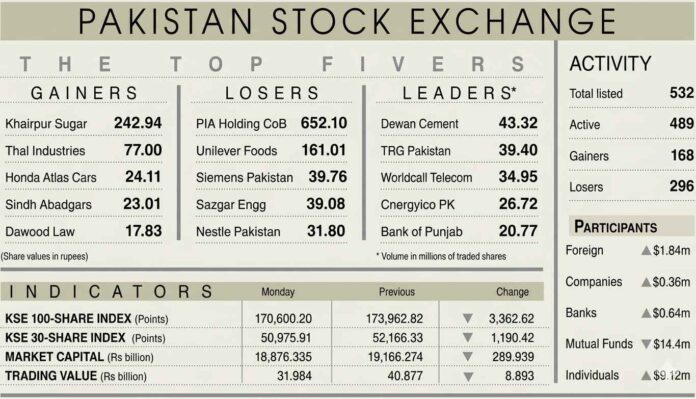

Pakistan Stock Market Starts June With Sharp Decline
The Pakistan Stock Exchange suffered a major setback at the start of June as investors reacted negatively to growing geopolitical tensions, rising international oil prices, and renewed inflationary concerns. After delivering a strong performance during the previous month, the stock market entered the new month under significant pressure, resulting in one of the largest single-session declines in recent weeks.
The benchmark KSE-100 Index witnessed intense selling throughout the trading session as investors rushed to reduce exposure amid uncertainty in global markets. The sharp decline reflected increasing concerns over regional developments, particularly the failure of diplomatic efforts to ease tensions in the Middle East.
Investor confidence weakened considerably as fears surrounding higher energy prices, inflationary pressures, and potential economic disruptions combined to create a highly cautious market environment. The result was a broad-based selloff across major sectors, dragging the benchmark index deep into negative territory.
Benchmark Index Suffers Massive Point Loss
The trading session proved challenging from the opening bell as sellers dominated market activity. The benchmark KSE-100 Index experienced persistent downward pressure throughout the day, eventually closing with a loss of 3,362 points.
The index ended the session at 170,600 points after touching an even lower level during intraday trading. At one stage, the market had fallen by more than 3,500 points as panic selling accelerated across multiple sectors.
The decline represented a loss of nearly two percent in a single trading session, highlighting the severity of investor concerns.
Market participants described the trading day as one of the most volatile sessions witnessed in recent months, with sentiment turning sharply negative as developments in global markets weighed heavily on local equities.
Geopolitical Tensions Trigger Market Panic
A major factor behind the stock market decline was the resurgence of geopolitical uncertainty in the Middle East.
Global investors closely monitored developments involving tensions between regional powers, while diplomatic efforts aimed at reducing hostilities failed to produce meaningful progress. The absence of a breakthrough increased concerns about the possibility of prolonged instability in an already sensitive region.
Financial markets worldwide tend to react strongly to geopolitical developments because such events can disrupt trade routes, energy supplies, and global economic activity.
In this case, fears of escalating conflict raised concerns regarding energy security and economic stability, prompting investors to adopt a more defensive approach.
The uncertainty created an environment in which risk appetite declined significantly, leading investors to reduce exposure to equities and move toward safer assets.
The Pakistan Stock Exchange, like many emerging markets, was particularly vulnerable to shifts in investor sentiment triggered by global geopolitical developments.
Rising Oil Prices Add to Investor Concerns
The increase in international oil prices played a crucial role in shaping market sentiment.
Oil prices surged as concerns grew regarding potential supply disruptions in the Middle East. Since the region remains one of the world’s most important energy-producing areas, any increase in tensions often results in higher crude oil prices.
For Pakistan, rising oil prices carry significant economic implications.
The country relies heavily on imported energy products, making it vulnerable to fluctuations in global oil markets. Higher oil prices increase the cost of imports, widen external account pressures, and contribute to inflationary trends.
Investors immediately recognized the potential consequences of sustained increases in energy prices.
Higher fuel costs can affect transportation, manufacturing, agriculture, and electricity generation, ultimately increasing costs throughout the economy.
The prospect of higher inflation and greater economic pressure prompted investors to reassess market risks, contributing to widespread selling activity.
Inflation Concerns Return to the Spotlight
In addition to geopolitical uncertainty and rising oil prices, investors also reacted negatively to the latest inflation figures.
Recent data showed consumer inflation increasing to 11.66 percent during May, compared with 10.89 percent in the previous month.
The rise in inflation signaled renewed price pressures within the economy, raising concerns about purchasing power, consumer spending, and future monetary policy decisions.
Although the inflation reading remained broadly in line with several market expectations, the increase was enough to reinforce concerns about the overall economic outlook.
Higher inflation typically creates challenges for businesses and consumers alike.
Companies often face increased operating costs, while households experience reduced disposable income due to higher prices for goods and services.
For stock market investors, inflation introduces uncertainty regarding future earnings growth, interest rates, and economic expansion.
These concerns further weakened investor confidence and amplified selling pressure across the market.
Broad-Based Selling Across Major Sectors
The market decline was not limited to a few specific stocks or sectors.
Instead, selling pressure spread across a wide range of industries, reflecting widespread investor caution.
Banking stocks, energy companies, fertilizer producers, cement manufacturers, and large industrial firms all came under pressure as investors reduced positions in major market-heavyweight companies.
The broad nature of the selloff demonstrated that market participants were reacting to macroeconomic concerns rather than company-specific developments.
Large-cap stocks bore the brunt of the decline because they often represent the most liquid investment options during periods of uncertainty.
Institutional investors and portfolio managers frequently adjust positions in these stocks when market sentiment deteriorates.
As a result, many of the market’s largest companies contributed significantly to the overall decline in the benchmark index.
Energy Sector Faces Additional Pressure
The energy sector emerged as one of the most closely watched segments during the trading session.
While higher oil prices can sometimes benefit certain energy companies, the broader implications for the economy created significant concerns among investors.
Rising energy costs can increase production expenses for businesses and place additional pressure on consumers.
Furthermore, concerns regarding external account stability and import costs created uncertainty about the long-term impact of elevated oil prices.
Investors therefore adopted a cautious approach toward energy-related stocks despite the increase in global crude prices.
The mixed outlook contributed to volatility within the sector and added to overall market weakness.
Banking Sector Also Comes Under Pressure
The banking sector, which often serves as a key indicator of investor confidence, also experienced significant selling activity.
Investors worried that rising inflation and potential economic challenges could affect future lending growth, business activity, and financial performance.
Higher inflation can create uncertainty regarding interest rate policy and borrowing costs, influencing profitability across the banking industry.
As concerns mounted regarding the broader economic environment, banking stocks became a target for profit-taking and portfolio adjustments.
The decline in major financial stocks added substantial downward pressure to the benchmark index.
Cement and Industrial Stocks Decline
Industrial and construction-related stocks also experienced notable losses.
Companies linked to infrastructure development, manufacturing, and construction are often sensitive to economic conditions and energy costs.
Rising fuel prices can increase transportation and production expenses, while inflationary pressures may reduce demand for construction materials and industrial products.
Investors responded to these risks by reducing exposure to industrial stocks, contributing to the broader market downturn.
The weakness in these sectors highlighted concerns regarding the potential impact of global developments on domestic economic growth.
Trading Activity Remains Strong Despite Market Fall
Interestingly, despite the sharp decline in stock prices, overall market activity remained relatively strong.
Trading volumes increased compared to previous sessions, indicating that investors remained actively engaged in the market.
A substantial number of shares changed hands during the trading session as buyers and sellers reacted to rapidly evolving conditions.
The increase in trading volume reflected heightened market participation during a period of elevated volatility.
However, while volume increased, the total value of trades declined significantly.
This suggests that investors focused more on reducing positions and managing risk rather than making large-scale new investments.
The divergence between trading volume and traded value highlighted the cautious mood prevailing throughout the market.
Investor Sentiment Remains Fragile
Market analysts noted that investor sentiment remains highly sensitive to developments both at home and abroad.
Recent gains recorded by the stock market had helped improve confidence, but the sudden resurgence of geopolitical risks quickly reversed much of that optimism.
The current environment underscores the importance of stability, predictability, and confidence in maintaining positive market momentum.
When uncertainty increases, investors often prioritize capital preservation over risk-taking, leading to higher volatility and increased market fluctuations.
Until greater clarity emerges regarding geopolitical developments and economic trends, investor sentiment is likely to remain cautious.
Impact on Foreign Investment Flows
Geopolitical uncertainty can also influence foreign investment flows into emerging markets.
International investors frequently reassess risk exposure during periods of global instability, often reducing allocations to higher-risk assets.
For markets such as Pakistan, foreign participation plays an important role in supporting liquidity and market depth.
Any sustained deterioration in global risk sentiment could potentially affect capital flows and investment activity.
As a result, market participants continue monitoring international developments closely for signals regarding future investor behavior.
What Investors Will Watch Next
Looking ahead, investors will focus on several key factors that could influence market direction.
Developments in the Middle East will remain a major source of attention, particularly any diplomatic progress capable of reducing geopolitical tensions.
Oil prices will also continue to play a critical role in shaping sentiment. Sustained increases could intensify concerns regarding inflation, import costs, and economic stability.
Additionally, upcoming economic data, inflation trends, and policy decisions will influence expectations regarding future market performance.
Investors will be watching closely for signs that inflationary pressures are easing and that economic conditions remain supportive of corporate earnings growth.
Any improvement in these areas could help restore confidence and stabilize market conditions.
Conclusion
The Pakistan Stock Exchange began June on a challenging note as investors reacted to rising geopolitical tensions, higher oil prices, and renewed inflation concerns. The benchmark index suffered a sharp decline of 3,362 points, reflecting widespread caution and reduced risk appetite across the market.
The selloff demonstrated how closely local financial markets remain connected to global developments, particularly those affecting energy prices and economic stability. While trading activity remained strong, investor sentiment weakened significantly as uncertainty returned to financial markets.
Moving forward, the direction of the stock market will largely depend on geopolitical developments, inflation trends, and broader economic conditions. Until greater clarity emerges, investors are likely to remain cautious as they navigate an increasingly uncertain global environment.
Read More
Budget 2026-27 Leaves Farmers Anxious Over Future Support Measures