
TWO DECADE OLD TRAVEL PERK FOR JOURNALISTS SCRAPPED BY PAKISTAN RAILWAYS
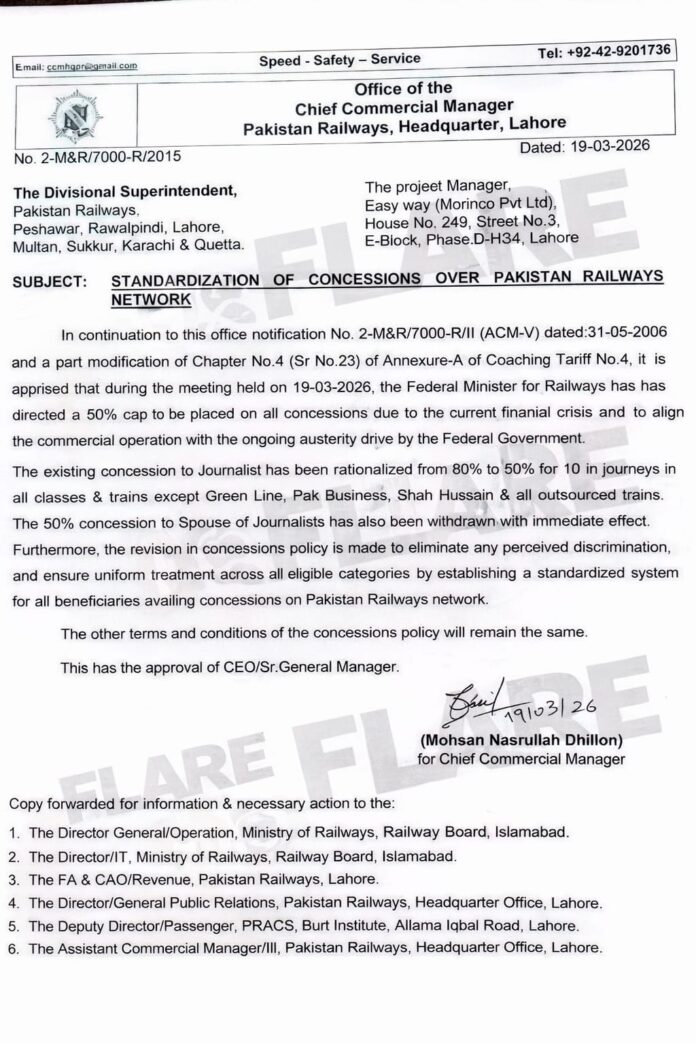
Pakistan Railways has introduced sweeping changes to its long-standing travel concession policy for journalists, significantly scaling back a facility that had remained in place for nearly two decades. Under the revised framework, the discount available to media professionals has been reduced from 80 percent to 50 percent, while the previously flexible and widely used travel allowance has now been capped at just 10 tickets per year. In addition, the concession that was earlier extended to spouses of journalists has been completely withdrawn.
The decision, formalized through an official notification issued in March 2026, reflects a broader shift in policy aimed at controlling expenditures and aligning concessions with the government’s ongoing austerity measures. The move marks a major departure from a system that had long been considered a crucial support mechanism for journalists across the country.
MAJOR REDUCTION IN TRAVEL BENEFITS FOR JOURNALISTS
The most notable aspect of the revised policy is the sharp reduction in the fare discount. For years, journalists enjoyed an 80 percent concession on train travel, a benefit that significantly eased the financial burden associated with frequent travel for reporting assignments. Under the new policy, this concession has been cut down to 50 percent, effectively increasing travel costs for media professionals.
In addition to the reduced discount, the introduction of a strict annual limit of 10 single journeys has fundamentally changed the nature of the facility. Previously, the concession allowed journalists a high degree of flexibility, enabling them to travel as needed without rigid restrictions. The new cap, however, imposes a significant limitation, particularly for those who rely heavily on rail travel for covering stories across multiple regions.
The revised policy applies across most classes and train services, although certain premium services have been excluded from the concession altogether. This further narrows the scope of the benefit, making it less accessible and less practical for regular use.
WITHDRAWAL OF SPOUSE CONCESSION ADDS TO CONCERNS
Another key change introduced under the new policy is the immediate withdrawal of the 50 percent travel concession that was previously available to spouses of journalists. This facility had provided additional support to media professionals, particularly those who often traveled with family members or required assistance during long journeys.
The removal of the spouse concession has added to the concerns already being voiced by journalist communities, as it represents yet another reduction in the overall support structure that had been in place for years.
A POLICY THAT DEFINED TWO DECADES OF MEDIA MOBILITY
The journalists’ travel concession was originally introduced in 2006 as part of an effort to facilitate media professionals in carrying out their duties more effectively. At the time, the initiative was widely welcomed and quickly became an essential resource for journalists working across different beats, including politics, business, and regional reporting.
Over the years, the facility enabled thousands of journalists to travel extensively at minimal cost, allowing them to cover events, conduct field investigations, and report from remote areas. The flexibility of the policy, combined with the substantial discount, made it one of the most valuable support mechanisms available to the media industry.
For many journalists, particularly freelancers and those working in smaller cities, the concession played a critical role in ensuring access to opportunities and information that would otherwise have been difficult to obtain due to financial constraints.
STRONG REACTION FROM JOURNALIST COMMUNITY
The recent decision to scale back the concession has triggered widespread concern and criticism within journalistic circles. Many media professionals have described the move as a setback that could negatively impact their ability to perform their duties effectively.
One of the primary concerns raised is the lack of consultation with journalist bodies and representative organizations prior to the implementation of the policy. Stakeholders argue that a decision of such significance should have involved dialogue with those directly affected, allowing for a more balanced and practical outcome.
Journalists have also pointed out that limiting the concession to just 10 tickets per year makes it largely impractical, especially in the current economic environment where transportation costs continue to rise. For reporters who frequently travel for assignments, the new cap could quickly be exhausted, leaving them to bear the full cost of subsequent journeys.
Freelance journalists and those based in regional areas are expected to be the most affected, as they often rely on cost-effective travel options to sustain their work. Without adequate support, many fear that their ability to cover important stories may be compromised.
PART OF BROADER AUSTERITY AND STANDARDIZATION MEASURES
According to official indications, the revision of the journalists’ concession is part of a wider effort to standardize benefits across different categories and reduce financial strain on the railway system. Authorities have emphasized the need to bring all concessions within a uniform framework, ensuring that no single group receives disproportionately higher benefits.
The changes are also aligned with broader austerity measures being implemented across various sectors, aimed at controlling public expenditure and improving financial sustainability. In this context, the reduction of concessions is seen as a necessary step to balance operational costs and revenue generation.
However, reports suggest that the impact of these measures is not limited to journalists alone. Other groups that previously benefited from concessional travel, including senior citizens and sports-related individuals, have also experienced reductions or restrictions in their respective facilities. This has led to broader concerns about declining public support services and accessibility.
CALLS FOR REVIEW AND POLICY RECONSIDERATION
In response to the changes, journalist organizations and media representatives have called for a review of the decision. Many are urging authorities to reconsider the reduction in the discount rate and the strict limitation on annual travel.
Some stakeholders have proposed a middle ground, suggesting that while financial constraints may necessitate certain adjustments, the policy should still provide sufficient flexibility to support the practical needs of journalists. Increasing the annual ticket limit or restoring a higher percentage of the concession are among the suggestions being put forward.
The debate surrounding the revised policy highlights the ongoing challenge of balancing fiscal responsibility with the need to support essential professional services. For journalists, access to affordable travel is not merely a convenience but a critical component of their work, enabling them to report accurately and comprehensively.
IMPACT ON THE FUTURE OF FIELD REPORTING
As the new policy takes effect, its long-term impact on the media landscape remains to be seen. Reduced mobility could potentially limit the scope of field reporting, particularly in regions that require frequent travel. This, in turn, may affect the depth and diversity of news coverage available to the public.
At a time when access to timely and accurate information is more important than ever, the ability of journalists to move freely and efficiently plays a crucial role in maintaining a well-informed society. Any constraints on this mobility could have broader implications beyond the media industry itself.
The coming months are likely to see continued discussions and negotiations as stakeholders seek to address the challenges posed by the revised concession policy. Whether these efforts lead to further adjustments remains uncertain, but the issue has clearly underscored the importance of supporting journalism as a vital public service.
Read More