

Pakistan’s information technology sector has emerged as one of the country’s most promising export industries, generating billions of dollars in foreign exchange and creating employment opportunities for thousands of professionals. Over the past decade, the country has built a reputation as a competitive destination for software development, IT-enabled services, freelancing, and digital outsourcing. Despite this growth, a new challenge has emerged that could determine the future trajectory of Pakistan’s technology industry.
While global demand for artificial intelligence services continues to rise, Pakistan remains largely absent from one of the fastest-growing and most lucrative segments of the digital economy. Industry experts believe that the country is missing a significant opportunity to increase export earnings by expanding its presence in the international AI consulting and implementation market.
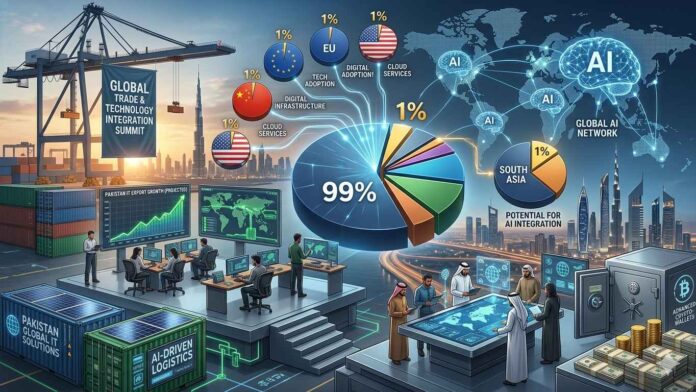
A recent industry report highlights a major gap between Pakistan’s growing IT capabilities and its participation in the global artificial intelligence ecosystem. The report estimates that Gulf countries alone spend more than $12 billion annually on AI consulting, deployment, implementation, and strategic advisory services. However, Pakistan currently captures less than 1 percent of this market, raising concerns about the country’s ability to compete in higher-value technology sectors.
Pakistan’s IT Export Growth Story
Pakistan’s technology industry has experienced remarkable expansion in recent years. Rising internet penetration, an increasing number of software companies, a thriving startup ecosystem, and a rapidly growing freelancer community have all contributed to stronger export performance.
The country has become a recognized destination for software outsourcing and IT-enabled services. Pakistani firms provide software development, mobile application creation, web development, cloud services, digital marketing solutions, and business process outsourcing to clients across multiple regions.
Technology exports have continued to grow despite economic challenges, demonstrating the resilience of the sector. Industry leaders often highlight the availability of skilled software engineers, competitive operating costs, and a large pool of young professionals as major advantages for Pakistan in the global technology market.
However, much of this success has been concentrated in traditional outsourcing services rather than high-value consulting segments. As a result, Pakistan remains heavily dependent on lower-margin technology work, limiting its ability to maximize export revenues.
The Rise of the Global AI Economy
Artificial intelligence has become one of the most transformative technologies of the modern era. Governments, corporations, financial institutions, healthcare providers, logistics companies, and manufacturers are investing billions of dollars in AI-powered solutions to improve efficiency, automate operations, and gain competitive advantages.
Organizations around the world are increasingly seeking expert guidance to develop AI strategies, integrate machine learning systems, deploy intelligent automation, and manage large-scale data transformation projects.
This growing demand has created a massive global market for AI consulting services. Unlike traditional software development projects, AI consulting engagements often involve strategic planning, enterprise transformation, data architecture design, governance frameworks, model development, and long-term implementation support.
These services typically command significantly higher fees than standard outsourcing contracts, making them highly attractive for technology firms seeking stronger profitability and export growth.
The Gulf region has emerged as one of the most active investors in artificial intelligence. Governments and private enterprises across the region are allocating substantial resources to AI adoption as part of broader economic diversification and digital transformation strategies.
As a result, demand for specialized AI expertise continues to rise, creating opportunities for consulting firms capable of delivering advanced solutions.
Why Pakistan Captures So Little of the Gulf AI Market
Despite having a large pool of technology professionals and software engineers, Pakistan has struggled to secure a meaningful share of the Gulf’s rapidly expanding AI consulting industry.
According to industry observers, the issue is not a shortage of technical talent. Pakistani professionals possess strong capabilities in software development, data science, machine learning, cloud computing, and related fields. Universities continue to produce graduates with relevant technical skills, while many professionals gain practical experience through freelance platforms and outsourcing projects.
The challenge lies elsewhere.
One of the primary barriers is the lack of internationally recognized certifications and standards that can help Pakistani firms establish credibility in global markets. Large organizations investing millions of dollars in AI transformation projects often prefer consulting partners that meet specific certification requirements and adhere to internationally accepted frameworks.
Without these credentials, even highly capable firms may struggle to compete against established international consulting companies.
Another challenge is institutional credibility. Many global clients evaluate not only technical expertise but also governance structures, quality assurance mechanisms, compliance standards, and risk management capabilities.
Organizations responsible for major AI deployments require assurance that consulting partners can deliver projects according to recognized international benchmarks. In the absence of formal accreditation systems, Pakistani firms often face difficulties securing high-value contracts.
Brand recognition also remains a significant obstacle. Global enterprises are generally more familiar with technology providers from countries that have established strong reputations in advanced consulting services. Pakistan’s technology industry is still largely associated with outsourcing and freelance work rather than enterprise-level AI transformation projects.
Dependence on Low and Mid-Value Technology Services
The report indicates that more than 70 percent of Pakistan’s technology export revenue originates from low and mid-value services. These include software development, coding projects, IT support, maintenance services, and freelance assignments.
While these activities generate valuable foreign exchange earnings, they typically offer lower profit margins compared to AI consulting and strategic advisory services.
In many cases, Pakistani firms perform implementation work while higher-value consulting and strategy components are handled by international companies. This means that a significant portion of project revenue remains outside Pakistan despite the involvement of local technical talent.
As global demand shifts toward artificial intelligence and advanced digital transformation, the gap between traditional outsourcing and high-value consulting could become even more pronounced.
Countries that successfully position themselves as providers of AI strategy, implementation, and advisory services stand to benefit from higher export earnings and stronger industry growth.
The Economic Potential of AI Consulting
Artificial intelligence consulting represents a major opportunity for Pakistan to diversify and upgrade its technology exports.
Unlike conventional outsourcing projects, AI consulting services often involve complex engagements that require strategic expertise, industry knowledge, and long-term client relationships. These projects generate higher revenues and create opportunities for specialized employment.
Expansion into AI consulting could help Pakistan increase export earnings without relying solely on higher transaction volumes. Instead of competing primarily on cost, firms could compete on expertise, innovation, and value creation.
This shift would improve profitability across the technology sector while strengthening the country’s position in the global digital economy.
Industry experts believe that even a modest increase in Pakistan’s share of the Gulf AI market could generate substantial economic benefits. Capturing a larger portion of regional demand would support foreign exchange inflows, encourage investment in advanced technologies, and create new opportunities for highly skilled professionals.
The Need for a National AI Certification Framework
To address existing challenges, the report recommends establishing a Pakistan AI Certification Standard designed to align with internationally recognized technology frameworks.
The proposed certification system would provide a structured mechanism for evaluating and validating the capabilities of technology firms operating in the AI sector.
Such a framework could help organizations demonstrate compliance with international standards while improving client confidence in Pakistani service providers.
By introducing recognized certification pathways, the country could strengthen its reputation as a trusted destination for advanced AI consulting and implementation services.
Industry stakeholders argue that certification standards would serve multiple purposes. They would improve quality assurance, enhance transparency, encourage best practices, and create a benchmark for evaluating service providers.
Most importantly, they could help Pakistani firms compete more effectively for high-value international contracts.
Building Global Trust and Recognition
Trust plays a crucial role in the AI consulting industry. Organizations investing in artificial intelligence solutions often handle sensitive data, critical business operations, and strategic transformation initiatives.
As a result, clients place significant emphasis on reliability, security, governance, and compliance.
Developing internationally aligned certification standards could help bridge the trust gap that currently limits Pakistan’s participation in high-value AI projects.
A strong certification ecosystem would signal that local firms adhere to recognized best practices and maintain professional standards comparable to international competitors.
Over time, this could improve brand recognition for Pakistan’s technology sector and create new opportunities in global markets.
Targeting an Additional $500 Million in Exports
The report suggests that a successful certification initiative could contribute significantly to export growth over the next several years.
By helping firms secure larger and more sophisticated AI consulting contracts, the proposed framework aims to generate an additional $500 million in AI-related exports by fiscal year 2028.
Achieving this target would represent a major step forward for Pakistan’s technology industry.
The additional revenue could strengthen foreign exchange reserves, support job creation, and encourage further investment in advanced digital capabilities.
More importantly, it would signal a transition from traditional outsourcing toward knowledge-intensive services that generate higher economic value.
The Role of Government and Industry Collaboration
Industry transformation cannot occur through private-sector efforts alone. Experts emphasize the importance of collaboration between government institutions, technology companies, educational organizations, and industry associations.
A coordinated approach is needed to develop certification standards, promote international partnerships, strengthen workforce development programs, and support innovation initiatives.
Educational institutions can contribute by expanding AI-focused curricula and encouraging practical research. Industry organizations can help define certification requirements and facilitate knowledge sharing. Government agencies can provide policy support, international engagement, and regulatory frameworks that encourage growth.
Together, these efforts can create an ecosystem capable of supporting a competitive AI consulting industry.
Preparing the Workforce for the AI Era
Pakistan possesses one of the region’s largest youth populations, creating a significant advantage in the digital economy. However, maintaining competitiveness will require continuous investment in skills development.
Artificial intelligence consulting demands expertise that extends beyond technical programming abilities. Professionals must understand business strategy, data governance, project management, industry regulations, and organizational transformation.
Training programs focused on these areas could help develop a workforce capable of delivering high-value consulting services rather than solely technical implementation work.
Investing in advanced AI education and professional development will be critical to achieving long-term export growth.
A Critical Moment for Pakistan’s Technology Industry
The global artificial intelligence market is expanding rapidly, creating unprecedented opportunities for countries capable of providing specialized expertise.
Pakistan has already demonstrated its ability to compete in software development and outsourcing services. The next challenge is moving up the value chain and establishing a presence in premium consulting segments.
The report’s findings serve as both a warning and an opportunity. While the country currently captures less than 1 percent of the Gulf AI consulting market, the potential for growth remains substantial.
Failure to expand into higher-value AI services could result in continued reliance on lower-margin outsourcing activities. Conversely, strategic investments in certification, credibility, workforce development, and international engagement could unlock significant export opportunities.
As artificial intelligence becomes a defining force in the global economy, Pakistan faces a pivotal decision. By embracing advanced consulting services and building the institutional frameworks needed to support them, the country can position itself as a more influential player in the international technology landscape and unlock a new era of export-driven growth.
Read More
SBP Launches Naya Pakistan Certificates in Saudi Riyal and UAE Dirham


