
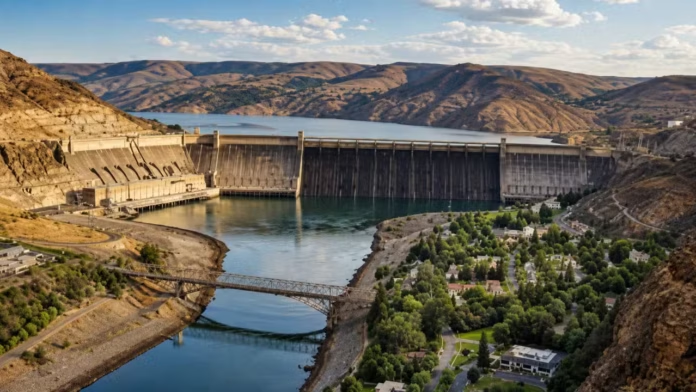

The long-delayed Gaj Dam project has once again come under scrutiny after the Federal Constitutional Court was informed that the contractor responsible for the project has received billions of rupees more than the original project cost, despite the dam still being far from completion.
During a recent hearing, the court was told that the contractor has already received approximately Rs. 62 billion, even though the project was originally approved at a cost of Rs. 26 billion. Despite receiving these additional funds, less than half of the work on the dam has reportedly been completed.
The case has raised serious concerns about project management, cost overruns, delays, and the use of public funds.
Court Reviews Delays in Gaj Dam Construction
A two-member bench of the Federal Constitutional Court, headed by Chief Justice Amin ud Din Khan, heard the case regarding the prolonged delay in the construction of Gaj Dam.
The court reviewed various aspects of the project, including its progress, funding issues, and the reasons behind the repeated delays.
After hearing preliminary arguments from both sides, the court adjourned the hearing until June 11 and directed Additional Attorney General Amir Rehman to present detailed arguments at the next hearing.
The judges are expected to examine whether the delays were caused by the contractor, government departments, funding shortages, or a combination of multiple factors.
What Is the Gaj Dam Project?
The Gaj Dam project is one of Pakistan’s important water infrastructure projects. It was designed to help improve water storage, irrigation facilities, and water supply in parts of Sindh.
Large dam projects play a critical role in Pakistan because they help store water for agriculture, reduce water shortages, and improve flood management.
The project was launched more than a decade ago with the expectation that it would contribute to regional development and support local farming communities.
However, progress on the project has remained slow, and the dam has become a symbol of the challenges facing large public-sector development projects in the country.
Original Cost Was Rs. 26 Billion
According to the lawyer representing WAPDA, the project was originally launched in 2011 with an estimated cost of Rs. 26 billion.
At the time, the budget was considered sufficient to complete the dam and related infrastructure.
However, over the years, costs continued to increase.
The court was informed that the contractor has now received an additional Rs. 36 billion over and above the original project estimate.
This means total payments linked to the project have reached around Rs. 62 billion.
The increase represents a cost escalation of approximately 138 percent compared to the original approved budget.
Such a large increase in project costs has become a major point of concern for the court and public authorities.
Less Than Half of the Project Completed
One of the most significant concerns raised during the hearing was the project’s slow progress.
According to WAPDA’s counsel, despite receiving billions of rupees in additional payments, the contractor has failed to complete even 50 percent of the work.
The lawyer argued that the pace of construction has remained unsatisfactory and that taxpayers have not received value for the money spent so far.
The court was informed that although substantial public funds have already been utilized, the dam remains unfinished many years after its launch.
This situation has led to questions regarding project planning, execution, monitoring, and accountability.
Previous Deadlines Were Missed
During the hearing, WAPDA’s legal team informed the court that the Sindh High Court had previously provided the contractor with a deadline to complete the project.
The contractor was expected to finish the remaining work within a specific timeline.
However, according to WAPDA, the deadline was not met.
The failure to complete the project within the court-approved timeframe further contributed to concerns regarding the management of the dam’s construction.
Repeated delays have not only increased costs but have also postponed the expected benefits that local communities were supposed to receive from the project.
Contractor Rejects Allegations
The contractor’s lawyer, Masood Khan, strongly disputed the allegations presented by WAPDA.
According to him, the picture being presented was incomplete and did not accurately reflect the challenges faced by the project.
He told the court that progress on the project had previously been acknowledged by the country’s highest court.
The lawyer argued that when the matter came before the Supreme Court in 2019, it had already been reported that approximately 50 percent of the work had been completed.
According to the contractor’s legal team, this fact was recognized by the Supreme Court in its judgment.
The contractor therefore rejected suggestions that little progress had been made despite receiving funding.
Funding Shortages Blamed for Delays
A major argument presented by the contractor’s lawyer was that insufficient funding from government authorities had slowed down construction work.
According to him, both the federal and provincial governments failed to provide funds on time.
The lack of regular financial support created difficulties for project implementation and prevented continuous construction activities.
The lawyer maintained that the contractor could not be held solely responsible for delays when the project itself suffered from funding shortages.
He argued that large infrastructure projects require uninterrupted financing, and without adequate funds, progress naturally slows down.
Work Reportedly Stopped Since 2024
The contractor’s counsel further informed the court that work on the Gaj Dam project has remained suspended since 2024.
According to him, the suspension occurred because required funds were not available.
As a result, construction activities came to a halt, causing further delays in project completion.
If this claim is correct, it means the project has effectively been stalled for an extended period, making it even more difficult to meet completion targets.
The court is expected to examine whether the suspension resulted from government funding failures, contractor issues, or a combination of both.
Questions Over Cost Escalation
One of the key issues before the court is the sharp increase in project costs.
Infrastructure projects often become more expensive over time due to inflation, rising material costs, exchange rate fluctuations, design changes, and delays.
However, when costs rise dramatically while progress remains limited, concerns naturally emerge regarding project oversight and financial management.
The court is expected to seek explanations regarding:
- Why project costs increased significantly.
- How additional funds were utilized.
- Whether payments were properly justified.
- Why project timelines were repeatedly missed.
- Who bears responsibility for delays.
Answers to these questions could help determine whether corrective action or accountability measures are needed.
Importance of Completing the Dam
The delay in completing Gaj Dam has implications beyond financial concerns.
Once completed, the project is expected to provide multiple benefits, including:
- Improved water storage capacity.
- Better irrigation facilities for farmers.
- Enhanced water availability in nearby regions.
- Flood control benefits.
- Support for agricultural productivity.
Many local communities have been waiting for these benefits for years.
The continued delay means that the expected economic and social advantages have also been postponed.
Court to Continue Hearing
After hearing arguments from both WAPDA and the contractor, the Federal Constitutional Court decided to adjourn the case until June 11.
The judges are expected to continue examining the facts, funding issues, construction progress, and legal responsibilities associated with the project.
Additional Attorney General Amir Rehman has been directed to assist the court and present arguments during the next hearing.
The upcoming proceedings may provide further clarity regarding the reasons behind the delays, the sharp increase in project costs, and the future of the Gaj Dam project.
As the case continues, public attention remains focused on whether one of Pakistan’s long-delayed infrastructure projects can finally move toward completion after years of delays, rising expenses, and ongoing legal disputes.