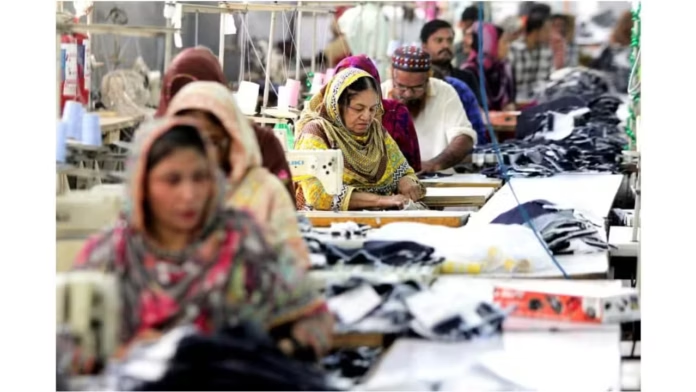

Pakistan’s textile industry has urged the government to introduce business-friendly measures in the upcoming Federal Budget 2026-27, warning that the country could miss a major opportunity to increase exports and attract international buyers if production costs remain high.
In a letter sent to Prime Minister Shehbaz Sharif, Fawad Anwar, Chairman of the Pakistan Textile Council (PTC), said global companies are increasingly looking for alternatives to their traditional suppliers. As international businesses diversify their supply chains, countries that can offer competitive prices, reliable production, and stable exports are likely to benefit.
According to the textile industry, Pakistan is well-positioned to take advantage of this opportunity. The country has a complete textile value chain, ranging from cotton production to finished garments, along with decades of experience in textile manufacturing and strong relationships with international brands and buyers.
However, the industry believes that several challenges are preventing Pakistan from fully benefiting from this global shift. High production costs, expensive energy, tax-related issues, and policy uncertainties continue to make Pakistani products less competitive compared to those from regional rivals.
Fawad Anwar noted that despite improving demand in international markets, Pakistan’s export performance has not improved as expected. During the first eleven months of fiscal year 2025-26, the country’s merchandise exports were approximately $1.66 billion lower than the same period of the previous year.
He said that many global buyers are actively searching for new sourcing destinations, and Pakistan is among the countries being considered. However, he warned that if production costs remain too high, international buyers may place their orders in competing countries instead.
According to the Pakistan Textile Council, economic stability alone is not enough to ensure long-term growth. While recent efforts to stabilize the economy have produced positive results, export growth remains essential for creating jobs, attracting investment, earning foreign exchange, and supporting overall economic development.
The council has called on the government to introduce several measures in the upcoming budget to support exporters and strengthen Pakistan’s competitiveness in global markets.
One of the key recommendations is the restoration of the Final Tax Regime (FTR), which exporters believe would simplify taxation and reduce compliance burdens. The industry also wants industrial electricity and gas tariffs to be reduced to levels comparable with those in competing countries.
Textile manufacturers argue that Pakistan currently has some of the highest industrial energy costs in the region. These higher costs increase production expenses and make it difficult for local exporters to compete with manufacturers in countries such as Bangladesh, Vietnam, and India.
The council has also urged the government to speed up the payment of pending tax refunds and withheld funds. According to industry representatives, large amounts of money remain stuck in delayed refunds, limiting cash flow and reducing the ability of businesses to invest in expansion, modernization, and job creation.
The textile and apparel sector remains Pakistan’s largest export industry and one of the country’s biggest sources of employment. Millions of Pakistanis depend directly or indirectly on the textile sector for their livelihoods, while textile exports contribute significantly to the country’s foreign exchange earnings.
The Pakistan Textile Council warned that if the government does not take timely action to improve competitiveness, other countries could secure new export orders that might otherwise come to Pakistan. This could result in lost business opportunities, slower industrial growth, and reduced export earnings.
Industry leaders believe that with the right policies, Pakistan can attract more international buyers, increase exports, create employment opportunities, and strengthen its position in the global textile market.
The council concluded by saying that it is ready to work closely with the government on reforms that can boost exports, support industrial growth, and contribute to long-term economic recovery. It stressed that the upcoming federal budget presents an important opportunity to help the textile sector become more competitive and capture a larger share of global trade.